EUR/USD faces selling pressure as Fed interest rate decision looms large
- EUR/USD drops to near 1.0400 as investors await the Fed’s policy outcome.
- The Fed is expected to keep interest rates steady with a slightly hawkish outlook.
- Trump’s tariffs plans and dovish ECB bets are expected to keep the Euro on the back foot.

EUR/USD slides to near 1.0400 in Wednesday’s North American session, with investors focusing on the Federal Reserve (Fed) monetary policy announcement at 19:00 GMT. The Fed is widely anticipated to keep interest rates steady in the range of 4.25%-4.50% as officials are worried that the disinflation trend toward the central bank’s target of 2% has stalled and the labor market has stabilized.
As markets have fully priced in that the Fed will keep rates unchanged, investors will pay close attention to Fed Chair Jerome Powell’s press conference after the policy decision. Investors would be keen to know for how long the Fed will keep interest rates at current levels, given the stubborn inflation outlook on the assumption that the imposition of hefty tariffs by United States (US) President Donald Trump will increase prices of goods and services.
Trump’s push for higher tariffs on its trading partners has escalated global growth concerns. President Trump has recommended tariffs on pharmaceuticals, steel and sophisticated chips to boost domestic production. Meanwhile, 25% tariffs on Canada and Mexico and 10% on China are very much on the cards, as White House Press Secretary Karoline Leavitt indicated on Tuesday. Leavitt said that 25% tariffs on Canada and Mexico from February 1 are “still on the books”. Leavitt added that the President is “very much still considering 10% tariffs on China” from Saturday.
Ahead of the Fed’s policy decision, the US Dollar (USD) trades subduedly, with the US Dollar Index (DXY) wobbling around 107.90. The US Dollar has performed strongly in the past few months on the assumption that Trump’s tariffs would accelerate price pressures and force the Fed to keep interest rates unchanged for longer.
Daily digest market movers: EUR/USD weakeans ahead of ECB policy meeting on Thursday
- Another reason behind the cautious performance of the EUR/USD pair is the European Central Bank’s (ECB) monetary policy meeting, scheduled for Thursday. Traders have fully priced in a 25 basis points (bps) interest rate cut, pushing the Deposit Rate lower to 2.75%. Market participants are also confident that the ECB will continue reducing its key borrowing rates in all meetings by the summer. Such a scenario would be unfavorable for the Euro’s (EUR) short and long-term outlook.
- ECB dovish bets have accelerated amid fears that Trump’s tariffs will weaken the already faltered Eurozone economy. Germany, the powerhouse of the shared bloc, is forecasted to contract this year, the Federal of German Industries (BDI) said on Tuesday. The agency expects that the German economy will shrink for the third year in a row as the government has been unable to address structural weakness in the national economy. "The situation is very serious: Growth in industry in particular has suffered a structural break," BDI President Peter Leibinger said.
- Investors will keenly focus on ECB President Christine Lagarde’s press conference on how the old continent will deal with Trump’s tariffs. Last week at the World Economic Forum (WEF) in Davos, Lagarde warned that Europe must “anticipate what will happen” and be “prepared in order to respond,” as Trump’s tariffs would be “selective” and “focused.”
- Analysts at ING said, “The tariff threat may be perceived more seriously given the Treasury’s active planning, and that materially shrinks the upside potential for the euro.” On Monday, US Treasury Secretary Scott Bessent proposed imposing a 2.5% tariff universally and also guided to raise them at a similar pace every month.
Euro PRICE Today
The table below shows the percentage change of Euro (EUR) against listed major currencies today. Euro was the strongest against the Australian Dollar.
| USD | EUR | GBP | JPY | CAD | AUD | NZD | CHF | |
|---|---|---|---|---|---|---|---|---|
| USD | 0.28% | 0.14% | -0.08% | 0.29% | 0.53% | 0.42% | 0.28% | |
| EUR | -0.28% | -0.14% | -0.36% | 0.00% | 0.24% | 0.16% | -0.01% | |
| GBP | -0.14% | 0.14% | -0.23% | 0.14% | 0.38% | 0.28% | 0.13% | |
| JPY | 0.08% | 0.36% | 0.23% | 0.37% | 0.61% | 0.49% | 0.36% | |
| CAD | -0.29% | -0.00% | -0.14% | -0.37% | 0.24% | 0.14% | -0.01% | |
| AUD | -0.53% | -0.24% | -0.38% | -0.61% | -0.24% | -0.10% | -0.25% | |
| NZD | -0.42% | -0.16% | -0.28% | -0.49% | -0.14% | 0.10% | -0.15% | |
| CHF | -0.28% | 0.00% | -0.13% | -0.36% | 0.00% | 0.25% | 0.15% |
The heat map shows percentage changes of major currencies against each other. The base currency is picked from the left column, while the quote currency is picked from the top row. For example, if you pick the Euro from the left column and move along the horizontal line to the US Dollar, the percentage change displayed in the box will represent EUR (base)/USD (quote).
Technical Analysis: EUR/USD retreats from 50-day EMA
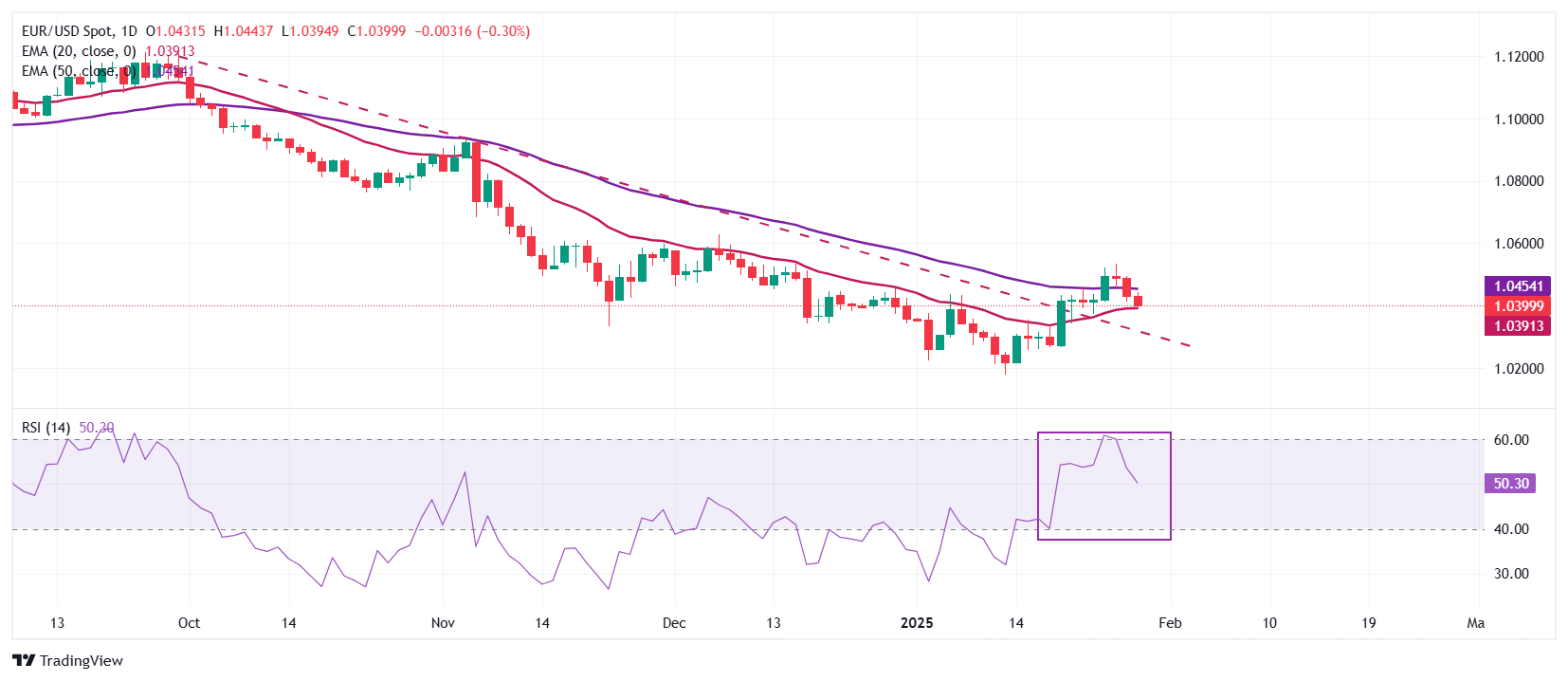
EUR/USD falls to near the 20-day Exponential Moving Average (EMA), which trades around 1.0395, on Wednesday in a corrective move from Monday's high of 1.0530. The major currency pair weakens after failing to sustain above the 50-day EMA, which trades around 1.0450.
The 14-day Relative Strength Index (RSI) failed to climb above the 60.00 hurdle after recovering from below the 40.00 level, suggesting that the trend would be sideways.
Looking down, the downward-sloping trendline from the September 30, 2024, high of 1.1209 will act as major support for the pair near the round level of 1.0300, followed by the January 20 low of 1.0266. Conversely, the December 6 high of 1.0630 will be the key barrier for the Euro bulls.
Author

Sagar Dua
FXStreet
Sagar Dua is associated with the financial markets from his college days. Along with pursuing post-graduation in Commerce in 2014, he started his markets training with chart analysis.

















