EUR/USD slumps below 1.0900 as US Dollar recovers on soft jobless claims
- EUR/USD falls sharply as the US Dollar recovers after lower US Initial Jobless Claims.
- Investors see the Fed cutting interest rates aggressively this year.
- The ECB is expected to reduce its key borrowing rates two times more by the year-end.

EUR/USD slumps below 1.0900 in Thursday’s American session. The major currency pair weakens as the US Dollar (USD) recovers strongly on soft United States (US) Initial Jobless Claims data for the week ending August 2. Individuals claiming jobless benefits for the first time came in lower at 233K than estimates of 240K, and the prior release of 249K. The US Dollar Index (DXY), which tracks the Greenback’s value against six major currencies, bounces back to near 103.40.
While the near-term outlook of the shared currency pair remains uncertain as investors are confident that the Federal Reserve (Fed) will choose an aggressive monetary policy stance to tame upside risks to potential United States (US) economic slowdown.
According to the CME FedWatch tool, 30-day Federal Funds futures pricing data shows that traders see 50 basis points (bps) cut in interest rates in September as imminent. The data also suggests that the Fed will reduce its key borrowing rates by more than 100 bps this year. Meanwhile, market participants have also anticipated that the Fed could announce emergency rate cuts as the US economy is exposed to a recession.
On the contrary, Economists at Goldman Sachs wrote in a note, “So while market stress is noticeably higher than a week ago, our Financial Stress Index (FSI) suggests that there have been no serious market disruptions to date that would force policymakers to intervene."
Market speculation that the Fed would deliver hefty rate cuts was bolstered by upside risks to job growth and a sharp contraction in the manufacturing sector. For more cues on the current labor market status, investors will focus on the
Daily digest market movers: EUR/USD drops as ECB Rehn sees more rate cuts
- EUR/USD slides below 1.0900 amid US Dollar's strong recovery. Meanwhile, the Euro is under pressure as the market mood remains risk-averse on fears of a global economic slowdown due to the maintenance of a restrictive interest rate stance for a longer period. The majority of global nations have pivoted to policy normalization, but the broader demand will not revive sooner.
- On the domestic front, the Euro will be influenced by market sentiment and speculation for European Central Bank (ECB) and US Federal Reserve (Fed) rate cuts this year amid an absence of top-tier economic data in the Eurozone.
- Meanwhile, investors expect that the ECB will cut its key borrowing rates two times more this year. The ECB kicked off its policy-easing cycle in June as policymakers were confident that price pressures would return to the desired rate of 2% in 2025. However, officials prefer to avoid committing to a specific rate-cut path and left interest rates unchanged in the July meeting, keeping a cautious approach to rate cuts.
- Regarding interest rate guidance, Finnish ECB policymaker Olli Rehn said in a speech on Wednesday, "Inflation continues to slow down, but the path to the two percent target remains bumpy this year." Rehn added, “The rate cuts would help the eurozone economy recover, in particular the "fragile" industrial growth and subdued investments,” Reuters reported.
Euro Price Today:
Euro PRICE Today
The table below shows the percentage change of Euro (EUR) against listed major currencies today. Euro was the strongest against the US Dollar.
| EUR | USD | GBP | JPY | CAD | AUD | NZD | CHF | |
|---|---|---|---|---|---|---|---|---|
| EUR | 0.04% | 0.04% | -0.40% | -0.06% | -0.50% | 0.03% | -0.43% | |
| USD | -0.04% | -0.01% | -0.42% | -0.08% | -0.53% | -0.01% | -0.49% | |
| GBP | -0.04% | 0.00% | -0.44% | -0.10% | -0.54% | -0.03% | -0.50% | |
| JPY | 0.40% | 0.42% | 0.44% | 0.35% | -0.09% | 0.38% | -0.07% | |
| CAD | 0.06% | 0.08% | 0.10% | -0.35% | -0.44% | 0.08% | -0.40% | |
| AUD | 0.50% | 0.53% | 0.54% | 0.09% | 0.44% | 0.52% | 0.03% | |
| NZD | -0.03% | 0.01% | 0.03% | -0.38% | -0.08% | -0.52% | -0.48% | |
| CHF | 0.43% | 0.49% | 0.50% | 0.07% | 0.40% | -0.03% | 0.48% |
The heat map shows percentage changes of major currencies against each other. The base currency is picked from the left column, while the quote currency is picked from the top row. For example, if you pick the Euro from the left column and move along the horizontal line to the US Dollar, the percentage change displayed in the box will represent EUR (base)/USD (quote).
Technical Forecast: EUR/USD dips below 1.0900
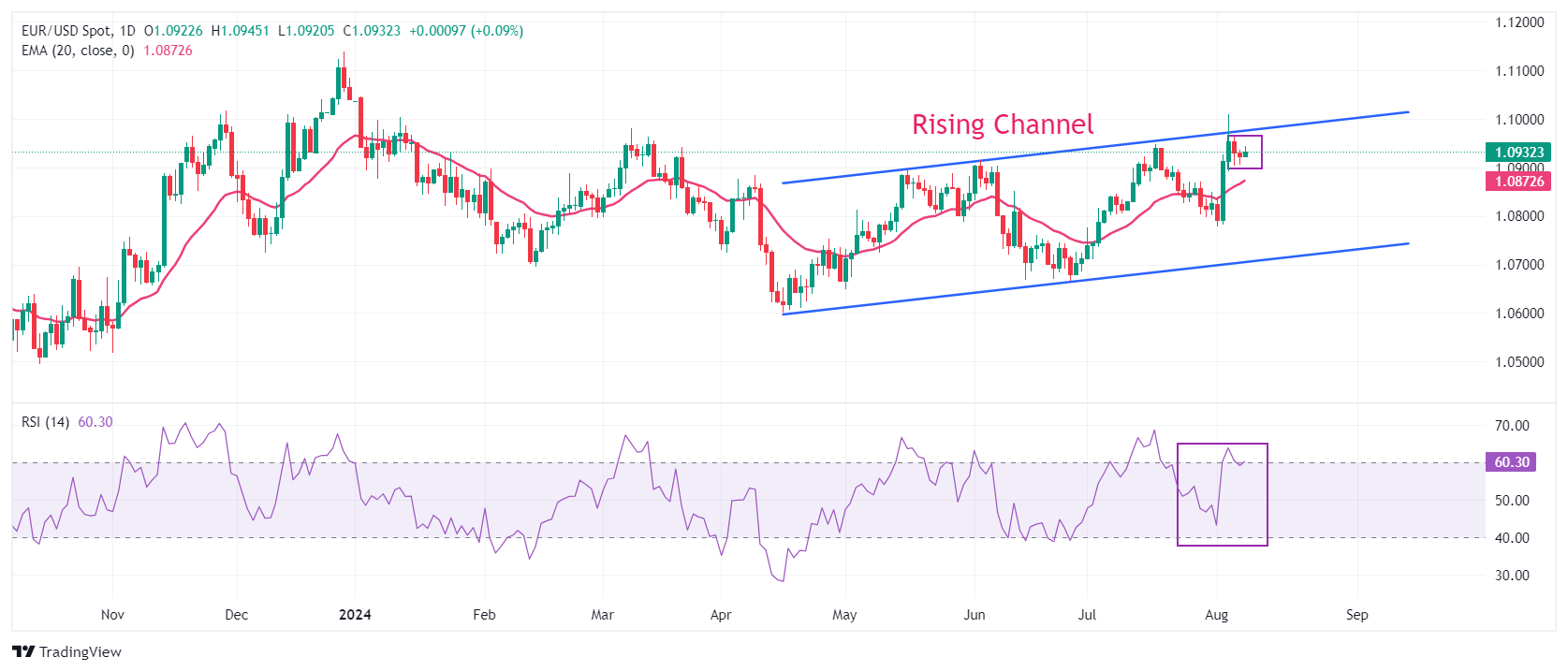
EUR/USD hovers near the upper boundary of a Channel formation on a daily timeframe. A breakout of the aforementioned chart pattern results in wider ticks on the upside and heavy volume. The 20-day Exponential Moving Average (EMA), near 1.0800, acted as major support for the Euro bulls.
The 14-day Relative Strength Index (RSI) indicator climbs above 60.00. If the RSI sustains above that level, bullish momentum will be triggered.
More upside would appear if the major currency pair breaks above Monday’s high of 1.1009. This would drive EUR/USD towards the August 10, 2023, high at 1.1065, followed by the round-level resistance at 1.1100.
In an alternate scenario, a downside move below the August 1 low at 1.0777 would drag the pair toward the February low near 1.0700. A breakdown below the latter would expose the asset to the June 14 low at 1.0667.
Author

Sagar Dua
FXStreet
Sagar Dua is associated with the financial markets from his college days. Along with pursuing post-graduation in Commerce in 2014, he started his markets training with chart analysis.