EUR/USD gains ground in big day for Fed speakers
- EUR/USD moves higher after correcting to near 1.1120 as the US Dollar struggles to extend recovery.
- Fed Chairman Jerome Powell didn't talk about monetary policy in his remarks at the US Treasury Market Conference.
- The ECB could deliver a second consecutive interest rate cut in October.

EUR/USD edges higher in Thursday’s North American session after correcting to near 1.1120 on Wednesday. The major currency pair rebounds even as US macroeconomic data came in higher than expected and amid a big day for Federal Reserve speakers.
On Wednesday, the shared currency pair faced selling pressure after testing territory above the round-level resistance of 1.1200 as the US Dollar (USD) bounced back. The US Dollar Index (DXY), which tracks the Greenback’s value against six major currencies, hovers near Wednesday’s high around 101.00.
Federal Reserve Chairman Jerome Powell delivered pre-recorded remarks at the US Treasury Market Conference, but these failed to move markets because he didn't talk about monetary policy. Seven other Fed have taken or will take the stage during the US session: Boston Fed Bank President Susan Collins, Fed Governor Adriana Kugler, Fed Governor Michelle Bowman, New York Fed Bank President John Williams, Fed Vice Chair for Supervision Michael Barr, Fed Governor Lisa Cook, and Minneapolis Fed Bank President Neel Kashkari.
Some of these policymakers didn't provide remarks worth mentioning, but others did. Federal Reserve Governor Michelle Bowman, who dissented from the Fed's decision to lower benchmark interest rates by 50 basis points, said that she prefers "a more measured re-calibration of policy" and that she continues to see "greater risks" to price stability.
FXStreet’s FedTracker, which gauges the tone of Fed officials’ speeches on a dovish-to-hawkish scale from 0 to 10 using a custom AI model, rated Bowman’s words as neutral with a score of 4.0.
Currently, markets expect that the Fed will reduce interest rates further by 75 basis points (bps) collectively in the remaining two meetings, according to the CME FedWatch tool. The tool also shows that the probability of the Fed announcing a second straight interest rate cut by 50 basis points (bps) in November has increased to 61% from 39% a week ago.
The latest comments from Fed policymakers have indicated that they were concerned over deteriorating labor market conditions. Out of 12 members-led Federal Open Market Committee (FOMC), only Fed Governor Michelle Bowman supported beginning the rate-cut cycle gradually by a 25 bps rate cut in September.
To get cues about the current inflation status, investors will focus on the United States (US) core Personal Consumption Expenditures Price Index (PCE) data for August, which will be published on Friday. The underlying inflation data is estimated to have grown at a faster pace of 2.7% against the July print of 2.6%.
On the economic front, Initial Jobless Claims for the week ending September 20 have come in lower at 218K than estimates of 225K and the prior release of 222K. The Durable Goods Orders remained flat in August, while economists expected them to have contracted by 2.6%.
Daily digest market movers: EUR/USD strengthens despite uncertainty over Euro's outlook
- EUR/USD rebounds to near 1.1150 as investors underpin the Euro (EUR) against the US Dollar (USD). The performance of the Euro against other major currencies is weak due to growing speculation that the European Central Bank (ECB) could cut the Rate on Deposit Facility for the second time in a row next month. This would be the third dovish decision by the ECB this year.
- US Durable Goods Orders were unchanged in August after increasing by a sharp 9.9% a month earlier. Still, this was better than economists' expectations of a 2.6% decline.
- On Tuesday, the comments from Dutch ECB governing council member Klaas Knot in an interview with the Dutch TV program Nieuwsuur indicated that the central bank will continue the policy-easing cycle to at least the first half of 2025 to a level between 2% and 3% saying, "I would expect us to continue to gradually reduce interest rates in the coming time, also in the first half of 2025."
- Market expectations for the ECB to reduce interest rates in October have been prompted by deepening concerns over the Eurozone’s activity growth. The Eurozone Composite PMI unexpectedly sank into contraction in September, as shown by the flash HCOB PMI report compiled with S&P Global.
- For fresh inflation status, investors will focus on the ECB President Christine Lagarde's speech, which is scheduled at 13:30 GMT.
- Meanwhile, a survey from Growth From Knowledge (GFK) showed on Thursday that German Consumer Confidence improved to -21.2 in October against estimates of -21.5 and the former release of -21.9.
Technical Analysis: EUR/USD bounces back from 1.1150
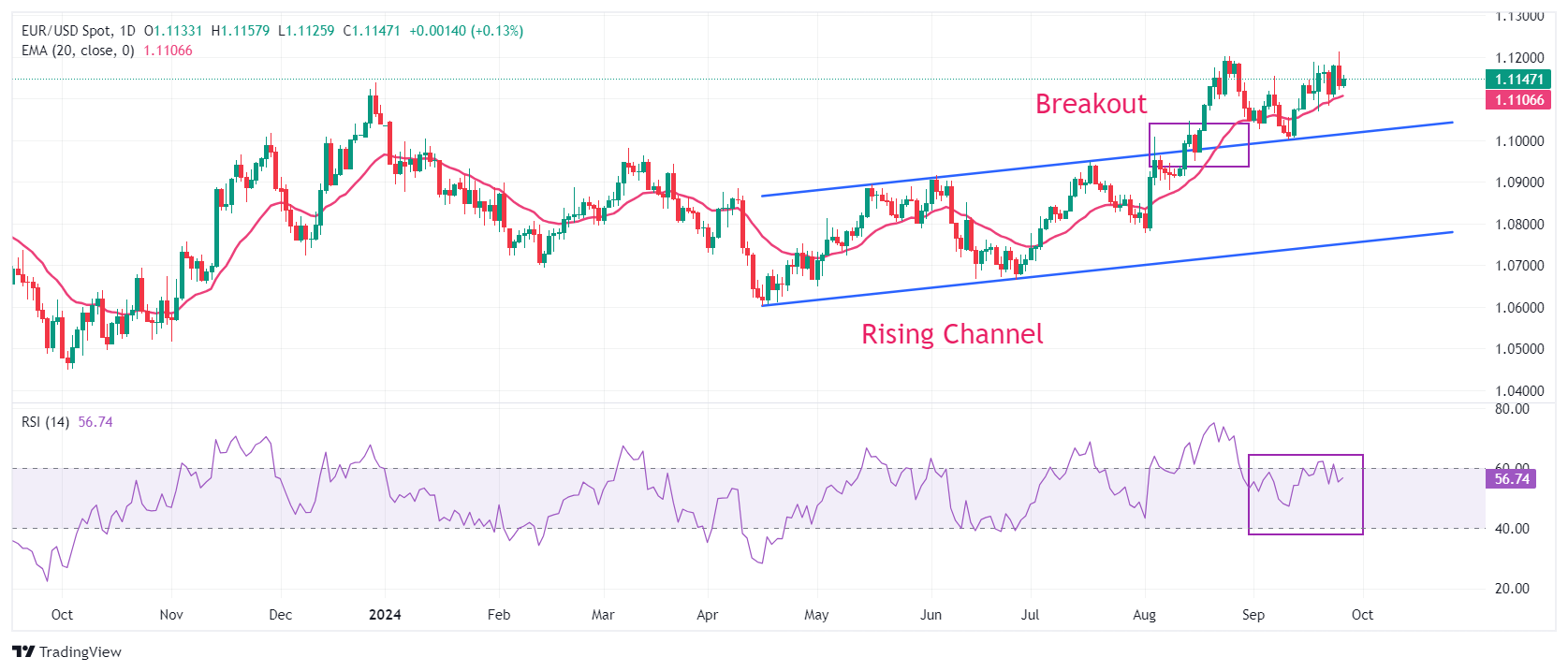
EUR/USD rebounds slightly from 1.1120 in the European trading session on Thursday. The major currency pair corrected on Wednesday from the key resistance of 1.1200. The near-term outlook of the shared currency pair remains firm as it holds the breakout of the Rising Channel chart pattern formed on a daily time frame near the psychological support of 1.1000.
The upward-sloping 20-day Exponential Moving Average (EMA) near 1.1100 suggests that the near-term trend is bullish.
The 14-day Relative Strength Index (RSI) consolidates below 60.00, suggesting momentum is weakening.
Looking up, a decisive break above the round-level resistance of 1.1200 will result in further appreciation toward the July 2023 high of 1.1276. On the downside, the psychological level of 1.1000 and the July 17 high near 1.0950 will be major support zones.
Author

Sagar Dua
FXStreet
Sagar Dua is associated with the financial markets from his college days. Along with pursuing post-graduation in Commerce in 2014, he started his markets training with chart analysis.