EUR/USD declines as Trump 2.0 stokes US Dollar's recovery
- EUR/USD corrects lower after revisiting a two-week high of 1.0430 as the US Dollar pares some of Monday’s losses.
- The US Dollar rebounds as Donald Trump confirms that the tariff hike plan remains afloat.
- Trump aims to fix the trade imbalance with Europe, which would keep the Euro on the backfoot.

EUR/USD corrects lower to near 1.0350 in Tuesday’s North American session after surging to 1.0430 on Monday. The major currency pair faces pressure on Tuesday as the US Dollar (USD) pares some of Monday’s losses. The US Dollar Index (DXY), which tracks the Greenback’s value against six major currencies, bounces back around 108.50 from its almost two-week low slightly below 108.00.
The Greenback dived vertically on Monday as Donald Trump’s presidential memo lacked immediate tariff imposition on foreign countries. The memo was directing federal agencies to study trade policies and evaluate US trade relationships with China and America’s continental neighbors, the Wall Street Journal (WSJ) reported.
Donald Trump clarified that the proposal of universal tariff hikes is on the table but “we are not ready for that yet”. However, he highlighted the sizeable trade deficit issue with the Eurozone. Trump said that he would remedy the trade imbalance either by “raising tariffs or Europe buying more US oil and gas”, Reuters reported.
The absence of tariff hikes by in Trump's comments on his first day at the White House led to a strong buying in risk-sensitive currencies. The Euro (EUR) rallied almost 1.3% against the US Dollar despite fears of higher tariffs remaining intact.
US Dollar PRICE Today
The table below shows the percentage change of US Dollar (USD) against listed major currencies today. US Dollar was the strongest against the Canadian Dollar.
| USD | EUR | GBP | JPY | CAD | AUD | NZD | CHF | |
|---|---|---|---|---|---|---|---|---|
| USD | 0.32% | 0.36% | -0.12% | 0.89% | 0.50% | 0.59% | 0.29% | |
| EUR | -0.32% | 0.04% | -0.40% | 0.57% | 0.19% | 0.27% | -0.03% | |
| GBP | -0.36% | -0.04% | -0.48% | 0.52% | 0.14% | 0.23% | -0.07% | |
| JPY | 0.12% | 0.40% | 0.48% | 1.00% | 0.62% | 0.69% | 0.41% | |
| CAD | -0.89% | -0.57% | -0.52% | -1.00% | -0.38% | -0.30% | -0.59% | |
| AUD | -0.50% | -0.19% | -0.14% | -0.62% | 0.38% | 0.08% | -0.21% | |
| NZD | -0.59% | -0.27% | -0.23% | -0.69% | 0.30% | -0.08% | -0.30% | |
| CHF | -0.29% | 0.03% | 0.07% | -0.41% | 0.59% | 0.21% | 0.30% |
The heat map shows percentage changes of major currencies against each other. The base currency is picked from the left column, while the quote currency is picked from the top row. For example, if you pick the US Dollar from the left column and move along the horizontal line to the Japanese Yen, the percentage change displayed in the box will represent USD (base)/JPY (quote).
Daily digest market movers: EUR/USD declines as Fed seems to keep interest rates steady for longer
- EUR/USD fails to sustain above the key level of 1.0400 due to a slight recovery in the US Dollar. Market participants are divided over US Dollar’s outlook as Trump has delayed tariff orders. The Greenback had a strong run-up in the last three months as investors feared that Trump would probably slap hefty tariffs soon after returning to the White House.
- Firm expectations that the Federal Reserve (Fed) will follow a more gradual policy-easing approach this year are expected to limit the downside in the US Dollar. According to the CME FedWatch tool, traders are confident that the Fed will not cut interest rates in the coming policy meetings later this month and in March.
- On the contrary, solid European Central Bank (ECB) dovish bets would continue weighing on the Euro. Market participants expect the ECB to keep easing its Deposit Facility rate at a gradual pace of 25 basis points (bps) for the next four policy meetings. Also, a string of ECB officials are comfortable with dovish bets.
- On Monday, ECB policymaker and Croatian central bank chief Boris Vujčić said, "I don't feel uncomfortable with the current market pricing.". Vujčić added that risks to the inflation outlook are broadly balanced.
- On the economic front, German ZEW Economic Sentiment Index declined at a faster pace to 10.3 in January from 15.7 in December. Economists expected the sentiment data to have eased to 15.3. However, the Eurozone ZEW Economic Sentiment Index came in surprisingly higher at 18 from 17 in December, while it was expected to come in slightly lower at 16.9.
Technical Analysis: EUR/USD aims to hold 20-day EMA
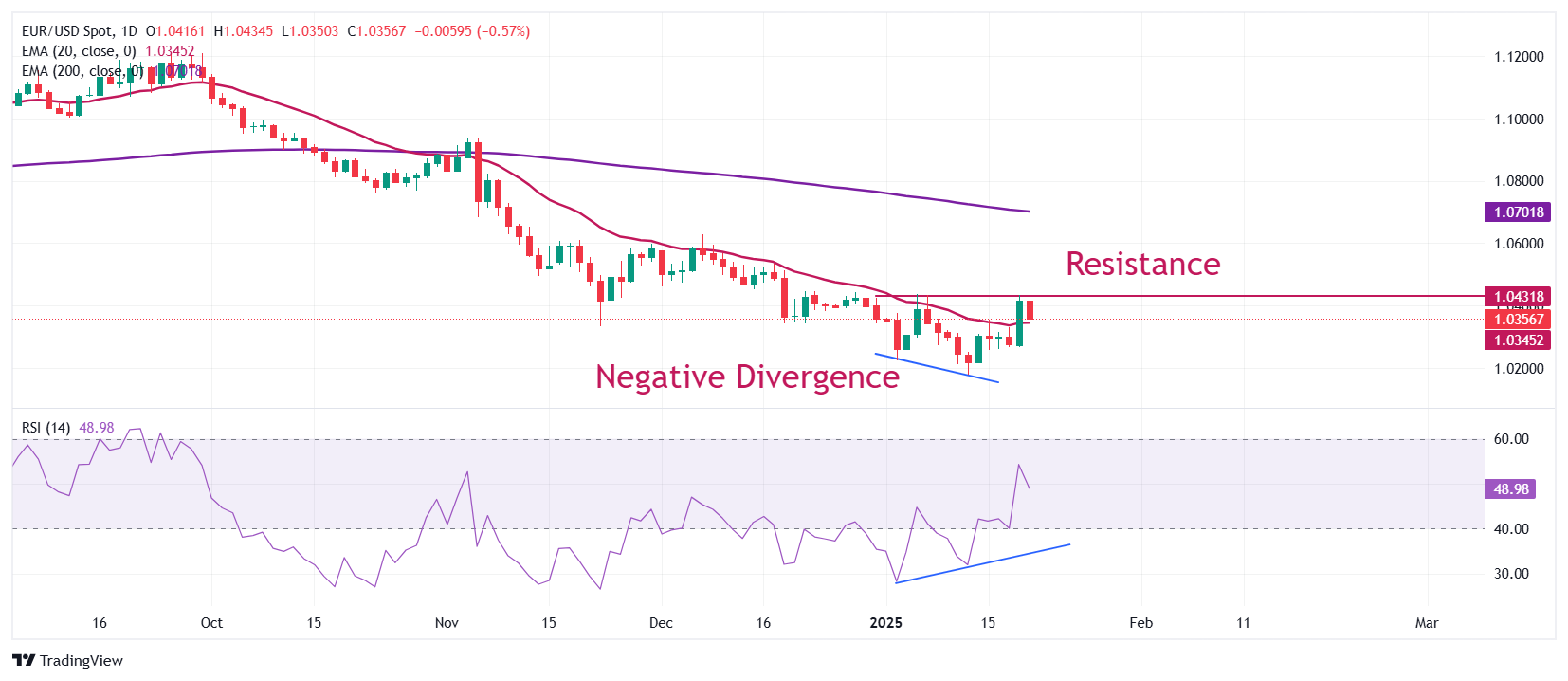
EUR/USD drops after revisiting a two-week high of 1.0430 in Tuesday’s European session. The major currency pair rebounds after a divergence in momentum and price action. The 14-day Relative Strength Index (RSI) formed a higher low, while the pair made lower lows.
The near-term outlook has improved as EUR/USD climbs above the 20-day Exponential Moving Average (EMA), which trades around 1.0346. However, the longer-term outlook remains bearish as the 200-day EMA at 1.0702 points downwards.
Looking down, the January 13 low of 1.0177 will be the key support zone for the pair. Conversely, the psychological resistance of 1.0500 will be the key barrier for the Euro bulls.
Author

Sagar Dua
FXStreet
Sagar Dua is associated with the financial markets from his college days. Along with pursuing post-graduation in Commerce in 2014, he started his markets training with chart analysis.