|

EUR/USD outlook: Limited recovery suggests that larger bears hold grip

EUR/USD

EURUSD fell on Tuesday morning, erasing about a half of Monday’s 1.3% rally, sparked by decision of President Trump to keep tariffs on hold, against initial plan to impose them from the day one.

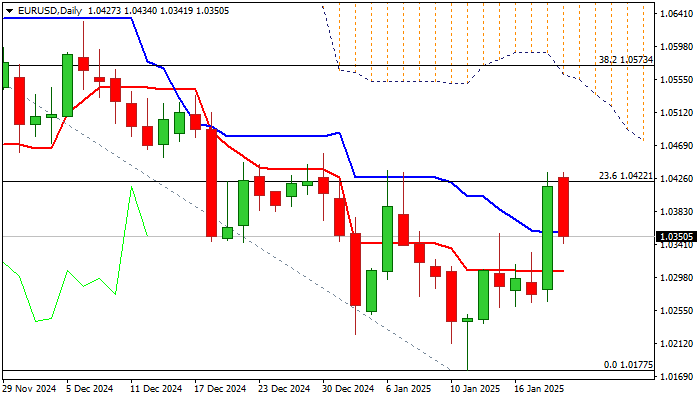
A breather in the larger downtrend seems to be short lived so far, as correction was minor and capped by solid barrier provided by Fibo 23.6% of 1.1214/1.0177 (1.0422) where recent recovery attempts were repeatedly capped.

Overall technical picture is predominantly bearish and signal that larger bears are likely to regain full control after current consolidation phase, as falling daily cloud (spanned between 1.0555 and 1.0690) continues to weigh on price action

Formation of 100/200DMA death cross adds to negative signals, along with south-heading RSI, which slid under neutrality territory.

Near term bias is expected to remain with bears while the action stays capped under Fibo barrier (1.0422).

Fundamental situation is not bright for Euro as bloc’s economy is struggling to get into recovery track, persisting political tremors continue to undermine and arrival of Donald Trump posses the biggest challenge for the Eurozone.

Threat of tariffs on all EU exports to the US, due to US trade deficit with EU, which Trump wants to erase, is serious problem for EU which tries to find the way strengthen ties with US and avoid the worst scenario, while fighting with high energy prices and contributions to the war in Ukraine.

Extended consolidation should be likely near-term scenario, with price action to remain within current range (stronger upticks to stall under the base of falling daily cloud), before larger downtrend off 2024 peak (1.1214) resumes.

Res: 1.0422; 1.0478; 1.0534; 1.0555.
Sup: 1.0305; 1.0260; 1.0224; 1.0200.
Chart

Interested in EUR/USD technicals? Check out the key levels

    1. R3 1.0646
    2. R2 1.054
    3. R1 1.0478
  1. PP 1.0372
    1. S1 1.031
    2. S2 1.0204
    3. S3 1.0142

Author

Slobodan Drvenica

Slobodan Drvenica

Windsor Brokers

Industry veteran with over 22 years’ experience, Slobodan Drvenica joined Windsor Brokers in 1995 when he was an active trader for more than 10 years, managing the trading desk and own account departments.


More from Slobodan Drvenica
Share:

Editor's Picks

GBP/USD clings to gains near 1.3400

GBP/USD retreats after reaching a three-week high above 1.3430, challenging the 1.3400 yardstick on Thursday. Although easing political uncertainty in the UK helps the quid limit its downside, escalating tensions in the Middle East support the Greenback, keeping Cable under scrutiny.

EUR/USD faces resistance around 1.1450

EUR/USD keeps the bid bias although it seems to have met a tough hurdle around 1.1450 on Thursday. The pair’s advance follows the bearish tone in the US Dollar despite escalating tensions in the Middle East and a broad-based cautious stance from market participants.

Gold flirts with two-day highs, approaches $4,130

Gold stages a modest rebound on Thursday, setting aside a three-day losing streak and managing to surpass the $4,100 mark per troy ounce. However, steady geopolitical tensions have revived concerns over persistently high global inflation, reinforcing expectations of higher rates across the board and somewhat curtailing the yellow metal’s upside potential.

Bitcoin stalls as mixed ETF flows, renewed US-Iran tensions cap upside

Bitcoin trades at $63,000 on Thursday, recovering slightly after facing rejection near $64,000. Renewed geopolitical uncertainty has dampened risk appetite, limiting BTC upside potential.

Japan may be changing its Yen strategy, but markets don’t look scared
Japan may be changing its intervention playbook, but that might not be enough to rescue the battered Yen. With USD/JPY hovering at four-decade highs, the currency’s weakness is being driven less by speculative pressure and more by a powerful structural force: the wide US-Japan rate gap.
Bye, forward guidance: How to trade when central banks choose silence

Central banks have spent years telling markets what might come next. Now, traders face the possibility that they say a lot less. From the Federal Reserve to the European Central Bank and the Bank of England, policymakers are pushing back against forward guidance.