EUR/USD surges as Trump's presidential memo lacks immediate tariff imposition
- EUR/USD soars to near 1.0400 after WSJ shows that Trump's presidential memo lacks immediate execution of tariffs.
- The Fed is expected to keep interest rates at their current levels by the May policy meeting.
- ECB’s Stournaras warns that higher tariffs by the US could drag Eurozone inflation below the central bank’s target.

EUR/USD rallies to near 1.0400. in Monday’s North American session. The major currency pair soars as the safe-haven appeal of the US Dollar (USD) diminishes significantly after a report from the Wall Street Journal (WSJ) indicated that the presidential memo by United States (US) President-elect Donald Trump lacks imposition of tariffs immediately. The US Dollar Index (DXY), which tracks the Greenback’s value against six major currencies, plunges to near 108.25.
The WSJ reported that Trump's presidential memo directs agencies to scrutinize the US's relationship with China and its neighboring nations and lacks tariffs' imposition right from the first day of office, which market participants feared earlier.
The Greenback was already under pressure after investors digested reports from Bloomberg that Trump would declare a national emergency soon after taking office. Market participants expected that this move would allow him to boost domestic energy production and reverse some climate change policies executed under Joe Biden’s administration.
Also, a report from Fox News Digital shows that Trump would sign over 200 orders on his first day of office, which might include policies such as immigration controls, tax cuts, and higher import tariffs. The impact of these policies will be favorable for the US Dollar as investors expect them to boost growth and inflationary pressures in the United States (US). The scenario will allow the Federal Reserve (Fed) to keep interest rates at their current levels for longer.
According to the CME FedWatch tool, traders expect the Fed to keep borrowing rates in the current range of 4.25%-4.50% in the next three policy meetings. On the contrary, analysts at Morgan Stanley expect that the Fed can cut interest rates in March as the underlying inflation decelerated in December. Last week, the Consumer Price Index (CPI) report for December showed that core inflation – which excludes volatile food and energy prices – rose at a slower pace of 3.2% year-over-year.
US Dollar PRICE Today
The table below shows the percentage change of US Dollar (USD) against listed major currencies today. US Dollar was the strongest against the Swiss Franc.
| USD | EUR | GBP | JPY | CAD | AUD | NZD | CHF | |
|---|---|---|---|---|---|---|---|---|
| USD | -1.19% | -0.99% | -0.40% | -1.02% | -1.22% | -1.25% | -0.39% | |
| EUR | 1.19% | 0.14% | 0.70% | 0.06% | 0.02% | -0.17% | 0.67% | |
| GBP | 0.99% | -0.14% | 0.52% | -0.09% | -0.11% | -0.32% | 0.53% | |
| JPY | 0.40% | -0.70% | -0.52% | -0.62% | -0.78% | -0.95% | -0.18% | |
| CAD | 1.02% | -0.06% | 0.09% | 0.62% | -0.14% | -0.23% | 0.61% | |
| AUD | 1.22% | -0.02% | 0.11% | 0.78% | 0.14% | -0.29% | 0.57% | |
| NZD | 1.25% | 0.17% | 0.32% | 0.95% | 0.23% | 0.29% | 0.66% | |
| CHF | 0.39% | -0.67% | -0.53% | 0.18% | -0.61% | -0.57% | -0.66% |
The heat map shows percentage changes of major currencies against each other. The base currency is picked from the left column, while the quote currency is picked from the top row. For example, if you pick the US Dollar from the left column and move along the horizontal line to the Japanese Yen, the percentage change displayed in the box will represent USD (base)/JPY (quote).
Daily digest market movers: EUR/USD rallies as Trump returns to White House
- EUR/USD gains at the US Dollar's expense. However, the Euro (EUR) outlook remains uncertain as investors expect the European Central Bank (ECB) to deliver a series of interest rate cuts in coming policy meetings.
- Traders are fully pricing in an ECB’s 100 basis points (bps) interest rate reduction by mid-summer, which will come in the form of a 25 bps cut in each of the following four meetings. Dovish ECB bets have accelerated partly because of growing expectations that the Eurozone inflation will sustainably return to the central bank’s target of 2% and high uncertainty over incoming tariff policies from the US.
- Market experts are confident about further slower Eurozone inflation as they expect service inflation to slow down this year. Analysts at Capital Economics said in a report that the marginal increase in inflation in the services sector in December, to 4% from 3.9%, was driven by the transport and package holiday categories, which have a dependence on oil prices, while other sectors collectively contributed less to the overall inflation figure. The agency expects that oil prices are projected to drop based on historical patterns, which would soften the Eurozone inflation.
- Meanwhile, ECB officials are also comfortable with dovish bets. On Friday, ECB policymaker and the Governor of the Bank of Greece Yannis Stournaras said that policy should continue with a "series of rate cuts" at the next meetings. His dovish stance was based on the assumption that fresh protectionist measures imposed by the US could lead to "below-target Eurozone inflation."
Technical Analysis: EUR/USD jumps to near 1.0400
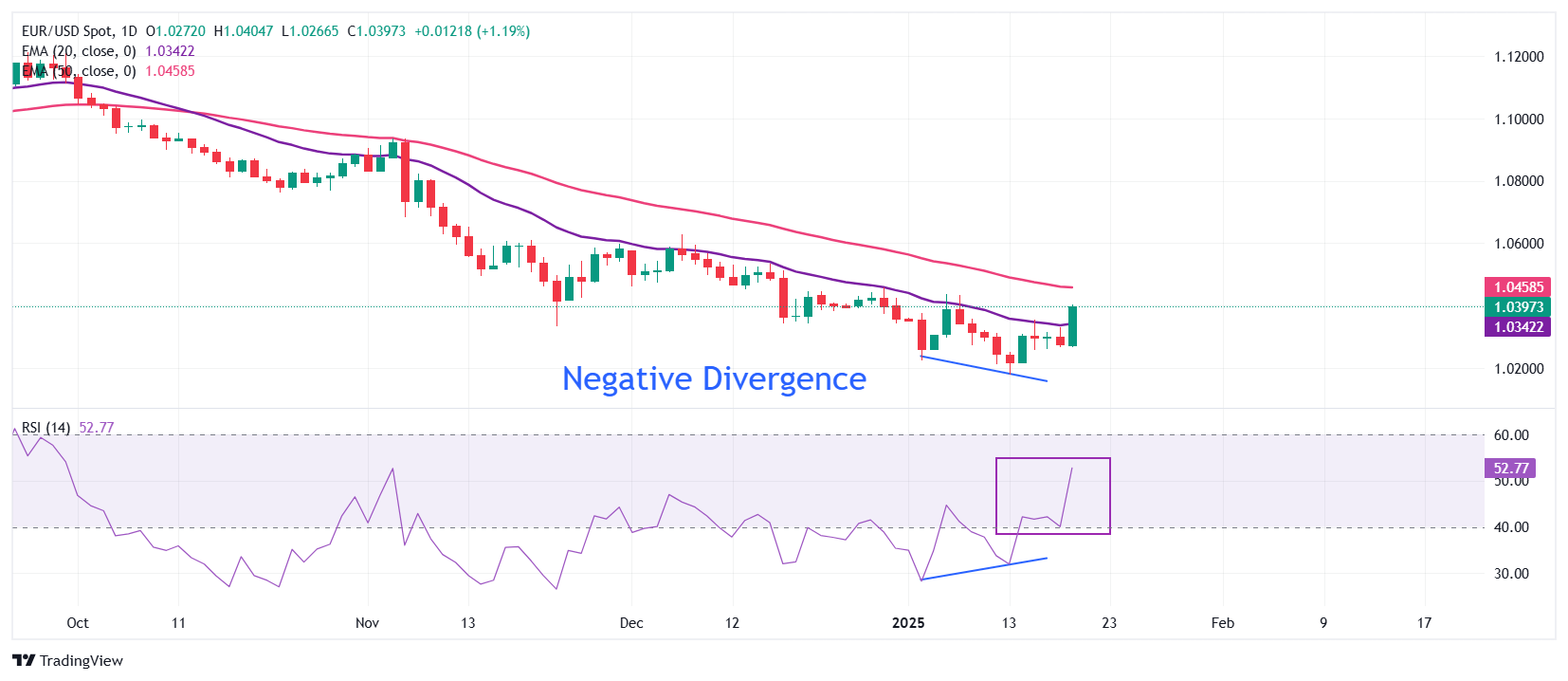
EUR/USD bounces back to near 1.0400 at the start of the week. The shared currency pair gains sharply after a divergence in momentum and price action. The 14-day Relative Strength Index (RSI) formed a higher low, while the pair made lower lows.
The outlook of the shared currency pair has improved as it climbs above the 20-day Exponential Moving Average (EMA), which trades around 1.0430.
Looking down, the January 13 low of 1.0175 will be the key support zone for the pair. Conversely, the psychological resistance of 1.0500 will be the key barrier for the Euro bulls.
(This story was corrected on January 20 at 11:08 GMT to say that the shared currency pair has been trading sideways around 1.0300 the last four trading days after recovering from an over two-year low of 1.0175, not 1.175.)
US Dollar FAQs
The US Dollar (USD) is the official currency of the United States of America, and the ‘de facto’ currency of a significant number of other countries where it is found in circulation alongside local notes. It is the most heavily traded currency in the world, accounting for over 88% of all global foreign exchange turnover, or an average of $6.6 trillion in transactions per day, according to data from 2022. Following the second world war, the USD took over from the British Pound as the world’s reserve currency. For most of its history, the US Dollar was backed by Gold, until the Bretton Woods Agreement in 1971 when the Gold Standard went away.
The most important single factor impacting on the value of the US Dollar is monetary policy, which is shaped by the Federal Reserve (Fed). The Fed has two mandates: to achieve price stability (control inflation) and foster full employment. Its primary tool to achieve these two goals is by adjusting interest rates. When prices are rising too quickly and inflation is above the Fed’s 2% target, the Fed will raise rates, which helps the USD value. When inflation falls below 2% or the Unemployment Rate is too high, the Fed may lower interest rates, which weighs on the Greenback.
In extreme situations, the Federal Reserve can also print more Dollars and enact quantitative easing (QE). QE is the process by which the Fed substantially increases the flow of credit in a stuck financial system. It is a non-standard policy measure used when credit has dried up because banks will not lend to each other (out of the fear of counterparty default). It is a last resort when simply lowering interest rates is unlikely to achieve the necessary result. It was the Fed’s weapon of choice to combat the credit crunch that occurred during the Great Financial Crisis in 2008. It involves the Fed printing more Dollars and using them to buy US government bonds predominantly from financial institutions. QE usually leads to a weaker US Dollar.
Quantitative tightening (QT) is the reverse process whereby the Federal Reserve stops buying bonds from financial institutions and does not reinvest the principal from the bonds it holds maturing in new purchases. It is usually positive for the US Dollar.
Author

Sagar Dua
FXStreet
Sagar Dua is associated with the financial markets from his college days. Along with pursuing post-graduation in Commerce in 2014, he started his markets training with chart analysis.