Amazon stock bucks Dow Jones downturn on Cyber Monday
- Cyber Monday has begun as American shoppers peruse Amazon.com for holiday deals.
- Adobe Analytics estimates that holiday online sales will rise more than 8% compared to 2023.
- Dow Jones sinks despite gains from AMZN and Boeing on Monday.
- Amazon founder Jeff Bezos made an investment in an Nvidia AI chip competitor.

Amazon (AMZN) stock has gained nearly 2% on Monday as the world’s largest ecommerce business is rife with Cyber Monday deals, the internet’s answer to Black Friday sales ahead of the Christmas gift-giving holiday.
Amazon.com is advertising sales up to 40% off, and data from third parties expects sales to rise at a healthy clip above the previous year’s sales figures.
The Dow Jones Industrial Average (DJIA), however, has trended 0.3% lower as most of its constituents other than Amazon and Boeing (BA) see moderate red at the start of the week. Later in the week, US equities will respond to the October Job Openings & Labor Turnover Survey (JOLTS) and November Nonfarm Payrolls (NFP) report.
Amazon stock news
A report from Adobe Analytics on Saturday claimed that Black Friday shopping in the US climbed 10.2% from a year ago to $10.8 billion during the nation’s largest shopping day. Adobe Analytics expects this rise in receipts to carry over to Cyber Monday as well.
The report says that Americans have spent more than $107 billion since the beginning of the holiday season on November 1 and that the Thanksgiving holiday alone accounted for $6.1 billion in receipts.
"Online retail spending is expected to hit new highs this holiday season. Adobe forecasts consumers will spend a record $241B online during the 2024 holidays, up 8.4% from 2023," the report reads.

Amazon.com homepage (December 2, 2024)
Adobe expects mobile shopping to account for about 53% of total online spending this holiday season, based on the data thus far. It also said that spending in 2024 is being boosted by the Buy Now Pay Later (BNPL) business model spearheaded by Affirm (AFRM), Afterpay and Klarna. About 7% of online spending so far has featured BNPL transactions, according to the report.
In other news, Amazon founder Jeff Bezos partnered with Samsung on a $700 million investment in Tenstorrent, an AI chip designer said to be in competition with Nvidia (NVDA). The deal values Tenstorrent at $2.6 billion, more than 1,000 times smaller than the leading chip designer. Amazon itself is not a party to the transaction but has been spending heavily on designing its own AI chips for its Amazon Web Services (AWS) cloud segment.
AWS has unveiled its in-house Trainium2 processor, which was designed by Annapurna Labs, a chip design house it acquired several years ago. AWS says the new chip was designed to train AI language models and is four times faster than the first generation of the chip. Additionally, Amazon recently made another investment in Anthropic, a generative AI competitor to OpenAI.
Amazon stock forecast
Amazon stock is not trading too far off its all-time high from November 14 of $215.90. That surface-level target would seem easy to overcome as JPMorgan said in November that Amazon stock still has lots of upside potential. The venerable Wall Street bank gives AMZN a $250 price target.
AMZN shares are in a general uptrend with the 50-day Simple Moving Average (SMA) separating itself steadily from its 100-day counterpart. The close proximity of the 100-day and 200-day SMAs near $185 give that price region the veil of support.
Traders may exit their long positions if AMZN stock crashes below the 50-day SMA, which now hovers near $195. However, with the market expecting big things from the holiday spending rush, Amazon stock is likely to keep its dyanamic advantage to the larger market through the end of the year. Also, the Relative Strength Index (RSI) at 61 demonstrates that AMZN is not yet at overbought levels.
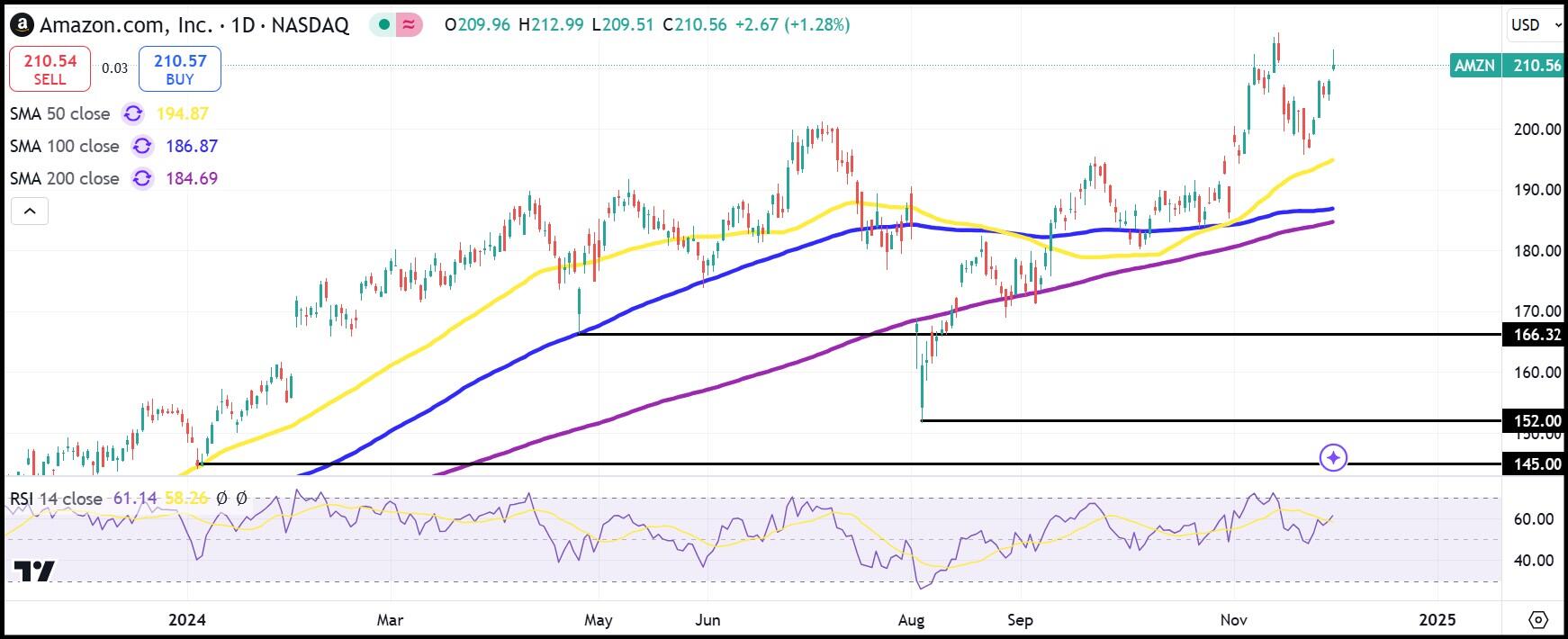
AMZN daily stock chart
Author

Clay Webster
FXStreet
Clay Webster grew up in the US outside Buffalo, New York and Lancaster, Pennsylvania. He began investing after college following the 2008 financial crisis.

















