As the Federal Reserve (Fed) prepares to hold interest rates steady at its July 30 meeting, American savers need more than ever to understand how the central bank's moves affect their retirement plans, particularly Individual Retirement Accounts (IRAs).
The Fed's interest rates and retirement planning
The Fed plays a central role in the financial lives of Americans. By adjusting its key interest rates, it influences the cost of credit, returns on savings and the evolution of financial markets.
While these mechanisms may seem abstract, their impact on your retirement planning, and in particular your IRA, is real.
When the Fed raises interest rates, borrowing becomes more expensive, which may slow the economy but improve returns on variable-rate savings accounts or new Bonds.
Conversely, lower interest rates stimulate economic growth by making money cheaper, but reduce interest income for savers.
IRAs: Why Fed interest rates matter
Individual Retirement Accounts are powerful tools for building a solid retirement. Whether Traditional or Roth, they allow savings to grow tax-free (or tax-deferred).
But their performance depends largely on the economic environment, and therefore on the Fed's decisions.
When interest rates rise, Bond funds held in an IRA may lose value in the short term. However, over the longer term, these funds will gradually integrate higher-rate Bonds, which can improve the income generated by the portfolio.
When interest rates fall, equities tend to perform better, as companies can borrow more cheaply to finance their growth. This can boost the valuation of equity-oriented IRA portfolios.
The current situation: A cautious Fed on the verge of action
Currently, the Fed is maintaining rates between 4.25% and 4.5% since December, a historically high level.
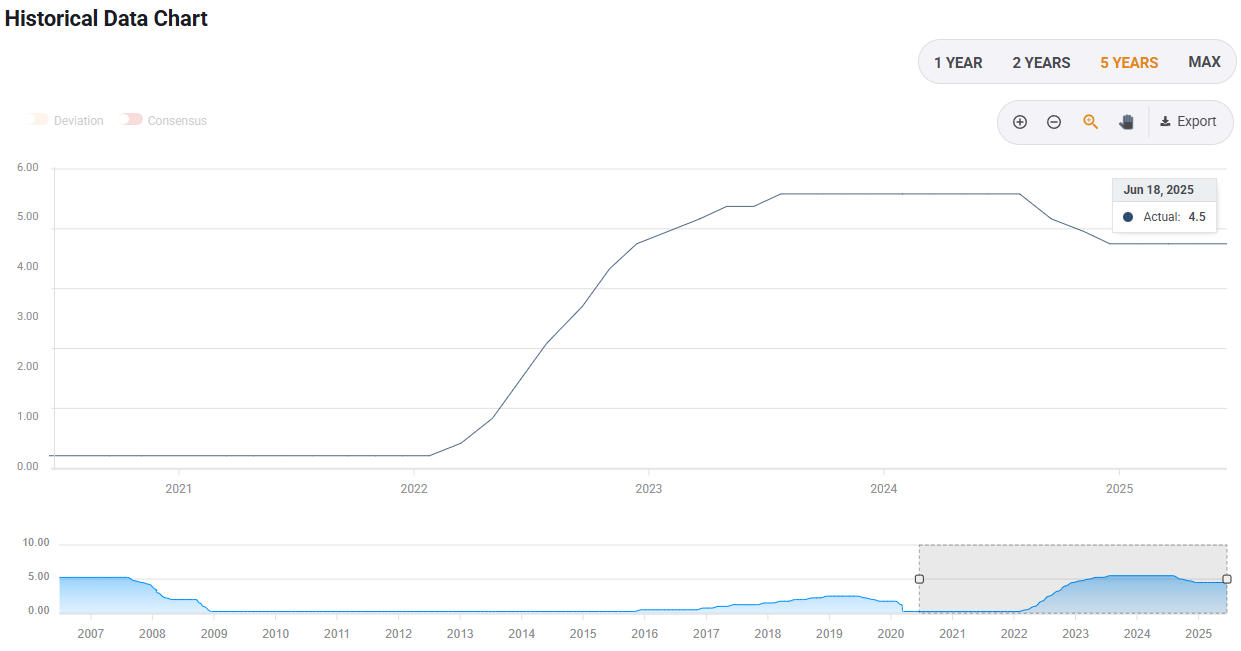
Fed interest rates. Source: FXStreet
Although inflation is stabilizing, the uncertainties associated with the tariffs imposed by the US President Donald Trump administration are prompting Fed policymakers to remain cautious.
However, markets are anticipating a first rate cut as early as September, if the next employment and inflation reports confirm an economic slowdown.
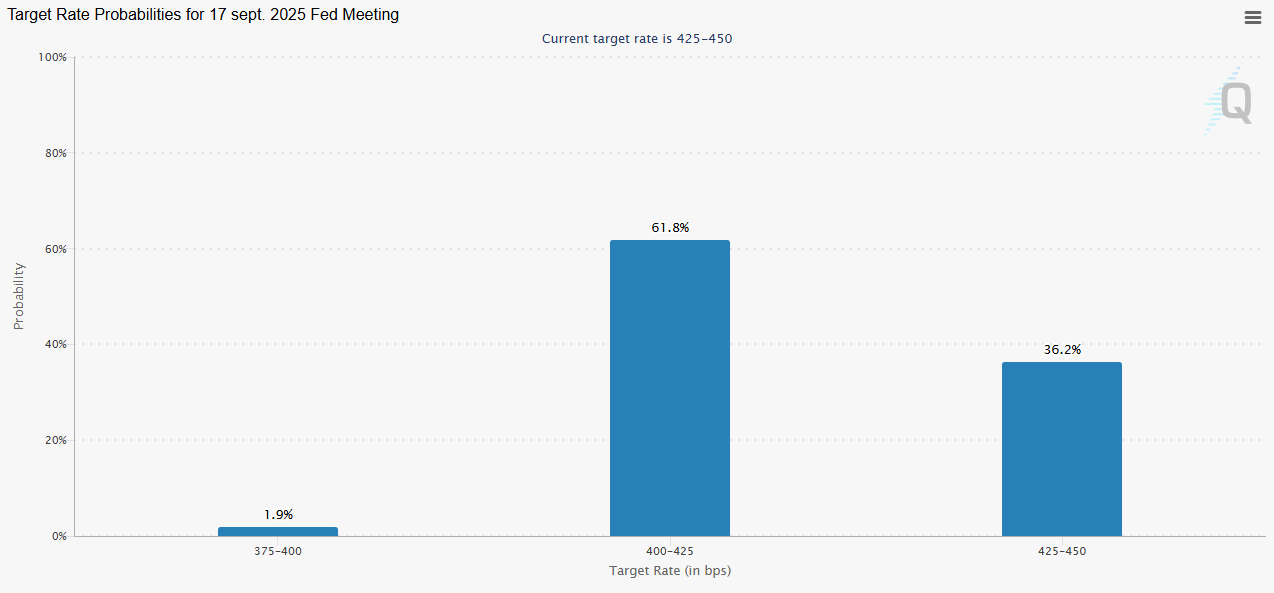
Target Rate Probabilities for the September meeting. Source: CME Group
For savers, this means that the cycle of interest rate cuts paused this year could soon resume, with concrete consequences for IRAs.
How to adapt your IRA strategy in this context
Reassess the Bond portion of your portfolio
If you hold Bonds via funds in your IRA, monitor their sensitivity to interest rates (duration).
In a context of falling interest rates, these assets may see their value rise. You could also consider extending duration or incorporating high-yield Bonds, with discretion.
Explore rate-sensitive stocks and sectors
Sectors such as Real Estate, Technology and Utilities can benefit from a low-rate environment.
Dividends from certain stocks can also offer an interesting alternative to Bond income in your IRA.
Stay diversified and aligned with your retirement horizon
It's tempting to adjust your portfolio with every Fed move, but your retirement planning strategy must remain consistent with your long-term goals.
Diversifying your IRA account between Equities, Bonds, cash and, where appropriate, Commodities remains key.
Consider the tax impact of distributions
If you're close to the age of Required Minimum Distributions (RMDs), a drop in interest rates could affect your future income.
Plan ahead to avoid forced withdrawals during unfavorable market conditions.
Follow the Fed, but don't panic
The Federal Reserve's movements have a profound influence on the economy and the markets, and therefore on your Individual Retirement Accounts.
But rather than reacting impulsively to every interest rate decision, the most prudent approach remains to follow a diversified strategy, rebalance your portfolio regularly and stay aligned with your retirement planning goals.
If interest rates fall soon, this could be an opportunity to boost your retirement savings. Provided you're prepared.
IRAs FAQs
An IRA (Individual Retirement Account) allows you to make tax-deferred investments to save money and provide financial security when you retire. There are different types of IRAs, the most common being a traditional one – in which contributions may be tax-deductible – and a Roth IRA, a personal savings plan where contributions are not tax deductible but earnings and withdrawals may be tax-free. When you add money to your IRA, this can be invested in a wide range of financial products, usually a portfolio based on bonds, stocks and mutual funds.
Yes. For conventional IRAs, one can get exposure to Gold by investing in Gold-focused securities, such as ETFs. In the case of a self-directed IRA (SDIRA), which offers the possibility of investing in alternative assets, Gold and precious metals are available. In such cases, the investment is based on holding physical Gold (or any other precious metals like Silver, Platinum or Palladium). When investing in a Gold IRA, you don’t keep the physical metal, but a custodian entity does.
They are different products, both designed to help individuals save for retirement. The 401(k) is sponsored by employers and is built by deducting contributions directly from the paycheck, which are usually matched by the employer. Decisions on investment are very limited. An IRA, meanwhile, is a plan that an individual opens with a financial institution and offers more investment options. Both systems are quite similar in terms of taxation as contributions are either made pre-tax or are tax-deductible. You don’t have to choose one or the other: even if you have a 401(k) plan, you may be able to put extra money aside in an IRA
The US Internal Revenue Service (IRS) doesn’t specifically give any requirements regarding minimum contributions to start and deposit in an IRA (it does, however, for conversions and withdrawals). Still, some brokers may require a minimum amount depending on the funds you would like to invest in. On the other hand, the IRS establishes a maximum amount that an individual can contribute to their IRA each year.
Investment volatility is an inherent risk to any portfolio, including an IRA. The more traditional IRAs – based on a portfolio made of stocks, bonds, or mutual funds – is subject to market fluctuations and can lead to potential losses over time. Having said that, IRAs are long-term investments (even over decades), and markets tend to rise beyond short-term corrections. Still, every investor should consider their risk tolerance and choose a portfolio that suits it. Stocks tend to be more volatile than bonds, and assets available in certain self-directed IRAs, such as precious metals or cryptocurrencies, can face extremely high volatility. Diversifying your IRA investments across asset classes, sectors and geographic regions is one way to protect it against market fluctuations that could threaten its health.
Information on these pages contains forward-looking statements that involve risks and uncertainties. Markets and instruments profiled on this page are for informational purposes only and should not in any way come across as a recommendation to buy or sell in these assets. You should do your own thorough research before making any investment decisions. FXStreet does not in any way guarantee that this information is free from mistakes, errors, or material misstatements. It also does not guarantee that this information is of a timely nature. Investing in Open Markets involves a great deal of risk, including the loss of all or a portion of your investment, as well as emotional distress. All risks, losses and costs associated with investing, including total loss of principal, are your responsibility. The views and opinions expressed in this article are those of the authors and do not necessarily reflect the official policy or position of FXStreet nor its advertisers. The author will not be held responsible for information that is found at the end of links posted on this page.
If not otherwise explicitly mentioned in the body of the article, at the time of writing, the author has no position in any stock mentioned in this article and no business relationship with any company mentioned. The author has not received compensation for writing this article, other than from FXStreet.
FXStreet and the author do not provide personalized recommendations. The author makes no representations as to the accuracy, completeness, or suitability of this information. FXStreet and the author will not be liable for any errors, omissions or any losses, injuries or damages arising from this information and its display or use. Errors and omissions excepted.
The author and FXStreet are not registered investment advisors and nothing in this article is intended to be investment advice.
Recommended content
Editors’ Picks

EUR/USD: US rate hike back on the table, US Dollar up
The EUR/USD pair pulled back in the last full week of August, settling a handful of pips below the 1.1600 mark. The US Dollar (USD) was able to post a comeback after suffering steady losses throughout the month, exacerbated by the United States (US) Department of the Treasury announcement of increased long-bond buybacks on August 19.

Gold: Bulls take a breather following three-week rally
After rising nearly 14% in a three-week rally and reaching its highest level since mid-May near $4,700, Gold (XAU/USD) corrected lower to end the week in negative territory. August employment data from the United States (US) could trigger a directional move next week, while the technical picture highlights that the bullish stance persists in the near term.

The Japanese Yen gives up the big figure intervention won back
Japan delivered the inflation and labour data the Bank of Japan needs to move next month and the Japanese Yen is weaker for a fifth consecutive session. Tokyo Consumer Price Index (CPI) inflation excluding food and energy reached 2% in August, the headline rate rose to 1.9%, and unemployment fell to 2.4% against a 2.5% forecast. USD/JPY takes the 160.00 handle regardless, at the high of the day.

Bitcoin: Billions in ETF inflows push BTC toward decisive breakout
Bitcoin (BTC) extends gains so far this week, trading near $80,000 after testing the 50-week Simple Moving Average (SMA) at $81,114 earlier. Strong institutional demand is supporting the rally, with spot BTC Exchange Traded Funds (ETFs) on track to record a second consecutive week of billion-dollar inflows.

US Dollar: Higher for longer is back… and the Dollar likes it
It has already been a positive week for the US Dollar (USD), but a hawkish speech from Chair Kevin Warsh at the Jackson Hole Symposium may have laid the groundwork for a more sustained rebound in the Buck.

GS price outlook: Goldman Sachs holds above 0.5 support arc. Potential rebound toward 1,070
Based on Arc Cycle Analysis applied to the 2h chart, Goldman Sachs is interacting with the 0.5 Support Arc within the current Arc Cycle. Price is holding above this Support Arc, suggesting the potential for a bullish rebound toward the next Resistance Arc. Price is holding above the 0.5 Support Arc, indicating that this Arc continues to provide support within the current Arc Cycle.