Terra Classic price spikes 2.5% after KuCoin increased LUNC burn tax
- KuCoin exchange declared support for the burn tax increase after passing a Terra Classic (LUNC) proposal.
- The 0.5% tax increase has kicked in for LUNC, and we immediately see a spike in the burns.
- The change was implemented on May 23, five days after introducing the proposal.
- LUNC burns are up 0.84%, while the price is up 2.5% in 24 hours.

Terra Classic (LUNC) price is up 2.5% in the last 24 hours, a newly found bullishness after the implementation of KuCoin exchange’s move to increase LUNC burn tax to 0.5% following the approval of a major proposal.
Also Read: Terra Luna Classic price needs consolidate for longer before LUNC triggers a quick rally
Terra Classic proposal to raise LUNC burn tax to 0.5% receives KuCoin support
KuCoin exchange declared support for the burn tax increase after the Terra community passed a proposal to raise it from 0.2% to 0.5%. The renowned Seychelles-based crypto exchange disclosed an official press release that was subsequently shared on Twitter.
#KuCoin Will Support to Increase the Tax Burn of Terra Classic (LUNC) Network from 0.2% to 0.5%
— KuCoin (@kucoincom) May 18, 2023
KuCoin articulated its resolve to facilitate the increase of both Terra Classic (LUNC) and TerraClassicUSD (USTC) on its platform upon the activation of the 0.5% burn tax at the predetermined Terra Classic block height of 12,902,399. Notably, the change took effect on Tuesday, May 23.
As part of the sacrifices made, KuCoin exchange users will henceforth pay more for their LUNC and USTC transactions. At the same time, the move is expected to help reduce the supply of LUNC, which could fuel a sustained price uptick.
The development is a watershed moment for the LUNC community, considering several exchanges had previously turned down proposals for a burn tax hike citing its potential negative impact on the exchange’s trading volume.
Notably, this is not the first time KuCoin has demonstrated support for the Terra ecosystem. In September 2022, the ecosystem voted to pass a proposal to increase the burn tax to 1.2%. KuCoin was among the first exchanges to announce support for the increase even before it officially passed. Other exchanges, like Binance, MEXC, and Crypto.com, followed suit shortly after.
According to on-chain data, the burn tax increase has impacted LUNC trading volume, discouraging investors from trading the asset amid heightened fees. As a result, the LUNC community voted to decrease the burn tax back to 0.2% in October 2022. Subsequent attempts to increase the tax had failed until the latest proposal passed.
Latest LUNC proposal receives support
Terra Classic’s latest Proposal 11515 introduced a more conservative increase to 0.5%, garnered community support, and aimed to reduce the abundant supply of LUNC tokens. It is among the others that sought to implement enhanced economic policies. Before it, three other proposals intended to augment demand. This would be done through improved staking rewards, bolstering developer funding through increased community pool funding, and enhancing chain utility and volume by whitelisting smart contracts. All these aim to support the revitalization plan of the Terra Classic ecosystem.
LUNC burn increase triggers a rally for Terra Classic
Barely 24 hours after the proposal implementation, LUNC burns have increased by 0.84% from the 58,005.788 million on May 18 to the current 58,490.781 million range, as shown below, Terrarity shows.
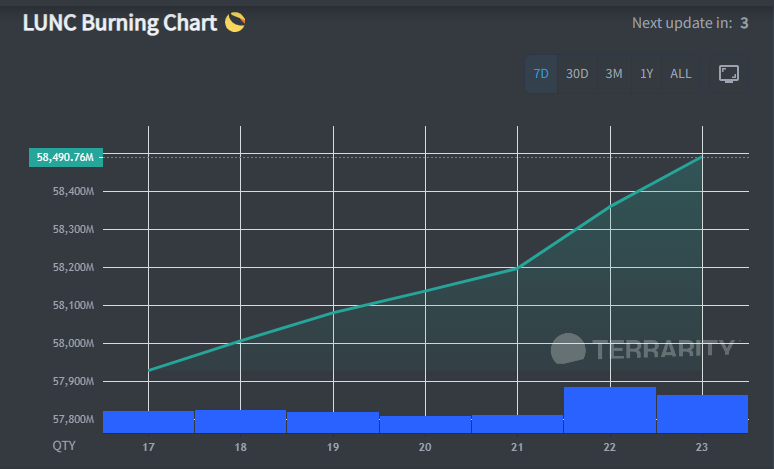
LUNC burning is bullish for Terra Classic price as it reduces the supply of the tokens against an ever-growing demand. Accordingly, the altcoin is up 2.5% within the same timeframe as investors look to record more gains.
BREAKING: the 0.5% tax increased has kicked in for #LUNC and we are immediately seeing a spike in the burns. $lunc pic.twitter.com/Qs48eKyfPk
— LUNC NEWS (@Chot4a) May 23, 2023
An increase in buyer participation from the current $0.00009 price level could see Terra Classic price reach the $0.00011 level soon or, in a highly bullish case, tag the $0.00013 resistance level, denoting a 50% uptick from current levels.
The bullish outlook is supported by the Relative Strength Index (RSI), which was headed north after signaling a buy signal and easing toward the midline. This indicates that buyers are slowly regaining control. Similarly, the Awesome Oscillators (AO) drew to the midline and could soon move into the positive zone, favoring the upside.
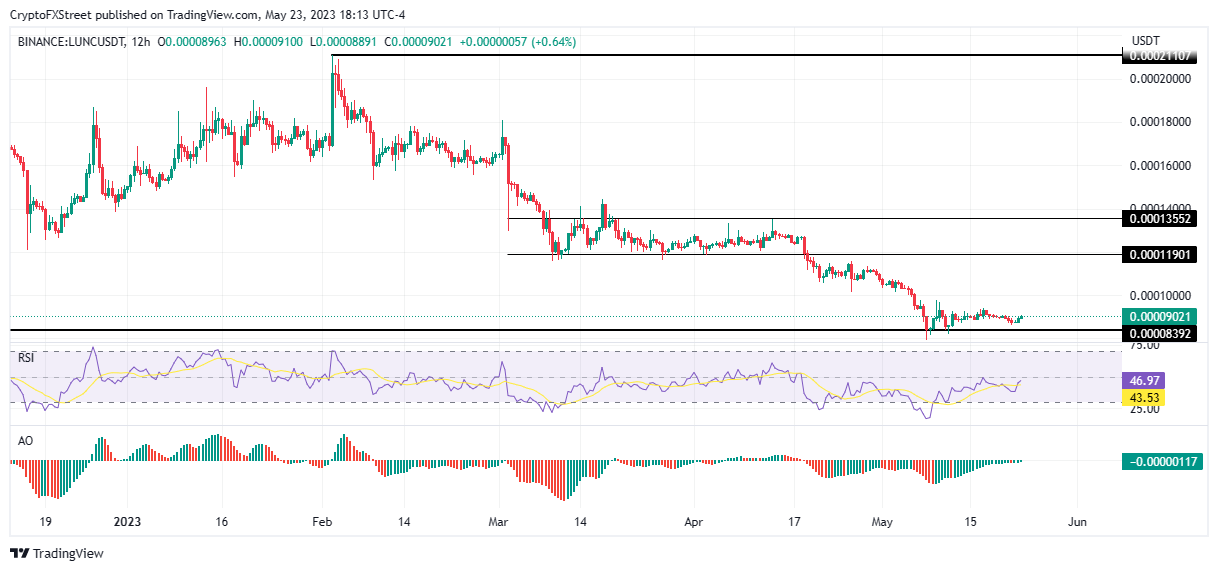
LUNC/USDT 1-Day Chart
Conversely, fading buyer momentum could see Terra Classic price bend toward the $0.00008 support floor.
Author

Lockridge Okoth
FXStreet
Lockridge is a believer in the transformative power of crypto and the blockchain industry.