|

Polkadot price is in a no-trade zone until this happens

  • DOT price is forming a new range between $14 and $16.
  • Polkadot price has breached the consolidation trend line.
  • Invalidation of the no-trade zone is a breach of $17.20.

Polkadot has questionable price action that needs further narrative before forecasting anything more than a 12% rally for the bulls. Traders should consider looking for more profitable opportunities.

Polkadot price is questionable

Polkadot price is portraying itself as an unfavorable digital asset lately. The DOT price has whipsawed liquidity on both sides of the playing field to start the month of May. The erratic price action displayed from DOT price could be Market Makers' attempt to form a new range within the $14-16 zone. If the technicals are correct, the Marker Maker's strategy will confine the DOT price within the zone for days to come. There could be much better opportunities in the Crypto ecosystem as a whole. Therefore it is best not to trade this digital asset until more evidence of a directional trend is displayed.

Polkadot price provides further confluence of the tight range in play as the price has breached the consolidation channel. Buying the lows could be a high-risk entry since breached trend channels are typical of wave three price action. Shorting the digital asset before retesting the breached trend line could also be a trade setup doomed for failure as Market Makers could continue the false breakouts within the forming range.
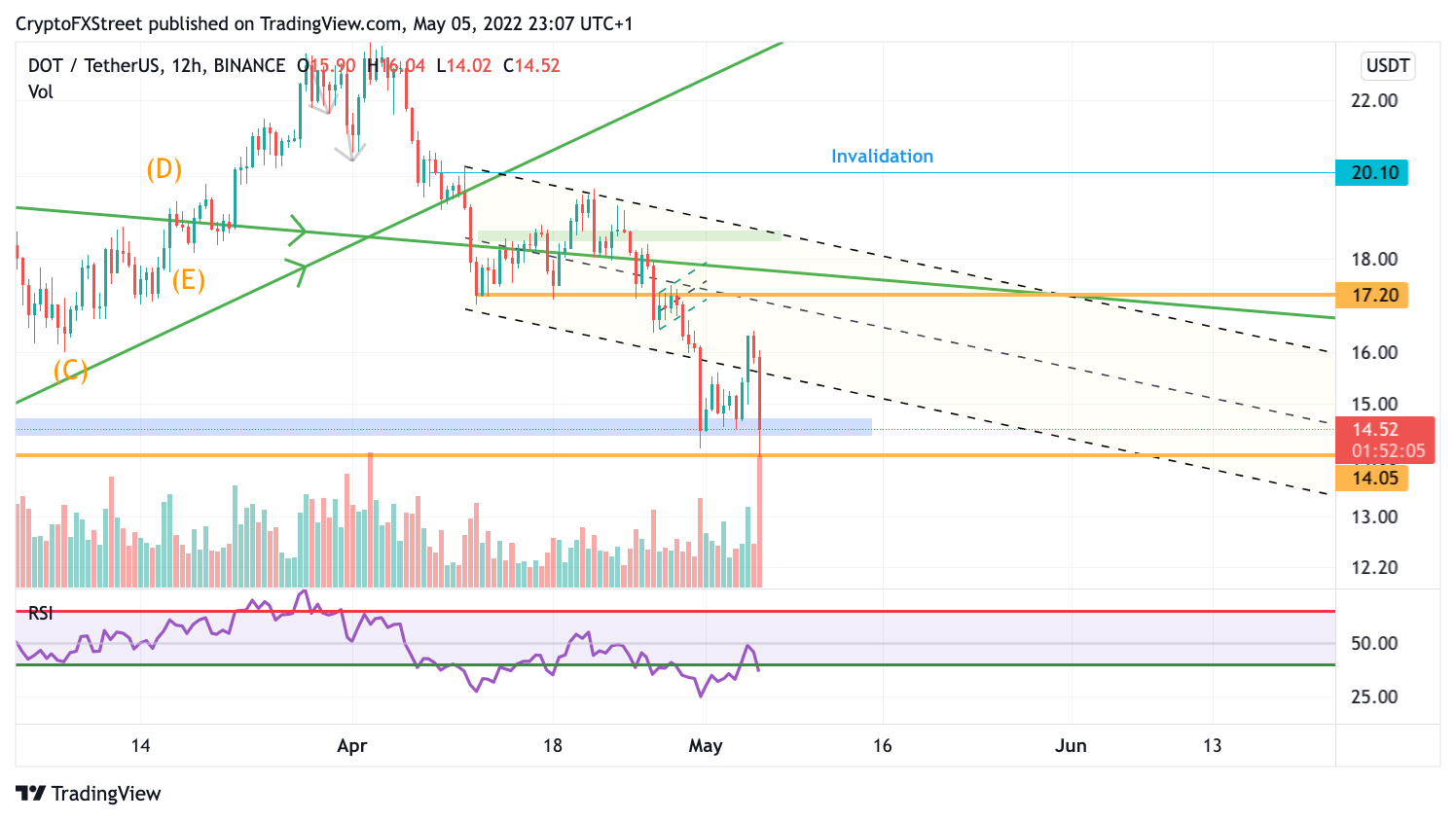
TM/DOT/5/5/22

DOT/USDT 12-Hour Chart

The invalidation of the no-trade zone will be a breach of $17.20. If this event occurs, analysts can deem the current downtrend as a corrective structure rather than impulsive. The DOT price could potentially rally back $20, resulting in a 40% increase from the current Polkadot price.

Author

Tony M.

Tony M.

FXStreet Contributor

Tony Montpeirous began investing in cryptocurrencies in 2017. His trading style incorporates Elliot Wave, Auction Market Theory, Fibonacci and price action as the cornerstone of his technical analysis.


More from Tony M.
Share:

Markets move fast. We move first.

Orange Juice Newsletter brings you expert driven insights - not headlines. Every day on your inbox.

By subscribing you agree to our Terms and conditions.

Editor's Picks

Dogecoin ticks lower as low Open Interest, funding rate weigh on buyers

Dogecoin extends its decline as risk-off sentiment dominates across the crypto market. DOGE’s derivatives market remains weak amid suppressed futures Open Interest and perpetual funding rate.

Crypto Today: Bitcoin, Ethereum, XRP decline as risk-off sentiment escalates

Bitcoin remains under pressure, trading above the $87,000 support at the time of writing on Tuesday. Selling pressure has continued to weigh on the broader cryptocurrency market since Monday, triggering declines across altcoins, including Ethereum and Ripple.

Chainlink risks further losses in early 2026 despite the ecosystem growth

Chainlink (LINK) is down 2% at press time on Tuesday, adding to a nearly 5% decline in December so far. The oracle token risks a negative close for the fourth straight month, potentially signaling a bearish start to 2026. 

Bitcoin retreats as $90,000 rejection, ETF outflows weigh on sentiment

Bitcoin continues to trade lower on Tuesday after failing to break the key $90,000 resistance level the previous day. US-listed spot ETFs record an outflow of $142.90 on Monday, while Strategy Inc. boosts its cash reserves to $2.19 billion.

Orange Juice Newsletter – Smart insights by real people. Every day.

A free newsletter highlighting key market trends to help traders stay a step ahead. Daily insights on the most relevant trading topics, compiled by our experts in an easy-to-read format so you never miss an important move.

Bitcoin: Fed delivers, yet fails to impress BTC traders

Bitcoin (BTC) continues de trade within the recent consolidation phase, hovering around $92,000 at the time of writing on Friday, as investors digest the Federal Reserve’s (Fed) cautious December rate cut and its implications for risk assets.