Yuan and Gold

In the previous editions of the Market Overview, we have already analyzed the relationship between gold and some major world currencies, such as the U.S. dollar, the euro, or the Japanese yen. But what is the link between the Chinese yuan (officially: renminbi) and the yellow metal? Let’s check it out.
Chart 1: The USD/CNY exchange rate (red line, right axis) and the price of gold (yellow line, left axis, London P.M. Fix) from January 1981 to September 2017.
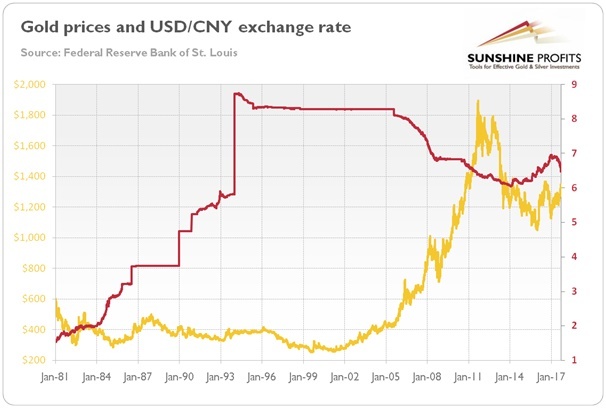
As one can see in the chart above, there is no clear long-term relationship between the yellow metal and the USD/CNY exchange rate. It is hardly surprising, as the exchange rate of the renminbi was set not by market forces but by the authorities for most of its history. In the beginning (until the 1970s, when the Chinese government started to liberalize the command economy), the yuan was overvalued to support imports and reduce the country’s dependence on imported manufactured goods. However, it was devalued to 8.74 in 1994 to support exports. The Chinese government maintained the peg to the U.S. dollar at about 8.3 until 2005. Although the peg was then lifted, it was reintroduced in 2008 when the financial crisis burst out. It was maintained until 2010, when China returned to the managed floating rate system. So let’s analyze the link between gold and the renminbi since then.
Chart 2: The USD/CNY exchange rate (red line, right axis) and the price of gold (yellow line, left axis, London P.M. Fix) from January 2010 to September 2017.
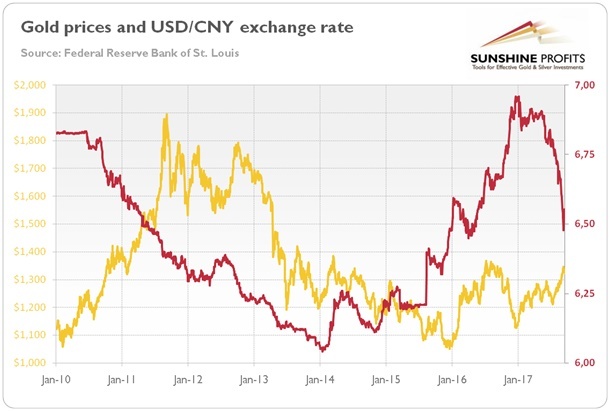
The chart above also does not show a clear correlation between these two assets. The yuan appreciated since the removal of the peg to the U.S. dollar in June 2010 until 2014. In that time the price of gold reached its multi-year high and then collapsed. In 2014-2017, the renminbi systematically depreciated against the greenback, but the yellow metal was generally in a sideways trend. In 2017, the USD/CNY exchange rate plunged, which helped the gold prices to rally.
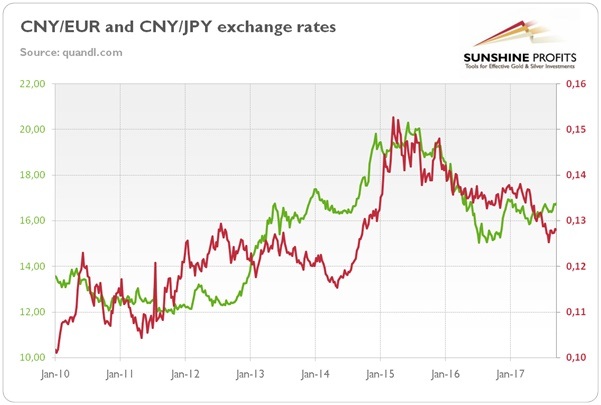
However, the decline in the exchange rate was caused by the weakness in the greenback rather than by internal strength in the yuan. As one can see in the chart below, in 2017, the renminbi did not appreciated against the Japanese yen and actually depreciated against the euro.
Chart 3: CNY/EUR exchange rate (red line, right axis, weekly averages) and CNY/JPY exchange rate (green line, left axis, weekly averages) from January 2010 to September 2017.
The lack of a clear pattern in the gold-yuan relationship does not mean that investors should not pay attention to yuan. First, the international importance of the Chinese currency has been rising recently. In January 2015, the yuan became the fifth most widely traded currency in the world, while in October 2016, it was added to the special drawing rights basket used by the IMF.
Moreover, China – which is the world’s biggest oil importer– has recently created a crude oil futures contractwhich is priced in yuan and convertible into gold. If such an instrument is adopted by oil exporters, the value of gold expressed in the U.S. dollar would likely rise, as the wide adoption of such a contract would lower the petro-demand for the greenback. However, yuan-denominated commodity contracts have been unsuccessful so far, so investors should not count on yuan dethroning the U.S. dollar anytime soon.
Second, sharp changes in the exchange rate of the yuan can send shock waves through financial markets, having an effect on gold. As a reminder, in summer of 2015 China devalued the yuan, which pushed global equities lower. Hence, a devaluation of the renminbi would imply an appreciation of the U.S. dollar, which does not sound good for the gold market.
However, the revaluation of the renminbi could also significantly affect the markets. This is because China purchases a lot of U.S. Treasuries in order to recycle its huge dollar surpluses (it buys foreign currencies to maintain cheap yuan, which stimulates exports). Hence, sudden sales of the PBOC’s forex reserves would increasethe U.S. yields. Higher interest rates are usually negative for the gold prices, but the safe-haven demand for the yellow metal could then increase.
To sum up, despite the rising importance of the renminbi in the world, its link with gold remains rather weak. Although permabulls believe that the U.S. dollar will collapse soon and the gold-backed yuan will replace it as the world’s reserve currency, gold investors should not investing in the yellow metal, betting on this scenario, as yuan is not as freely floating, liquid and transparent as the greenback.
If you enjoyed the above analysis and would you like to know more about the impact of China’s economy on the gold market, we invite you to read the October Market Overview report. If you’re interested in the detailed price analysis and price projections with targets, we invite you to sign up for our Gold & Silver Trading Alerts. If you’re not ready to subscribe at this time, we invite you to sign up for our gold newsletter and stay up-to-date with our latest free articles. It's free and you can unsubscribe anytime.
Want free follow-ups to the above article and details not available to 99%+ investors? Sign up to our free newsletter today!
Author
Arkadiusz Sieroń
Sunshine Profits
Arkadiusz Sieroń received his Ph.D. in economics in 2016 (his doctoral thesis was about Cantillon effects), and has been an assistant professor at the Institute of Economic Sciences at the University of Wrocław since 2017.

















