US Initial Jobless Claims Preview: Volatility is not a trend
- First time filings expected to increase to 833,000 after 803,000.
- Continuing claims predicted to rise to 5.433 million from 5.337 million.
- Forecasts have been erratic for the past two months.
- Currency markets can be volatile in the final weeks of the year.

Initial jobless claims are expected to continue their recent cycling between between surprise gains and losses. Requests for unemployment benefits are forecast to rise to 833,000 in the December 25 tracking period, two weeks after the highest total since early September and one week after the lowest filings this month.
Continuing claims are projected to reach 5.433 million in the December 18 week, after falling to 5.337 million, the lowest of the pandemic era, the previous week.
Claims and forecasts
Forecasts for initial claims have been unusually erratic for the past two months.
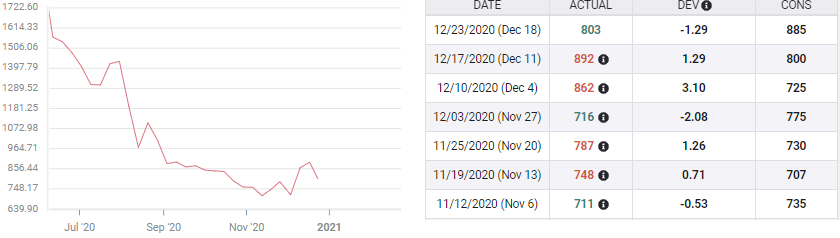
After jobless claims dropped to 711,000 in the week of November 6, the lowest of the pandemic, from 757,000 prior, the difficulties began. The forecast had been 735,000.
Improvement was predicted to continue in the November 13 week with a forecast of 707,000, instead claims rose to 748,000. The following week, November 20, the prediction was 730,000, the result was 787,000. In the final week of the month, November 27, the process reversed, forecast 775,000, reality 716,000.
December was more of the same: First week 725,000 expectation, 862,000 result; second week 800,000 forecast, 892,000 figure, third week 885,000 projection, 803,000 number.
Initial Jobless claims
Forecasts and closures
Predictions have become less accurate since a number of states, notably California, New York and Pennsylvania instituted tighter economic and social restrictions in November and December in response to a rise in COVID-19 positive tests.
Other large states,Texas and Florida for example, remain almost fully open, with lower case and hospitalization rates.
The problem for the statisticians is that the new rules are widespread enough to create a temporary surge in claims without affecting unemployment trends nationwide.
For instance, on December 11 Governor Andrew Cuomo of New York, banned indoor dining in New York City, again limiting restaurants to take-out service. In early December, Governor Tom Wolf of Pennsylvania restricted operations of restaurants statewide. California has been attempting to enforce some of the strictest travel, business and socialization rules in the country with poor results. Its case rate remains the highest per population in the nation.
These measures have once more forced restaurant employees onto the unemployment rolls, while leaving the general population of workers, where slow improvement continues, unmarked.
Conclusion
Initial Jobless claims in the US have been the pandemic's telltale. They signaled the abrupt shift to catastrophe in March and have been monitored ever since for the recovery. The recent volatility in filing is directly tied to the newly imposed restrictions in a few states. It does not represent a national trend.
As such the potential variation in the weekly numbers, will, barring a huge disparity, have little impact on the currency markets, even in their end of year liquidity desert.
Premium
You have reached your limit of 3 free articles for this month.
Start your subscription and get access to all our original articles.
Author
Joseph Trevisani
FXStreet
Joseph Trevisani began his thirty-year career in the financial markets at Credit Suisse in New York and Singapore where he worked for 12 years as an interbank currency trader and trading desk manager.

















