|

Pound edges lower, markets eye FedSpeak

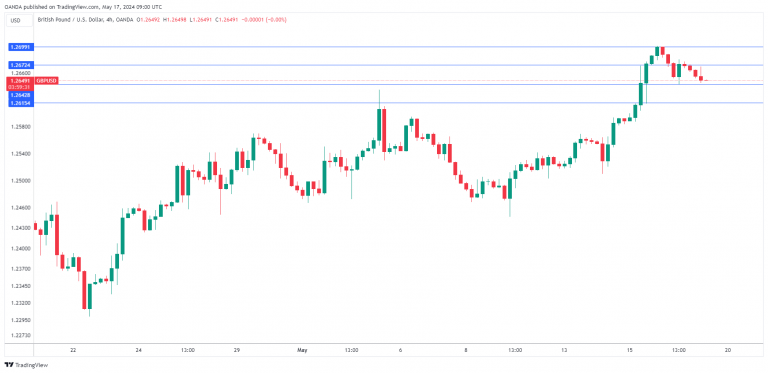
The British pound is down slightly on Friday. GBP/USD is down 0.14%, trading at 1.2648 in the European session at the time of writing.

It has been a good week for the pound, which has gained 1% against the US dollar. Wednesday’s inflation release showed CPI dipping in April, reversing the trend of the past several months. The unexpected stickiness in inflation had delayed a rate cut from the Federal Reserve and the drop in April inflation raised expectations for a rate cut, sending equity markets higher and the US dollar lower, with GBP/USD jumping 0.75% on Wednesday.

The Federal Reserve has been cautious about shifting its “higher for longer” policy, which has kept rates on hold for six straight times. The unexpected rise in inflation in the first quarter and strong US economic data has delayed plans to lower rates. The Fed signaled in January that it was planning to cut rates three times this year but is now looking at one or perhaps two rate cuts before the end of the year.

There are no key economic releases out of the US today but three FOMC members, Waller, Daly and Kugler, will deliver speeches which could provide some insights into future US rate policy. FOMC members have sounded rather hawkish, saying that restrictive policy is working and there is no rush to lower rates.

The Bank of England is under pressure to lower rates as inflation has fallen to 3.2%. The path to achieving the 2% target is likely to be bumpy but the labour market is showing signs of cooling down, which supports a rate cut. The June meeting promises to be interesting, with the markets pricing in a 50/50 probability of a rate cut or a hold.

GBP/USD technical

  • GBP/USD is putting pressure on support at 1.2642. Below, there is support at 1.2615.

  • 1.2672 and 1.2699 are the next resistance lines.
GBPUSD

Author

Kenny Fisher

Kenny Fisher

MarketPulse

A highly experienced financial market analyst with a focus on fundamental analysis, Kenneth Fisher’s daily commentary covers a broad range of markets including forex, equities and commodities.


More from Kenny Fisher
Share:

Editor's Picks

AUD/USD bounces off multi-month low, nears 0.6900

AUD/USD edges higher toward 0.6900 in the Asian session on Wednesday, recovering some of the previous day’s losses to its lowest level since March as the US Dollar stalls the hot US CPI-inspired rally amid hopes of a US-Iran peace deal. Meanwhile, hawkish comments from FOMC members have almost confirmed another December rate hike, which favors USD bulls and should cap the Aussie.

USD/JPY remains capped below 159.00 amid looming intervention risks

USD/JPY struggles to build on the previous day’s strong gains to a near one-month top as intervention risk supports the Japanese Yen while hopes of a US-Iran peace deal cap the safe-haven US Dollar. That keeps the pair's upside limited below 159.00, for now.

Gold: The $4,000 mark holds the downside, for now

Gold adds to Tuesday’s small pullback and remains close to the key $4,000 mark per troy ounce on Wednesday. The yellow metal’s continuation of the downward trend comes against the backdrop of a robust performance of the US Dollar, rising US Treasury yields across the board and rising bets of extra rate hikes by the Fed.

Crypto Today: Bitcoin, Ethereum and XRP struggle to find footing amid spot ETF outflows

Cryptocurrency prices are broadly consolidating near key lower support levels on Wednesday, led by Bitcoin, hovering around $74,000. Ethereum sits above $2,000 while its upside remains structurally capped. Ripple, meanwhile, holds delicately above $1.00.

Ten questions for China in 2027

2026 has been a year of slowing growth and increasing divergence within China's economy. We saw the gap between external and domestic demand, as well as between the new economy and the old economy, widen significantly. Here, we look ahead to the key questions facing China in 2027.

What the US CPI headline doesn’t tell you about inflation

Brent crude has fallen about a third since mid-October on hopes the Iran war is ending, but diesel, freight and fertiliser costs haven't followed. Those costs reach US consumer prices in stages through 2027 and could keep inflation high after gasoline gets cheaper.