US Initial Jobless Claims Preview: It is the trend that matters
- Unemployment claims expected to drop to 1 million from 1.106 million.
- Continuing claims forecast to 14.45 million from 14.844 million.
- Payrolls projected to be 1.55 million in August, were 1.763 million in July.
- Dollar aided by improved US July economic data.

Unemployment claims have been the touchstone for the US economy in this year’s Covid spring and summer.
In March the explosion of claims dramatized the labor market debacle of the lockdowns. In mid-July their unexpected reversal was taken as a warning that the second Covid wave was set to cripple the US recovery. The dollar began a month long decline. But while March was an accurate indicator of the looming economic catastrophe, July has not been.
The US economy has not retreated in the third quarter. Payrolls expanded smartly in July and are expected to do so in August. Retail and durable goods sales continued to grow, business sentiment in the Institute for Supply Management (ISM) and Market surveys were stronger than expected in July and August with the notable exception of the employment indexes.
The Atlanta Fed GDPNow third quarter estimate has risen steadily and is at 25.6% annualized. Only consumer attitudes belied the general improvement falling in July and August.
Initial claims and non-farm payrolls
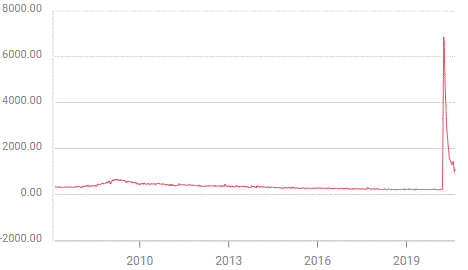
After the shutdown peak of 6.867 million in the week of March 27, claims dropped 81% in the next 15 weeks to 1.307 million on July 10. The 10% rise of the following two weeks coincided with second wave of Covid diagnoses in a number of Western and Southern states was thought to presage a retreat in the pace if not the fact of the recovery. The 32% drop to 0.971 million on August 7 and the subsequent rise to 1.106 million ended speculation that claims has reversed or that the weekly variation had a tight connection to overall economic conditions.
Initial jobless claims
Payrolls added 1.763 million workers in July, 10% better than the 1.6 million forecast, though one-third of the 4.8 million rehires in June. Of the 22.16 million lost jobs from March and April, 42% have returned to work, with 1.55 million more expected in August.
Retail sales and durable goods
Retail sales rose 1.2% in July and combined with the 18.2% and 8.4% gains in May and June have increased 4.9% more than the total March and April shutdown declines. The monthly excess gain of 1.63% in May through June would be considered an excellent performance in any normal era.
Durable goods sales jumped 11.2% in July, more than double the 4.3% forecast. Purchases have gained 34% in the last three month covering the 35% drop in March and April.
PMI
Purchasing managers’ indexes from ISM registered 54.2 in manufacturing and 58.1 in services for July, better than their 53.6 and 55 forecasts and 52.6 and 57.1 June results.
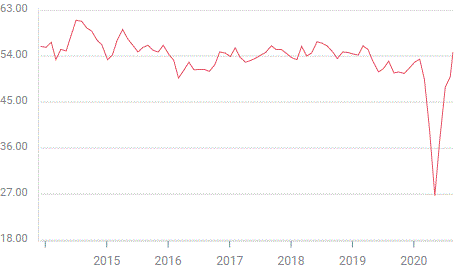
Markit’s August preliminary readings of 53.6 in manufacturing and 54.8 in services were also stronger than their 51.9 and 51 estimates and June scores of 50.9 and 50.
Markit services PMI
Markets conclusion
The weekly variation in claims has ceased to have much predictive value for the overall economy.
Initial claims have always been a trend indicator. The March events were an anomaly in their origin, there had never before been a government ordered economic shutdown, and in the absolute number of claims.
The trend in claims continue be down and that predicts economic improvement. Unless there is a large discrepancy between forecast and result. Markets await next Friday’s non-farm payrolls.
Author

Joseph Trevisani
FXStreet
Joseph Trevisani began his thirty-year career in the financial markets at Credit Suisse in New York and Singapore where he worked for 12 years as an interbank currency trader and trading desk manager.