The second and third-largest economies are ok, but the first? Not so much: What it means for asset prices

Outlook:
We get the usual Thursday jobless claims this morning, likely 1.375 million but with continuing claims forecast to drop below 19 million, according to Bloomberg. Bloomberg calls it a "mixed picture" because JOLTS showed 5.4 million new job openings when the forecast was for 4.5 million. "... the continued failure to control the virus outbreak is leading to warnings that the pace of recovery may slow."
Let's face it, hardly any of us are equipped to grasp the meaning of the data under current conditions. What does it mean that "separations" (firings and voluntary quits) fell by 5.83 million in May? Surely hardly anyone quit voluntarily. The number of hires jumped by 2.44 million to 6.5 million, a record high, but this includes workers who had been let go and re-hired. So, jobs lost is 5.83 million and hires rose to 6.5 million for a net of +670,000. So what? This is a whole lot of noise, especially in light of the surge in cases and re-imposed lockdowns over the past week. Maybe it's true that new layoffs are being offset by hiring and re-hiring, but what about the July 4 holiday messing up data, the mountain of unprocessed claims, and the Payroll Protection money running out in a few weeks?
It's likely the seeming improvement in the jobs numbers will be seen as less-bad and therefore good, boosting sentiment and equities, but it's a loaded inference that can blow up when the new numbers come in next week or next month.
Meanwhile, recent data and data today show that China and Germany are getting the recovery. If the second and third largest economies are doing well but the first largest economy is not, what does that mean for asset prices? It's not clear the euro can keep up with the yuan, which is hardly a freely traded currency. We were just puzzling over this when Gittler at BDSwiss published this amazing chart, showing that for a while, as least, the euro did track the yuan.
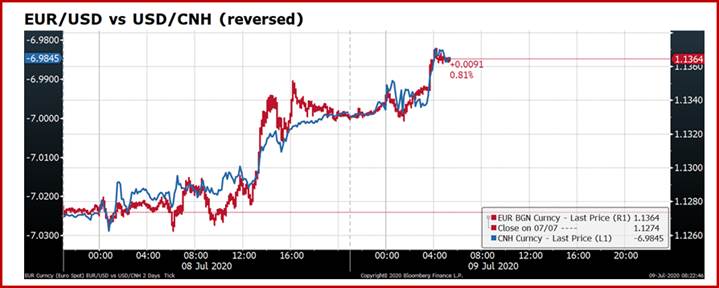
So while we are all struggling with jobless claims and the minestrone soup of the job market in the US—appropriate since workers are consumers and consumption is two-thirds of the US economy—the FX market is acknowledging something going on behind the scenes. Whether it's a loss of confidence in the US or rising confidence in China and Germany remains to be seen. But it may be one short chapter in the developing anti-US and anti-dollar story.
At some point those judging the government management of the pandemic have to come down on the side of the US doing the worst job. FX analysts keep shying away from this subject, but at some point they have to connect the dots among bad public health policies and bad economic outcomes, regardless of what the stock market is doing.
Alternative Facts: An op-ed in the FT today says "Americans want to be free to be stupid" and the resistance to government requests to self-isolate and wear the damn masks shows "pioneer spirt." What bilge! You don't have to check it to know the author is from Texas. And associated with the Hoover Institute. It was the Lt Gov of Texas who said recently Dr. Fauci "doesn't know what he's talking about" and Texans "don't need his advice any more." The author brings up historical incidents of people defying government orders, but the evidence is razor thin. For New Hampshire to have the motto on their license plates "Live free or die" has nothing to do with wearing a mask, although the author tries to make the mask a symbol of the "struggle between the dark and light tendencies of the American national psyche," saying the pioneer spirit accepted science and putting a man on the moon.
Pioneer spirit has almost nothing to do with rejecting authority or norms, and nearly everything to do with getting free land and economic opportunity. "Bare-faced citizens are busting their way into Walmart and picking fights at mini-marts." These are the ideologically addled or just plain stupid who would themselves sneer at the phrase "pioneer spirit."
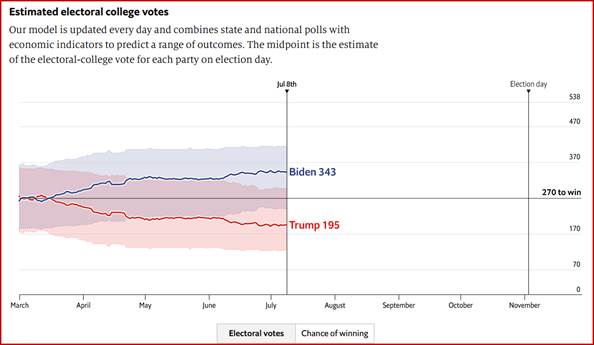
Politics: The chart is from The Economist magazine's daily update. It shows a low—near-impossible—probability of Trump re-election. We are skeptical, not only because of having been burned by polls in 2016 but also because the graphic starts in March with Biden and Trump each at 269. Therefore, the methodology is a measurement of change, understandable but subject to flakiness. Counting from March, the first moment of recognition of the pandemic, must skew the outcome. And if it took Biden four months to get the lead, can Trump get it back in the next four months? On the detail, we wonder how much weight The Economist is giving to the stock market. You can get source code and source data from the footnotes if you are feeling playful and understand that sort of thing. It's not your grandpa's modelling.
This is an excerpt from “The Rockefeller Morning Briefing,” which is far larger (about 10 pages). The Briefing has been published every day for over 25 years and represents experienced analysis and insight. The report offers deep background and is not intended to guide FX trading. Rockefeller produces other reports (in spot and futures) for trading purposes.
To get a two-week trial of the full reports plus traders advice for only $3.95. Click here!
This is an excerpt from “The Rockefeller Morning Briefing,” which is far larger (about 10 pages). The Briefing has been published every day for over 25 years and represents experienced analysis and insight. The report offers deep background and is not intended to guide FX trading. Rockefeller produces other reports (in spot and futures) for trading purposes.
To get a two-week trial of the full reports plus traders advice for only $3.95. Click here!
Author
Barbara Rockefeller
Rockefeller Treasury Services, Inc.
Experience Before founding Rockefeller Treasury, Barbara worked at Citibank and other banks as a risk manager, new product developer (Cititrend), FX trader, advisor and loan officer. Miss Rockefeller is engaged to perform FX-relat