S&P Global PMIs Preview: EU and US figures to shed light on economic progress
- March S&P Global preliminary PMIs are foreseen little changed from their previous readings.
- Speculative interest needs outrageous deviations to react to the numbers.
- EUR/USD bullish potential is intact ahead of the release, with 1.1000 on the table.

S&P Global PMIs measure private sector business activity in major economies on a monthly basis and in advance of comparable official economic data. On Friday, March 24, the company will unveil the March preliminary estimates of manufacturing and services conditions for the Eurozone and the United States.
Global businesses are still trying to recover from the pandemic-related setback that saw the world come to a halt three years ago. It has been a bumpy road, with back and forths in the middle, but central banks' decisions to tighten their monetary policies took its toll on businesses, with activity contracting for most of 2022.
Modest improvement in 2023
The beginning of the new year brought marginal bounces in the indexes but fell short of indicating economic expansion. In the Eurozone, the Manufacturing PMI was confirmed at 48.5 in February, with Services index coming in at 52.7. The Composite figure edged higher to 52, showing “a tentative return to growth after six successive months of decline,” according to the official report.
Across the Atlantic, the picture is quite alike, as the bounce is more notorious in the services sector, while the manufacturing index remains in contraction territory.
Market participants anticipate a limited improvement in S&P Global US indexes in March. Services output is seen holding within expansion territory, while the Manufacturing PMIs are mostly seen steady below the 50 threshold that separates growth from economic contraction.
The Eurozone Manufacturing PMI is foreseen at 49, up from the previous 48.5, while the services index is seen at 52.5 from 52.7 in February. German indexes are expected at 47 and 51, respectively, improving modestly from the previous month's readings. Finally, both United States indexes are seen below the final February readings, with only the Services PMI holding above the 50 threshold.
EUR/USD possible reactions
Dismal figures will come as no surprise, but market players will pay attention to the extent of the setback. Much worse than anticipated figures will probably trigger risk-aversion, with the US Dollar benefiting from profit-taking ahead of the weekend. On the other hand, upbeat figures will boost ongoing confidence and push the Greenback further lower.
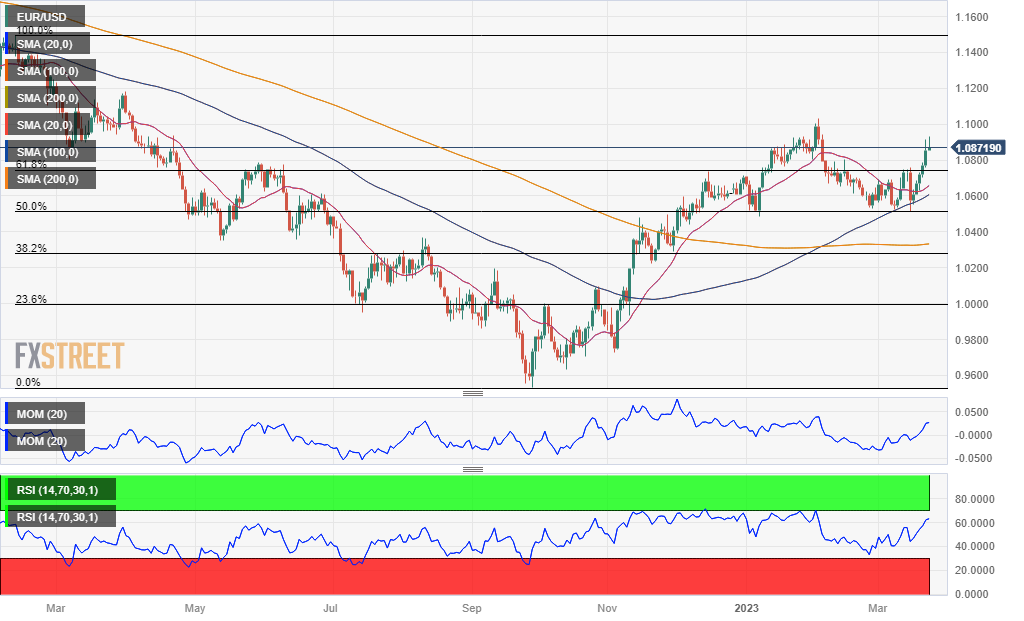
The EUR/USD pair holds near the 1.0900 figure, but sellers continue to reject the price around it. Near-term technical readings suggest the undergoing corrective decline may continue, although there is a long way to go before it can turn bearish. In fact, the pair would need to trespass the 1.0745 level, the 61.8% retracement of its 2022 slump, for that to be the case, which is quite an unlikely scenario with S&P Global indexes.
Near-term support comes at 1.0840, followed by the 1.0800 threshold. Below the latter, the pair can finish the day near the aforementioned Fibonacci level. Renewed buying interest above 1.0900, on the other hand, should result in an approach to the 1.1000 psychological mark before the weekly close.
Author

Valeria Bednarik
FXStreet
Valeria Bednarik was born and lives in Buenos Aires, Argentina. Her passion for math and numbers pushed her into studying economics in her younger years.















