|

Nonfarm Payrolls Preview: Long path to recover to be even longer

  • Hopes for an economic comeback overshadow tepid macroeconomic figures.
  • US employment sector to keep on suffering through the winter.
  • Dollar gains are likely to be temporal and short-lived.

A tumultuous start to 2021 will see the US publishing this Friday its monthly employment report. The December Nonfarm Payroll is expected to show that the country added just 100K new positions in the month, although the unemployment rate is foreseen steady at 6.7%. Average hourly earnings are expected to have grown by a modest 0.2% MoM, while the annual figure is foreseen unchanged at 4.4%.

Noise from the fundamental side

The once first-tier economic release has been losing its power to impact financial markets in the last few years.  Initially, because the sector was steadily healthy, and later, within the pandemic scenario, because the worst-case outcome has been widely anticipated.

These days, markets are getting boosted by vaccine hopes, which speculative interest translates into an economic comeback in the second half of this year. Massive stimulus provided by governments and central banks, also fuel demand for riskier assets in detriment of the greenback.

Meanwhile, political chaos in the US continues. The Senate finally confirmed Joe Biden’s victory, after the Georgia runoff was won by Democrats, which now control both chambers. Current US President Donald Trump keeps claiming the election was fraudulent, although it hasn’t been proved. His supporters stormed Capitol on Wednesday and things got out of control. Nevertheless, financial markets have shown little reaction to the events, and Wall Street kept rallying to all-time highs.

Leading Indicators point to a poor outcome

Market’s expectations are aligned with leading indicators, which anticipate a soft job’s creation in December.  The country added just 245K new positions in November, with the main figure on a downtrend ever since topping at 4.78 million in June.

Initial Jobless Claims are pretty much stable above 800K per week, with some exceptions at the end of the year, amid shortened holidays’ weeks.

Worrisome clues have from consumer-related behavior, as Consumer Confidence indexes remain in retreat mode and well below pre-pandemic levels. The spread of the coronavirus in the US is affecting consumption beyond restrictive measures coming from local authorities.

In regards to the ISM business indexes, the Manufacturing PMI´s employment sub-component bounced back above 50 in December, indicating at least expansion. The employment sub-component within the ISM Services PMI plummeted to 48.2 from 51.5.

The latest Challenger Job Cuts report showed that US-based companies planned cuts by 77,030 in December, after printing 64.8K in the previous month.  The official report shows that “in 2020, 2,304,755 job cuts were announced, 289% higher than the 592,556 cuts announced in 2019.”

US jobs report pre-release checklist – Jan 8th, 2020

Previous Non-Farm PayrollsNegativeThe US economy added 245K jobs in November, nearly just half of expectations and accelerating the downtrend of the post-pandemic labor market recovery.
Challenger Job CutsNegativeThe number of corporate layoffs increased in December, with 77K jobs lost from 64.8K in November. 
Initial Jobless Claims NegativeFirst-time employment claims 4-week average has been on the rise for the last two releases, back above 800K, showing the worsening condition of US job market.
Continuing Jobless Claims PositiveThe downtrend of unemployment-benefit claimants seems relentless, falling below 5.5 million for the first time since COVID-19 halted the economic activity.
ISM Services PMI NegativeThe labor sub-index in the US main service survey decreased back to contraction territory, below 50 levels, the worst figure in the last four months.
ISM Manufacturing PMI PositiveThe employment sub-index in the US main manufacturing survey bounced back to above 50 levels in December, back in expansion territory.
University of Michigan Consumer Confidence Index NegativeThe UMich consumer sentiment survey has remained stuck around the 80 mark since the pandemic struck, way below pre-covid levels.
Conference Board Consumer Confidence Index NegativeThe Conference Board Consumer Confidence Index® registered its third consecutive negative month, back below 90, showing that US consumers are still wary of spending too much.
ADP Employment Report NegativePrivate sector employment printed a dismal 123K loss of jobs in December, hinting at a dismal NFP figure for the same month.
JOLTS Job Openings PositiveHiring recovered in the last JOLTS release (October), although the lagging nature of this indicator makes it less decisive for evaluating NFP. 

Dollar’s possible reaction to different scenarios

The greenback is temporarily strong across the board, but it remains far from bullish as it trades near its recent multi-month lows against most of its major rivals. In the meantime, US indexes keep rallying to record highs, with the DJIA above 31,000 for the first time ever and the S&P trading at around 3,750.

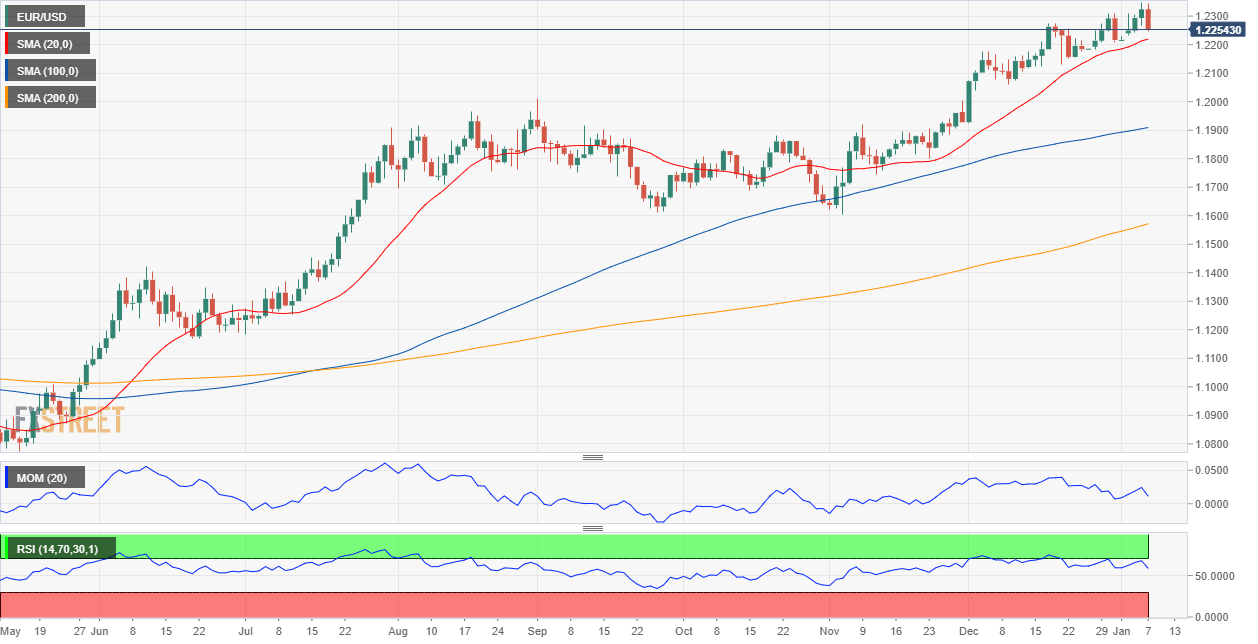
Further dollar’s gains are likely, but only in the near-term. Risk aversion could return if the report comes worst than anticipated, and favour the American currency. Still, the EUR/USD pair holds in its latest comfort zone around 1.2250, and dips will attract buyers.

USD/JPY will likely follow the lead of yields while commodity-linked currencies will move alongside equities. 
Author

Valeria Bednarik

Valeria Bednarik was born and lives in Buenos Aires, Argentina. Her passion for math and numbers pushed her into studying economics in her younger years.


More from Valeria Bednarik
Share:

Editor's Picks

GBP/USD flirts with weekly highs in the Fed's aftermath

GBP/USD reversed early losses following the Federal Reserve decision to keep rates on hold and neared the 1.3360 level before shedding some ground. Focus shifts to Governor Kevin Warsh's speech, while the Bank of England will announce its monetary policy decision on Thursday.

EUR/USD extends rally pass 1.1450 on Fed's Warsh

EUR/USD trades at fresh weekly highs above 1.1450, following the Federal Reserve monetary policy decision to keep interest rates on hold. The statement showed policymakers remain confident in economic progress while blaming inflation on energy prices. The divided vote among officials put in doubt a September hike, leading to sharp US Dollar losses.

Gold  hovers around $4,100 as Fed decision hits the USD

Gold surged following the Federal Reserve's decision to keep the benchmark interest rate unchanged at 3.50%-3.75%. Policymakers noted that inflation remains elevated and that economic activity is expanding at a solid pace despite elevated uncertainty, spurring doubts about a rate hike in September. XAU/USD peaked above $4,100, now battling to retain the level.

No soft target: Warsh vows to return inflation to 2%
The Fed left interest rates unchanged at 3.50%-3.75%, but the decision carried a distinctly hawkish edge as three officials voted for an immediate 25-basis-point increase. Chair Kevin Warsh reinforced that message, insisting there was no tolerance for a softer inflation target and warning that the Fed would not hesitate to act.
How the CLARITY Act unlocks Wall Street’s tokenization pipeline
The United States (US) Digital Asset Market Clarity Act (CLARITY Act), awaiting a full Senate floor vote, promises to unlock Wall Street’s potential to tokenize financial assets, including equities, US Treasuries, private credit, real estate and commodities at a scale that could supercharge the real-world asset (RWA) market from the current $17 billion level to $5.5 trillion by 2030, according to
US Dollar mid-year outlook: Exceptional currency, exceptional risks?
The US Dollar enters the second half of 2026 in a markedly different position from a year ago. The King currency has recovered, reflecting persistent US inflation, changing expectations for Fed policy, geopolitical tensions and renewed demand for defensive assets.