Gold Price Forecast: XAU/USD sees a dead cat bounce, $1849 in sight amid covid, election jitters
- Gold bulls attempt a bounce but not out of the woods yet.
- COVID-19 fears, US election anxiety to keep the US dollar in favor.
- September low of $1849 is in sight along with US macro data.

Following a close below the 100-day moving average (DMA), Gold (XAU/USD) extended its declines into the second straight day on Thursday. The bright metal fell to fresh monthly lows of $1860 before recovering some ground to settle the day near $1868. “Sell everything mode” returned to markets in the first half of the day, as the coronavirus fears dominated and bolstered the haven demand for the US dollar across the board. However, the risk sentiment stabilized in the American session after the US GDP data showed a sharp recovery in the third quarter and helped Wall Street rebound. The greenback continued to draw bids and reached monthly highs above 94.00 vs, its main competitors, underpinned by the US fiscal stimulus impasse, election anxiety and dovish ECB.
So far this Friday’s trading, gold is attempting a tepid bounce, as the US dollar bulls take a breather after the solid upsurge. The market mood remains sour amid risk-off action in the Asian stocks and US equity futures, in light of a mixed bag of earnings reports from top-tier US tech companies failed to impress the investors. With the US reporting record 91K new virus infections and tighter restrictions in the EU, the risk-off flows could intensify going forward and revive the haven bids for the greenback. Therefore, the risks remain skewed to the downside for gold, as the metal is on track for the worst week in over a month.
Gold: Short-tern technical outlook
Daily chart
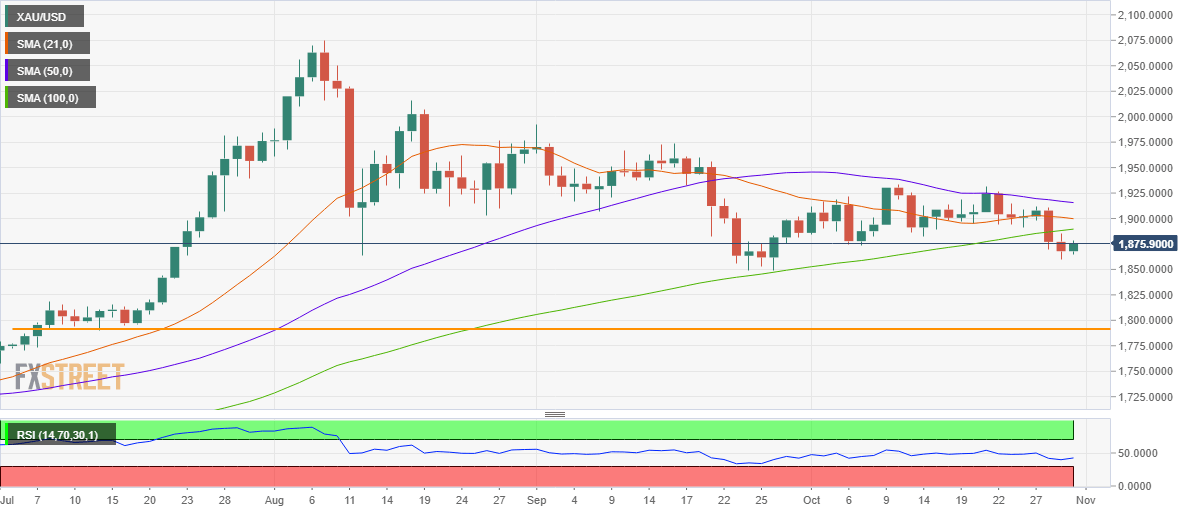
Gold gave a daily closing below the critical 100-DMA, now at $1890, for the second day in a row, convincing investors that the path of least resistance is to the downside.
The 14-day Relative Strength Index (RSI) sees an upturn but remains below the midline, within the bearish region, adding credence to the bearish outlook.
Therefore, the next stop for the bears is seen at $1849, the September month low. Acceptance below the latter could trigger a fresh sell-off towards the horizontal trendline (orange) support at $1791.
Alternatively, recapturing the 100-DMA barrier on a daily closing basis is critical to easing off the selling pressure in the near-term.
Author

Dhwani Mehta
FXStreet
Residing in Mumbai (India), Dhwani is a Senior Analyst and Manager of the Asian session at FXStreet. She has over 10 years of experience in analyzing and covering the global financial markets, with specialization in Forex and commodities markets.
















