Gold Price Forecast: XAU/USD rebound could extend on weak US ADP jobs data
- Gold price is licking its wounds near $2,020 amid a broad retreat in the US Dollar.
- Gold price uptick appears capped by positive US Treasury bond yields.
- Gold price awaits US ADP jobs data for a fresh boost, as technical stay supportive.

Gold price is making a minor recovery attempt near $2,020 early Wednesday, replicating the move seen in Tuesday’s Asian trading. Risk sentiment appears to be in a tepid spot, underpinning the Gold price alongside a pause in the US Dollar upswing.
Gold price looks to US ADP jobs report
The US Dollar has stalled its two back-to-back days of recovery even though markets have turned cautious after Moody’s Investors Service downgraded its outlook on China’s government credit ratings to negative from stable. The rating agency, however, retained China’s “A1” long-term rating on the country’s sovereign bonds.
Also, uncertainty surrounding the US Federal Reserve (Fed) interest rate outlook tempers investors’ sentiment, especially after a mixed set of US economic data released on Tuesday.
The latest data from the Institute for Supply Management (ISM) showed that the Services PMI registered 52.7 in November, firming up from October's reading of 51.8. However, US JOLTS Job Openings slid to more than a 2-1/2-year low of 8.733 million in October, suggesting that labor market conditions are loosening further.
Markets continue pricing about 60% odds of a Fed rate cut in March but investors await Wednesday’s US ADP Employment Change data for placing fresh bets on the US Dollar and Gold price. The ADP is likely to show that the American private sector added 130K jobs in November, up from 113K jobs addition seen in October.
A smaller-than-expected increase in the US ADP jobs data could bolster dovish Fed bets, fuelling further downside in the US Dollar. In such a case, Gold price could extend its renewed upside toward $2,050. On the contrary, a souring risk sentiment and strong US jobs report could offer additional support to the ongoing US Dollar recovery, offering a fresh leg lower in Gold price.
Gold price technical analysis: Daily chart
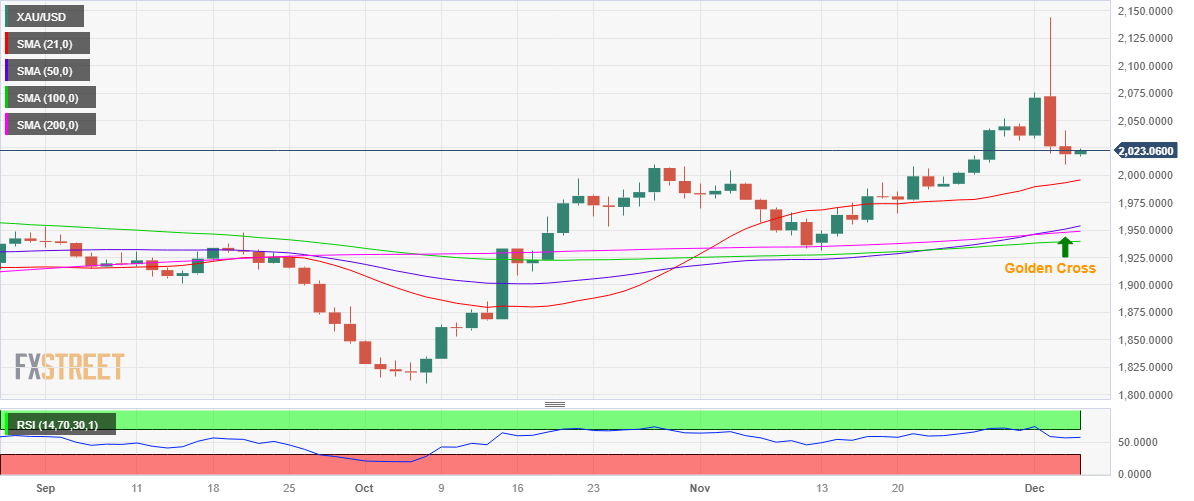
Nothing seems to change for Gold price technically in the near term, as its bullish bias is likely to remain in place.
The 14-day Relative Strength Index (RSI) indicator is inching higher above the midline, justifying the bounce in Gold price.
Further, the Golden Cross, as represented by the 50-day Simple Moving Average (SMA) and the 200-day SMA bullish crossover, remains in play.
Gold buyers need to find acceptance above the $2,050 psychological barrier on a daily closing basis to resume the uptrend toward the intial hurdle at $2,100. A sustained move above the latter will challenge all-time-highs of $2,144 once again.
On the flip side, the immediate support is seen at the $2,000 threshold should the Gold price correction regain traction.
The 21-day SMA at $1,995 wil then come to the rescue of Gold buyers. The last line of defense for Gold buyers is seen at the $1,990 round figure.
Gold FAQs
Why do people invest in Gold?
Gold has played a key role in human’s history as it has been widely used as a store of value and medium of exchange. Currently, apart from its shine and usage for jewelry, the precious metal is widely seen as a safe-haven asset, meaning that it is considered a good investment during turbulent times. Gold is also widely seen as a hedge against inflation and against depreciating currencies as it doesn’t rely on any specific issuer or government.
Who buys the most Gold?
Central banks are the biggest Gold holders. In their aim to support their currencies in turbulent times, central banks tend to diversify their reserves and buy Gold to improve the perceived strength of the economy and the currency. High Gold reserves can be a source of trust for a country’s solvency. Central banks added 1,136 tonnes of Gold worth around $70 billion to their reserves in 2022, according to data from the World Gold Council. This is the highest yearly purchase since records began. Central banks from emerging economies such as China, India and Turkey are quickly increasing their Gold reserves.
How is Gold correlated with other assets?
Gold has an inverse correlation with the US Dollar and US Treasuries, which are both major reserve and safe-haven assets. When the Dollar depreciates, Gold tends to rise, enabling investors and central banks to diversify their assets in turbulent times. Gold is also inversely correlated with risk assets. A rally in the stock market tends to weaken Gold price, while sell-offs in riskier markets tend to favor the precious metal.
What does the price of Gold depend on?
The price can move due to a wide range of factors. Geopolitical instability or fears of a deep recession can quickly make Gold price escalate due to its safe-haven status. As a yield-less asset, Gold tends to rise with lower interest rates, while higher cost of money usually weighs down on the yellow metal. Still, most moves depend on how the US Dollar (USD) behaves as the asset is priced in dollars (XAU/USD). A strong Dollar tends to keep the price of Gold controlled, whereas a weaker Dollar is likely to push Gold prices up.
Author

Dhwani Mehta
FXStreet
Residing in Mumbai (India), Dhwani is a Senior Analyst and Manager of the Asian session at FXStreet. She has over 10 years of experience in analyzing and covering the global financial markets, with specialization in Forex and commodities markets.