GBP/USD Price Forecast: Bears have the upper hand amid BoE rate cut bets
- GBP/USD attracts fresh sellers on Thursday amid divergent BoE-Fed policy expectations.
- The mixed UK macro data fails to impress the GBP bulls or lend support to spot prices.
- Traders now look forward to the US Retail Sales and Jobless Claims for a fresh impetus.

The GBP/USD pair extends the previous day's retracement slide from the 1.2300 mark and attracts some follow-through selling on Thursday. Spot prices stick to intraday negative bias through the first half of the European session and fail to gain any respite from the mixed UK macro data. The UK Office of National Statistics reported that the economy grew at a lackluster pace of 0.1% in November following a decline of 0.1% in the previous month. The reading, however, missed estimates for a 0.2% growth, while the UK Industrial and Manufacturing Production fell more than expected, by 0.4% and 0.3%, respectively, in November.
This comes on top of Wednesday's release of a cooler-than-expected UK annual inflation print for December lifted bets for a 25-basis-points rate cut by the Bank of England (BoE) at the next policy meeting on February 6. Apart from this, the emergence of some US Dollar (USD) dip-buying, bolstered by the growing acceptance that the Federal Reserve (Fed) will pause its rate-cutting cycle later this month, further exerts pressure on the GBP/USD pair. That said, the US Consumer Price Index (CPI) released on Wednesday increased the chances that the Federal Reserve could cut interest rates twice this year and might cap the USD.
Data published by the US Bureau of Labor Statistics (BLS) showed that the headline CPI rose 0.4% in December and the yearly rate accelerated to 2.9% from 2.7% in the previous month. The core gauge, which excludes volatile food and energy prices, rose 3.2% on a yearly basis as compared to the 3.3% increase recorded in November and expectations. This, along with softer-than-expected US producer prices, pointed to signs of abating inflationary pressures in the US and triggered a sharp decline in the US Treasury bond yields. Apart from this, the risk-on mood dragged the safe-haven USD to a one-week low on Wednesday.
Moving ahead, traders now look forward to the US economic docket – featuring the release of monthly Retail Sales figures, the usual Weekly Initial Jobless Claims and the Philly Fed Manufacturing Index later during the North American session. This, along with speeches by influential FOMC members and the US bond yields, might influence the USD price dynamics and provide some impetus to the GBP/USD pair. The sentiment surrounding the British Pound (GBP), however, remains fragile amid concerns about the UK’s fiscal situation. This, in turn, suggests that the path of least resistance for spot prices remains to the downside and any meaningful recovery attempt might still be seen as an opportunity for bearish traders.
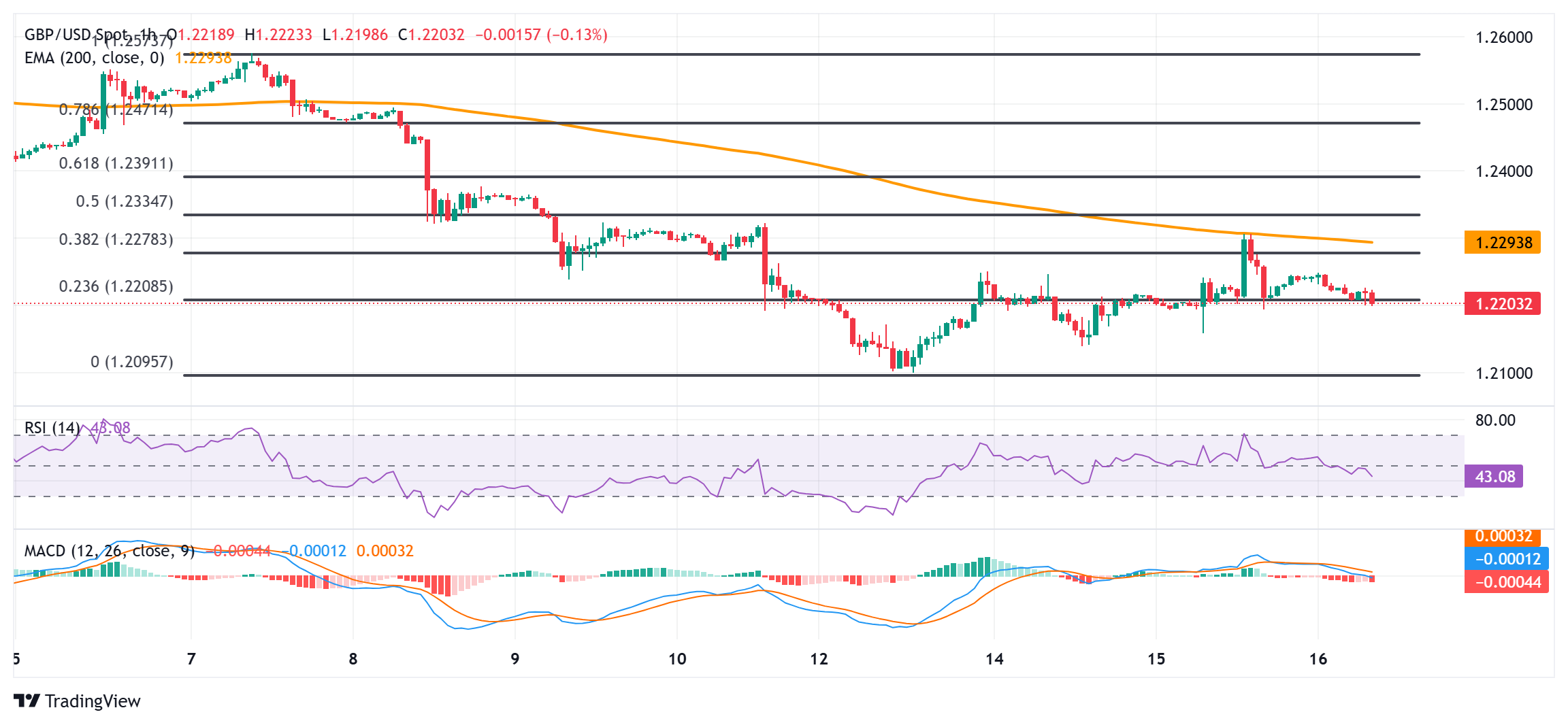
GBP/USD 1-hour chart
Technical Outlook
From a technical perspective, the overnight failure near the 200-hour Exponential Moving Average (EMA) and the subsequent slide favors bearish traders. That said, the Relative Strength Index (RSI) on the daily chart remains close to oversold territory and supports prospects for an extension of the weekly consolidative price move.
In the meantime, the 1.2240 region now seems to act as an immediate hurdle ahead of the 1.2280 area (38.2% Fibonacci retracement level of the downfall from the monthly peak), the 1.2300 mark and the 1.2335 region (50% Fibo. level). A convincing breakout through the mentioned barriers might shift the bias in favor of bullish traders and pave the way for additional gains.
On the flip side, weakness back below the 1.2200 round figure could find some support near the 1.2150-1.2140 area. Some follow-through selling, however, might expose the 1.2100 mark, or over a one-year low touched on Monday. A sustained break below the latter will be seen as a fresh trigger for bearish traders and pave the way for an extension of the GBP/USD pair’s nearly four-month-old downtrend.
Author

Haresh Menghani
FXStreet
Haresh Menghani is a detail-oriented professional with 10+ years of extensive experience in analysing the global financial markets.