GBP/USD Forecast: Ready for a rout as UK recession fears grow
- GBP/USD has been consolidating its losses amid a US holiday.
- Concerns about Brexit and global trade weigh on the pound.
- Thursday's four-hour chart points to additional falls for the currency pair.

Brexit may have already tipped the UK to the verge of a recession – while Britain is still in the EU. The third and final forward-looking purchasing managers' index from Markit/CIPS has shown that the services sector is stagnating. The score of 50.1 points is minimally above the 50-point threshold separating expansion from contraction. The previous releases for the manufacturing and construction sectors are contracting.
The series of devastating data points has weighed on the pound, with GBP/USD trading at the lowest since mid-June. Cable is under pressure despite downbeat figures from the other side of the Atlantic as well. The US private sector has gained only 102K in June according to ADP – America's largest payrolls provider. ISM's services PMI has dropped to 55.1 points last month, indicating a slowdown.
The greenback has shrugged off the data due to two reasons. First, markets are awaiting the all-important official jobs report – Non-Farm Payrolls – to react. It is due on Friday. The second reason is the US Independence Day holiday that constrains traders to limited ranges.
Back in the UK, the Conservative Party's leadership contest continues. Outgoing PM Theresa May will visit Scotland today and is set to stress the integrity of the Union between the UK's four nations. Her words are seen as a jab at Boris Johnson which is keen on leaving the EU even without a deal – a move that may revive the Scottish National Party's independence bid. Some speculate that May, as a backbencher, may vote against a hard Brexit.
Overall, politics are due to set the tone as the economic calendar is devoid of events.
GBP/USD Technical Analysis
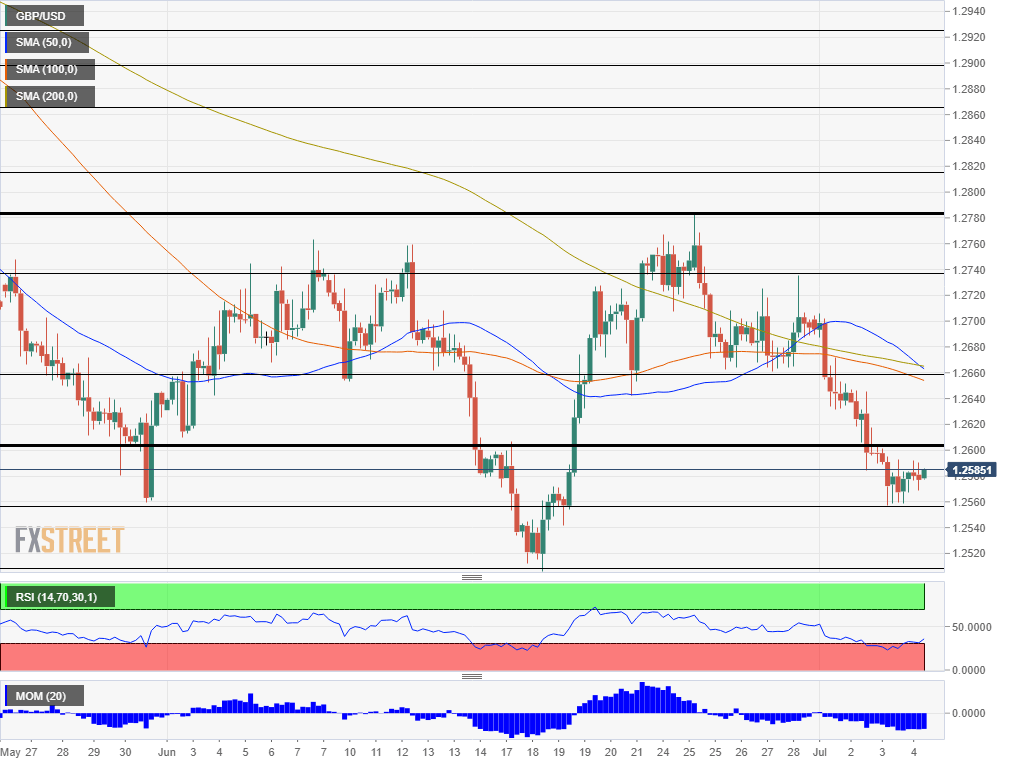
The Relative Strength Index on the four-hour chart has topped 30 – exiting oversold conditions – and indicating further falls. Momentum remains to the downside and GBP/USD continues trading below the 50, 100, and 200 Simple Moving Averages.
Support awaits at 1.2558 which was the low point on Wednesday and also May's trough. Further down, 1.2505 is June's low and the lowest since January. The next lines are 1.2475 and 1.2445.
Pound/dollar faces resistance at 1.2605 which has capped it in mid-June and served as support beforehand. The next line to watch is 1.2660 that provided support in late June, and 1.2740 which was a swing high around the same time. 1.2780 is next.
Author

Yohay Elam
FXStreet
Yohay is in Forex since 2008 when he founded Forex Crunch, a blog crafted in his free time that turned into a fully-fledged currency website later sold to Finixio.
















