Federal Reserve Beige Book Preview: Back to the future in March
- Survey of the US economy prepared for the April 28-29 meeting.
- No rate changes expected at next FOMC meeting and for the next year.
- The sources that informed the Fed’s March 3 and March 15 decision are many of the same that staff the Beige Book Surveys.

The six weeks between the emergency Fed meeting on March 15 and the scheduled April Federal Reserve Open Market Committee (FOMC) will be remembered as some of the most eventful in the economic history of the United States, comparable to the financial crash of 2008 and the terrorist attacks of 2001.
Beige Book
Beige Book Surveys are anecdotal assessments of the state of the US economy gathered by the regional Federal Reserve banks and designed to supplement the statistical picture provided by the various government and private sources.
One of its chief purposes is to give an economic view as close to the FOMC meeting as possible. Many of the statistics that cover the period between the committee’s deliberations are not available until after the governors reach their decision.
The March emergency meetings
In last month’s case the Fed’s rate, quantitative easing and loan decisions were based in an economic situation that developed so suddenly as to preclude all prior statistical documentation.
When the Fed cut the fed funds upper target rate from 1.25% to 0.25% and opened a $700 billion bond purchase program on March 15, the most recent jobless claims number was 211,000 for the week of March 6 reported on March 12. The enormous layoffs were still almost two weeks in the future beginning with 3.283 million on March 26.
Fed Funds Upper Target Rate
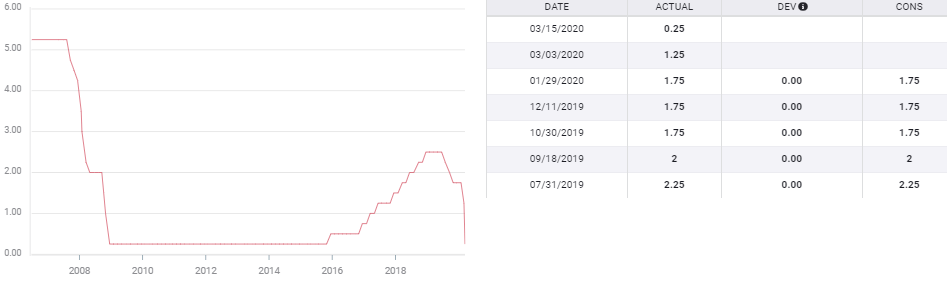
The scheduled March 4 Beige Book chronicling the economic situation since the prior FOMC meeting on January 28-29 had been completely superseded by events.
In making its momentous choices the governors were partially relying on the same type of anecdotal information that informs the Beige Book survey. The Fed has a large network of sources around the country that it utilizes in a somewhat formal manner for the survey and in a much more informal way when it requires immediate information and judgement.
Federal Reserve District Assessments
It is assumed that all 12 Federal Reserve districts will report declining economic activity and large employment losses. The judgement will add color to the economic picture which, except for initial claims and the preliminary Michigan consumer sentiment number, is still largely extrapolating from March figures for the complete impact in April.
Conclusion and the dollar
This Beige Book is in the unusual position of elucidating the past rather than the future. It covers the economic situation that provided the rational for the two emergency March decisions, choices that in less dire circumstances might still be pending. The Fed’s actions were justified in part by what it was hearing from its Beige Book sources and those anecdotes should fill this issue.
The Beige Book is never an event for the currency markets, its information does not lend itself to specific policy interpretations or trading decisions. But as economic and human drama it will be interesting to know some of what the governors were hearing from their sources unfiltered by the American media.
Author

Joseph Trevisani
FXStreet
Joseph Trevisani began his thirty-year career in the financial markets at Credit Suisse in New York and Singapore where he worked for 12 years as an interbank currency trader and trading desk manager.