EUR/USD Weekly Forecast: Eyes turn to Fed amid heating inflation
- The ECB, optimistic but cautious, upwardly revised its growth and inflation forecasts.
- US inflation rose in May at its fastest pace in almost 13 years.
- EUR/USD has turned bearish in its daily chart, could test the critical 1.2000 level.

The EUR/USD pair trades at fresh monthly lows around the 1.2100 level and with increased bearish potential. Investors read past upwardly revised US inflation figures, which hit 5% YoY in May, accelerating at the fastest pace since 2008. The US Federal Reserve will have a monetary policy meeting next week, and the assessment of record inflation would be critical for the dollar’s direction.
What’s going on?
FX volumes are at their lowest in over a year. After peaking in March 2020, when the pandemic took its toll on global markets, the focus was put on the economic comeback. Over one year later, optimism returned. There are signs of robust growth among the developed economies, although the recovery is uneven. Low and middle-income countries are still on the back foot. And while vaccines against COVID-19 have brought some relief, the pandemic is far from over. New strains, delays in immunization and even anti-vaxxers pose a risk to it.
Besides, it is taking too long. The WHO initially estimated 18 months to the end of the pandemic. At this point, the world is in a transition toward normalcy, with the northern hemisphere better shaped to complete the process in the second half of the year.
The general optimism tends to back demand for high-yielding assets to the detriment of the greenback. At the same time, the US seems to be one step forward compared with its counterparts in the return to some sort of normal. This particular lockdown will only be broken by central banks. The first to scale back financial support will be the one to give a boost to its local currency.
Meanwhile, speculative interest continues to struggle on whether to buy the greenback on self strength or sell it to the benefit of higher-yielding currencies.
ECB down, Fed to go
The European Central Bank announced its latest decision on monetary policy on Thursday, and as widely anticipated, policymakers left rates and assistance programs unchanged. President Christine Lagarde was utterly cautious over the persistent risks and said that the ultra-loose monetary policy would remain in place to avoid spikes in borrowing costs that may delay the recovery. At the same time, the central bank upwardly revised its growth and inflation forecasts for this year and the next ones.
On June 16, the US Federal Reserve will announce its monetary policy decision. The American central bank is widely anticipated to maintain its current policy unchanged, despite the sharp rise in consumer prices. Fed officers have repeated ad exhaustion that heating inflation would likely be transitory amid resurgent demand and supply chain lags. As usual, it takes more than a swallow to make a summer. The Fed could become worried about inflation if it does not recede from the latest level in the upcoming months. Nevertheless, tapering talks would have to wait.
Fluctuating macroeconomic data
German data published in the last few days was mixed, reflecting what was said earlier. Developed countries are on their way to recovery but not there yet. Industrial Production in the country contracted 1% MoM in April, while Factory Orders were down 0.2%, although the annual readings beat expectations. The ZEW Survey showed that Economic Sentiment was down to 79.8 in June, while the seasonally adjusted Trade Balance posted a surplus of €15.9 billion.
In the EU, the June Sentix Investor Confidence printed at 28.1, while the Q1 Gross Domestic Product was upwardly revised to -0.3% QoQ, both better than anticipated. The US published the April Goods Trade Balance, which posted a deficit of $ 68.9 billion, better than anticipated. Initial Jobless Claims for the week ended June 4 came in at 376K, improving from the previous 428K but above expectations. On Friday, the country released the preliminary estimate of the June Michigan Consumer Sentiment Index, which improved by more than anticipated, hitting 86.4.
Beyond the Fed, the macroeconomic calendar includes other relevant macroeconomic figures such as the May German Consumer Price Index and US May Retail Sales. The European Union will publish its May inflation figures.

EUR/USD technical outlook
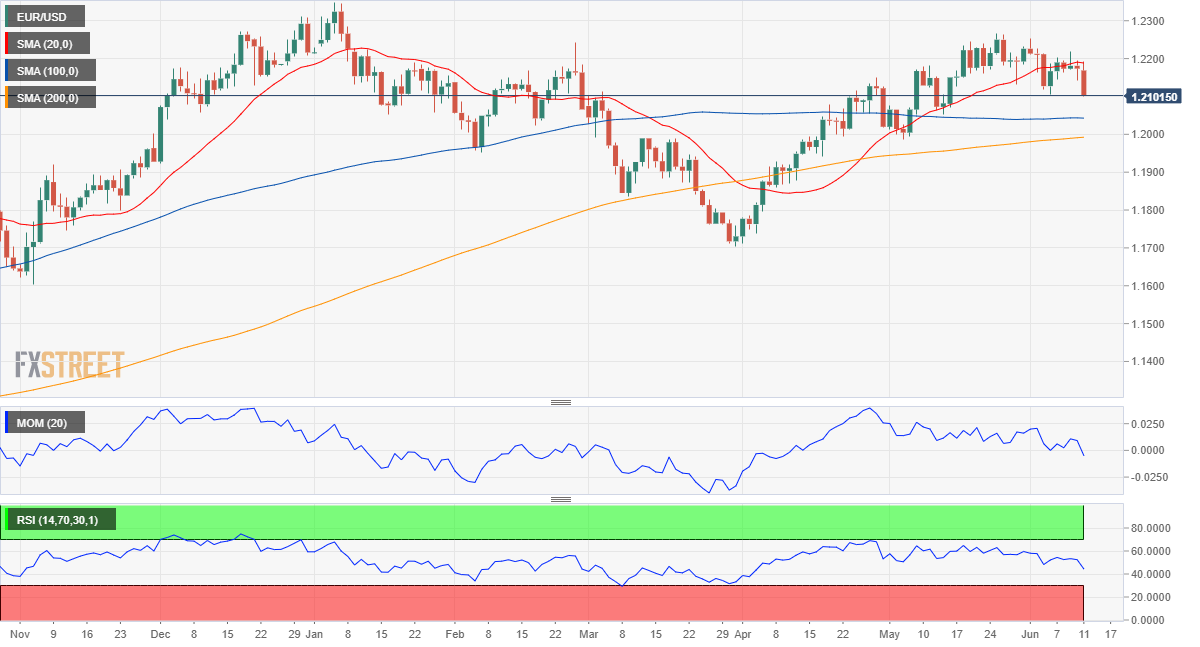
The EUR/USD pair has been confined to a tight range this past week, posting modest losses and trading near the monthly low around the 1.2100 figure, which skews the risk to the downside. The weekly chart shows that technical indicators remain within positive levels but have lost their positive momentum. Meanwhile, the pair keeps developing above all of its moving averages, with the 20 SMA currently providing dynamic support at 1.2040.
In the daily chart, the pair is clearly bearish. The pair broke below its 20 SMA, accelerating its slump after several failed attempts to cross above it. Technical indicators head firmly lower within negative levels, reflecting increased selling interest.
Sellers are aligned around 1.2200, where the mentioned daily 20 SMA rests. A clear break below the 1.2100 figure should open the door to test the psychological 1.2000 threshold next week. A slide below the latter could be triggered by a hawkish Fed, with the next possible bearish target at 1.1940. Above 1.2200, the pair has its next resistance level at 1.2245, en route to the 1.2300 price zone.
EUR/USD sentiment poll
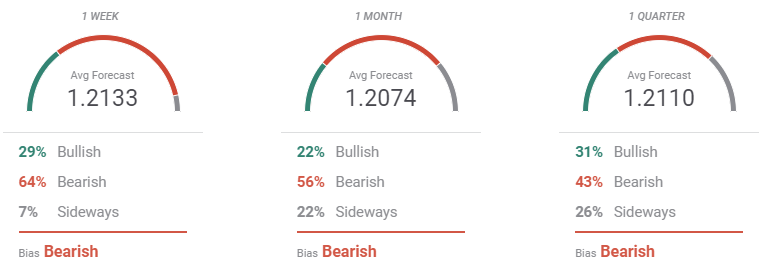
Bears took over EUR/USD, according to the FXStreet Forecast Poll. The pair is seen on the downside in the three time-frame under study, although bearish interest decreases as time goes by. The number of those waiting for a slide on a weekly basis stands at 64% and slides to 43% in the quarterly view. Worth noting that bulls are around or below 30% in all cases.
The Overview chart shows that the moving averages are neutral-to-bearish with the number of possible targets below the current level increasing slightly in the weekly and monthly views. In the longer-term perspective, however, most targets accumulate between 1.21 and 1.24 suggesting a sustained dollar’s advance is still unclear.
Related Forecasts:
USD/JPY Weekly Forecast: Fed timing is everything
GBP/USD Weekly Forecast: Sterling's time to shine? UK data, Fed may put fuel to fire
Author

Valeria Bednarik
FXStreet
Valeria Bednarik was born and lives in Buenos Aires, Argentina. Her passion for math and numbers pushed her into studying economics in her younger years.