EUR/USD Weekly Forecast: Sellers looking at European PMIs for confirmation
- The European Central Bank trimmed interest rates as expected and delivered a dovish message.
- Upbeat United States macroeconomic figures and a dismal mood supported the US Dollar.
- EUR/USD bearish case becoming firmer in the long term, though a corrective advance is not out of the table.

The EUR/USD pair bottomed at 1.0810 on Thursday, its lowest since early August, closing for the third straight week in the red a handful of pips above the level. On the one hand, the US Dollar (USD) benefited from a risk-averse environment and upbeat United States (US) macroeconomic data. On the other, the Euro (EUR) suffered from a dovish European Central Bank (ECB) monetary policy announcement and renewed fears of an economic setback in the Eurozone.
United States solid growth
Market participants continued to reduce bets on aggressive Federal Reserve (Fed) interest rate cuts amid data showing economic progress in the world’s largest economy, particularly after the country reported that Retail Sales rose 0.4% mont-on-month (MoM) in September and that weekly Initial Jobless Claims rose by 241K, less than the 260K anticipated, in the week ended October 11. Investors were expecting a larger increase amid the hurricane that hit the country last week. Finally, the Philadelphia Fed Manufacturing Survey unexpectedly jumped to 10.3 in October from 1.7 in September. The combo of economic indicators published on Thursday backed the USD.
Anyway, it would be fair to add that a dismal market mood also helped the Greenback. Geopolitical tensions in the Middle East and fears of an escalation pushed speculative interest into safety. The upcoming US elections also fuel demand for safe-haven assets, as polls show no clear leader.
At the end of the day, the USD strengthened amid diminished concerns of a potential soft landing. A recession was out of the picture long ago.
Eurozone and the European Central Bank
In Europe, the focus was on the European Central Bank’s monetary policy decision. ECB officials trimmed the three benchmark rates by 25 basis points (bps) each. The Rate on the Deposit Facility then stands now at 3.25%. The announcement was widely anticipated and triggered no reaction on EUR/USD.
However, the accompanying statement and comments from ECB President Christine Lagarde were tilted to dovish, sending the Euro to fresh multi-week lows against its major rivals. Policymakers repeated that decisions will continue to follow a data-dependent and meeting-by-meeting approach, which is nothing new.
Yet, at the same time, policymakers expressed concerns about inflation and growth. “Incoming data suggest that activity is weaker than expected,” Lagarde noted. Regarding inflation, officials gave no importance to the Harmonized Index of Consumer Prices (HICP), which rose at an annual pace of 1.7% in the Eurozone in September, below the central bank’s 2% goal. On the contrary, policymakers still see risks on both sides of the inflation forecast and expect it to rise again before falling back toward 2% in 2025. “Domestic inflation remains high, as wages are still rising at an elevated pace,” the statement noted.
What’s next in the docket
The upcoming week will bring some relevant figures. The Hamburg Commercial Bank (HBOC) will release the preliminary estimates of the October Purchasing Manager Indexes (PMIs), while S&P Global will publish the same data for the US, all of which are scheduled for Thursday.
ECB President Christine Lagarde referred to soft PMIs figures a couple of times in the press conference that followed the monetary policy decision, clearly highlighting concerns about growth and giving the upcoming data more relevance.
The US will publish data on September Durable Goods Orders and the final estimate of the October Michigan Consumer Sentiment Index on Friday.
Other than that, ECB President Christine Lagarde will make multiple public appearances throughout the first half of the week, and comments on monetary policy may affect the Euro. Across the Atlantic, different Fed officials will participate in different events and may also provide hints on what’s next for the US central bank.

EUR/USD technical outlook
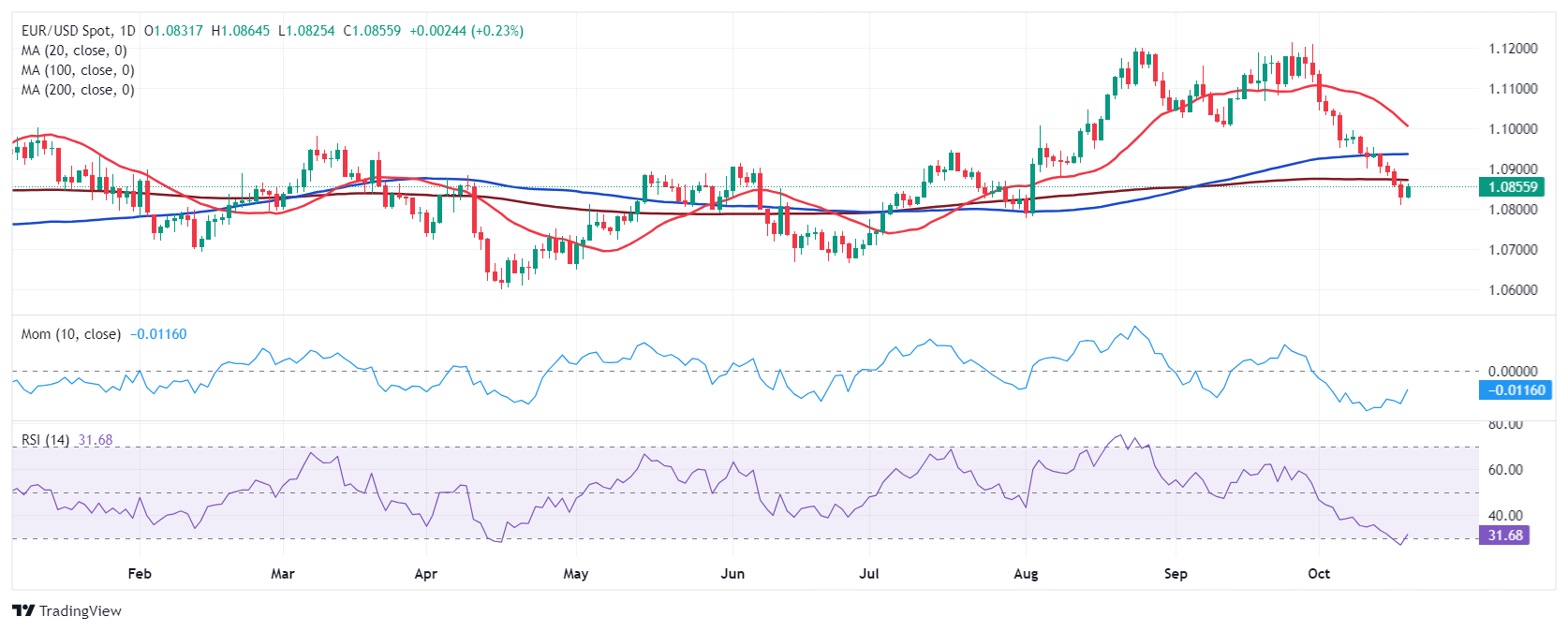
The EUR/USD pair hovers around 1.0850, and technical readings in the weekly chart show it is on the brink of entering a more sustained bearish spiral. EUR/USD found sellers around a flat 20 Simple Moving Average (SMA), while a mildly bullish 100 SMA provided support at around 1.0810. The 200 SMA, in the meantime, gains downward traction above the shorter ones. At the same time, technical indicators offer firmly bearish downward slopes, crossing their midlines into negative territory and reflecting persistent selling interest.
The daily chart shows that EUR/USD may correct higher in the next few sessions. Technical indicators are bouncing from oversold readings, albeit the upward momentum is limited. At the same time, the pair is developing below all its moving averages, with a firmly bearish 20 SMA gaining downward traction above directionless 100 and 200 SMAs. The latter offers near-term resistance at around 1.0900.
Further up, the corrective advance may meet sellers around the 1.0900 mark, although clear gains beyond it expose the 1.1000 figure. Gains beyond the latter seem unlikely in the current bearish scenario.
A break below 1.0810, on the other hand, could see the pair quickly reaching the 1.0770 area, where EUR/USD bottomed in August. Further selling pressure could result in a test of the 1.0700-1.0720 price zone.
Economic Indicator
HCOB Manufacturing PMI
The Manufacturing Purchasing Managers Index (PMI), released on a monthly basis by S&P Global and Hamburg Commercial Bank (HCOB), is a leading indicator gauging business activity in the Eurozone manufacturing sector. The data is derived from surveys of senior executives at private-sector companies from the manufacturing sector. Survey responses reflect the change, if any, in the current month compared to the previous month and can anticipate changing trends in official data series such as Gross Domestic Product (GDP), industrial production, employment and inflation. The index varies between 0 and 100, with levels of 50.0 signaling no change over the previous month. A reading above 50 indicates that the manufacturing economy is generally expanding, a bullish sign for the Euro (EUR). Meanwhile, a reading below 50 signals that activity among goods producers is generally declining, which is seen as bearish for EUR.
Read more.Next release: Thu Oct 24, 2024 08:00 (Prel)
Frequency: Monthly
Consensus: 45.1
Previous: 45
Source: S&P Global
Economic Indicator
HCOB Composite PMI
The Composite Purchasing Managers’ Index (PMI), released on a monthly basis by S&P Global and Hamburg Commercial Bank (HCOB), is a leading indicator gauging private-business activity in the Eurozone for both the manufacturing and services sectors. The data is derived from surveys to senior executives. Each response is weighted according to the size of the company and its contribution to total manufacturing or services output accounted for by the sub-sector to which that company belongs. Survey responses reflect the change, if any, in the current month compared to the previous month and can anticipate changing trends in official data series such as Gross Domestic Product (GDP), industrial production, employment and inflation. The index varies between 0 and 100, with levels of 50.0 signaling no change over the previous month. A reading above 50 indicates that the private economy is generally expanding, a bullish sign for the Euro (EUR). Meanwhile, a reading below 50 signals that activity is generally declining, which is seen as bearish for EUR.
Read more.Next release: Thu Oct 24, 2024 08:00 (Prel)
Frequency: Monthly
Consensus: 49.7
Previous: 49.6
Source: S&P Global
Euro PRICE This week
The table below shows the percentage change of Euro (EUR) against listed major currencies this week. Euro was the weakest against the US Dollar.
| USD | EUR | GBP | JPY | CAD | AUD | NZD | CHF | |
|---|---|---|---|---|---|---|---|---|
| USD | 0.72% | 0.23% | 0.28% | 0.26% | 0.68% | 0.63% | 0.97% | |
| EUR | -0.72% | -0.56% | -0.54% | -0.37% | -0.02% | -0.18% | 0.16% | |
| GBP | -0.23% | 0.56% | 0.00% | 0.05% | 0.57% | 0.41% | 0.70% | |
| JPY | -0.28% | 0.54% | 0.00% | -0.01% | 0.42% | 0.41% | 0.69% | |
| CAD | -0.26% | 0.37% | -0.05% | 0.01% | 0.36% | 0.39% | 0.53% | |
| AUD | -0.68% | 0.02% | -0.57% | -0.42% | -0.36% | -0.03% | 0.28% | |
| NZD | -0.63% | 0.18% | -0.41% | -0.41% | -0.39% | 0.03% | 0.27% | |
| CHF | -0.97% | -0.16% | -0.70% | -0.69% | -0.53% | -0.28% | -0.27% |
The heat map shows percentage changes of major currencies against each other. The base currency is picked from the left column, while the quote currency is picked from the top row. For example, if you pick the Euro from the left column and move along the horizontal line to the US Dollar, the percentage change displayed in the box will represent EUR (base)/USD (quote).
Author

Valeria Bednarik
FXStreet
Valeria Bednarik was born and lives in Buenos Aires, Argentina. Her passion for math and numbers pushed her into studying economics in her younger years.