EUR/USD Weekly Forecast: Defying gravity near 1.0650 ahead of Fed’s decision
- United States inflation-related figures were higher than anticipated in August.
- The European Central Bank delivered a dovish hike, fueling risk of a recession.
- EUR/USD fell to its lowest since March and has room to extend the slump.

The EUR/USD pair ends an intense week trading near a weekly bottom of 1.0632, its lowest since last March. The Euro advanced throughout the first half week amid a better mood spurred by Asian news.
On the one hand, Bank of Japan (BoJ) Governor Kazuo Ueda hinted at a shift in the ultra-loose monetary policy. “The BoJ could have enough data by year-end to determine whether it can end negative rates,” Ueda noted, adding they will focus now on a “quiet exit.” On the other, China’s inflation picked up modestly in August, following a negative reading in July. Chinese Consumer Price Index (CPI) rose 0.3% MoM and 0.1% YoY. At the same time, mortgage demand and corporate loans surged, suggesting the country could be turning the corner. The news put pressure on the US Dollar, with financial markets optimistic but cautious ahead of first-tier events.
Hotter US inflation
Things changed on Wednesday when the United States (US) released the August CPI, as inflation was slightly higher than anticipated. The annual inflation rate ticked higher from 3.6% in July to 3.7%. In the month, inflation was 0.6%, as expected, while the core annual figure also matched expectations at 4.3%. The numbers boosted the USD despite being hotter than previous numbers, as market players considered they were not enough to twist the Federal Reserve's (Fed) dovish path.
On Thursday, the US published the Producer Price Index (PPI), which increased by 0.7% MoM and 1.6% YoY from 0.4% and 0.8%, respectively, alongside Retail Sales, up 0.6% in August and much better than anticipated. Once again, the data confirmed the American economy remains resilient, while price pressures did not vary enough to become worrisome.
Dovish hike from the ECB
On Thursday, the European Central Bank (ECB) decided to go forward with hikes and lifted rates by 25 basis points (bps), taking the Deposit Facility Rate to a record 4.0%. The announcement was, however, seen as dovish, as President Christine Lagarde and co hinted at a potential peak.
“Based on its current assessment, the Governing Council considers that the key ECB interest rates have reached levels that, maintained for a sufficiently long duration, will make a substantial contribution to the timely return of inflation to the target,” the accompanying statement read. Additionally, Lagarde said that the focus will probably move to the duration of higher rates rather than to the level of rates themselves.
The news hit hard the Euro, as the Euro Zone already suffers from stagnation, that is, little to no economic growth. Coupled with stubbornly high inflation, the future looks gloomy, particularly for the less powerful south, including countries such as Portugal, Spain and Italy.
Italian Deputy Prime Minister and League Leader Matteo Salvini accused President Lagarde of living “on Mars,” blaming the ECB for caring about the economic difficulties of families and businesses.
Sentiment upbeat at the end of the week
Speculative interest recovered its optimism by the end of the week, despite Fitch Ratings cutting Chinese growth forecast to 4.8% for 2023 while lifting global economic growth. The better mood could partially be explained by upbeat data, as China published August Industrial Production and Retail Sales, up 4.5% and 4.6% respectively, and much better than anticipated.
Meanwhile, US data also resulted better than expected. August Capacity Utilization increased to 79.7% from 79.5% in July, while Industrial Production rose 0.4% vs expectations of a 0.1% advance. On a down note, the preliminary estimate of the Michigan Consumer Sentiment Index printed at 67.7 in September, down from 69.5 in August.
Federal Reserve decision takes centre stage
Financial markets gear up for the US Fed monetary policy announcement next Wednesday. The central bank is widely anticipated to remain on hold. According to the CME WatchTool, the odds for a no-change stand at 97% ahead of the event. At the same time, the chance for a 25 bps hike in November currently stands at 34.4%. Investors believe there is a chance for a final hike before year-end.
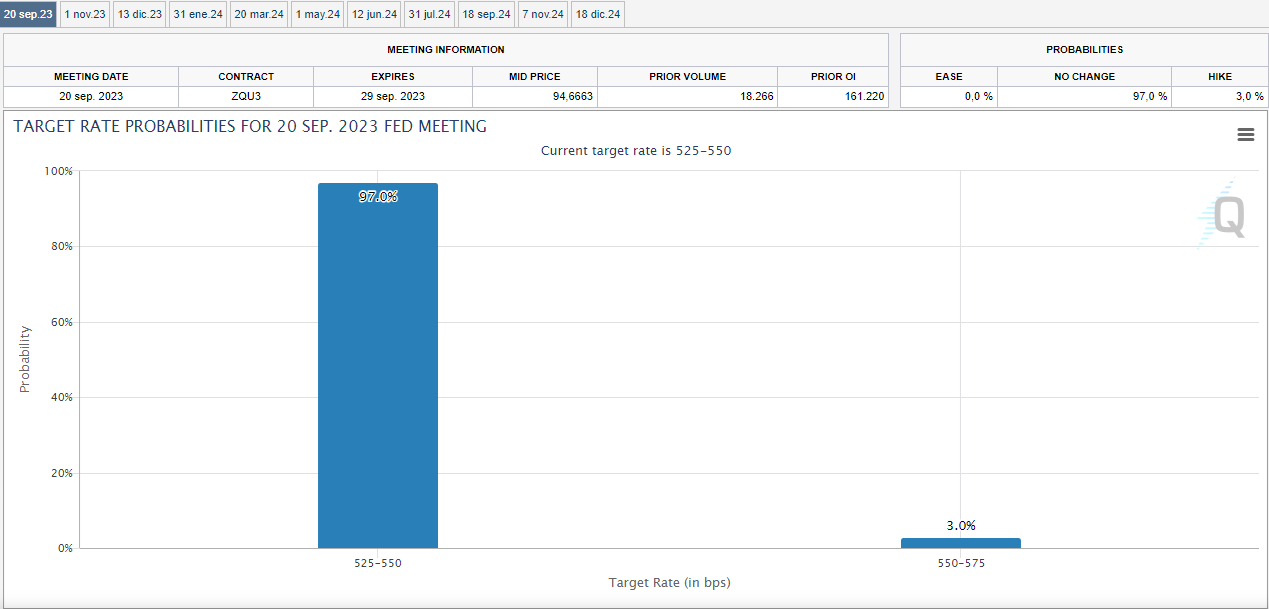
As said, the central bank is not expected to act. Still, words from Chair Jerome Powell will be closely watched in search of clues on future decisions. Furthermore, the Fed will publish fresh economic projections and the so-called dot plot, which could give a picture of when policymakers may consider cutting rates.
Beyond the US central bank's decision, the macroeconomic calendar will include the preliminary estimates of the September S&P Global PMIs for Europe and the US. The indexes measure business activity and indicate whether the economy is expanding or contracting.

EUR/USD technical outlook
The US Dollar heads into the weekend losing some ground across the FX board, although not far from its recent highs. The EUR/USD pair closes in the red for a ninth consecutive week, and there are no technical signs of an interim bottom. The pair has broken below a bearish 100-week Simple Moving Average (SMA) for the first time since last May, while the 20 SMA gains downward traction above the longer one, reflecting persistent selling interest. The Momentum indicator, in the meantime, accelerates below its 100 line, while the Relative Strength Index (RSI) indicator maintains its bearish slope at around 40.
Technical readings in the daily chart favor a bearish continuation. EUR/USD currently develops below all its moving averages, with the 20 SMA heading firmly south below the longer ones. Finally, technical indicators stabilized within negative levels, not enough to confirm an interim bottom.
A strong static support area could be found at around 1.0640, where the pair bottomed several times between May and June. Once below the latter, EUR/USD can test 1.0515, the March monthly low. On the contrary, the 1.0700 figure comes as an immediate resistance level, followed by 1.0745 and the 1.0820/40 price zone.

EUR/USD sentiment poll
The FXStreet Forecast Poll suggests EUR/USD could finally correct higher, as the pair is seen as bullish in the three time frames under study. The number of buyers increases as time goes by, with 57% of the polled experts looking for gains in the weekly perspective and 70% in the quarterly one. In the three-month view, the pair is seen recovering on average towards the 1.1000 price zone.
The Overview chart shows that the near-term moving average extended its slide, while the longer ones have turned neutral. In the monthly view, most potential targets accumulate between 1.0700 and 1.0900, while the range increases from 1.0900 to 1.1100 in the quarterly view. Overall, the pair is hardly seen below the 1.0400 mark, which means an interim bottom could be around the corner.

Author

Valeria Bednarik
FXStreet
Valeria Bednarik was born and lives in Buenos Aires, Argentina. Her passion for math and numbers pushed her into studying economics in her younger years.