EUR/USD Weekly Forecast: Bears return with a vengeance
- US macroeconomic data and Middle East tensions revived US Dollar demand.
- Central banks maintain the course as economies struggle to recover.
- EUR/USD long-term bearish case is in full fashion after a modest bounce.

The EUR/USD pair failed to extend its recovery gains and resumed its decline to end the week in the red at around 1.0520. The pair bottomed at 1.0447 in early October and aimed to rebound from the level, but the latest developments ended up benefiting once again the US Dollar.
Two factors supported the USD these last few days; none were good news. Firstly, the American currency gapped higher at the weekly opening after the Palestinian group Hamas attacked Israel on Saturday, resulting in Israeli Prime Minister Benjamin Netanyahu declaring war on Sunday. Fears of a wider conflict in the Middle East backed demand for safety, with government bonds on the rise and yields sliding, supporting the safe-haven USD but limiting its gains.
The Greenback shed some ground afterwards, as Treasury yields remained on the backfoot while the market digested Middle-East news. Still, the USD got another boost on Thursday, following the release of United States (US) inflation and employment-related figures, which indicated the American battle against inflation is far from over.
No good news on the inflation front
US data has proved resilient, spooking the ghost of a steep recession despite the Federal Reserve's (Fed) aggressive monetary tightening to combat price pressures. Still, inflation remains high, as the September Consumer Price Index (CPI) was up by 0.4% MoM and rose by 3.7% from a year earlier, higher than anticipated. The annual core CPI grew 4.1%, meeting expectations while easing from the previous 4.3% but still doubling the central bank’s target.
At the same time, the number of people claiming unemployment benefits in the week ended October 6 was 209K, slightly better than anticipated and reflecting a still tight labor market. A tight labor market means more open jobs than available candidates, forcing employers to offer higher salaries to fill positions and, hence, putting upward pressure on inflation.
The EUR/USD pair retreated from a weekly high of 1.0639 towards the 1.0520 price zone, as US Treasury bond yields trimmed early losses and set fresh weekly highs following discouraging American news.
Still, Federal Reserve officials speaking earlier in the week were more optimistic than market participants. Some members noted that higher yields tighten monetary conditions on their own, and as a result, the Federal Open Market Committee (FOMC) would not need to hike rates further.
Central banks on well-known paths
Also, the FOMC released the Minutes of the September meeting, which showed policymakers differed on whether any additional interest rate increases would be needed but agreed on the view that rates would need to stay elevated until inflation falls into target.
European Central Bank (ECB) officials were also on the wires and also agreed on something: more rate hikes are still possible in the Old Continent. Austrian central bank Governor Robert Holzmann discussed “one or two” further increases, while French central bank Governor Francois Villeroy de Galhau said inflation may be near 2% by 2025.
The economic situation in the Euro Zone is far less stable than the US one, while inflationary pressures are still high. Germany confirmed the September Harmonized Index of Consumer Prices (HICP) at 4.3% YoY on Wednesday, while the EU will report the September final HICP next week, with the core annual reading foreseen at 4.5%. Other than that, the macroeconomic calendar will offer US Retail Sales and the German ZEW Survey on Economic Sentiment.

EUR/USD technical outlook
The weekly chart for the EUR/USD pair shows the bearish trend is alive and kicking. The pair continued to develop below bearish moving averages. The 100-week Simple Moving Average (SMA) currently stands at 1.0700, drawing an immediate line in the sand. At the same time, technical indicators resumed their declines within negative levels, standing at fresh one-year lows and without signs of downward exhaustion.
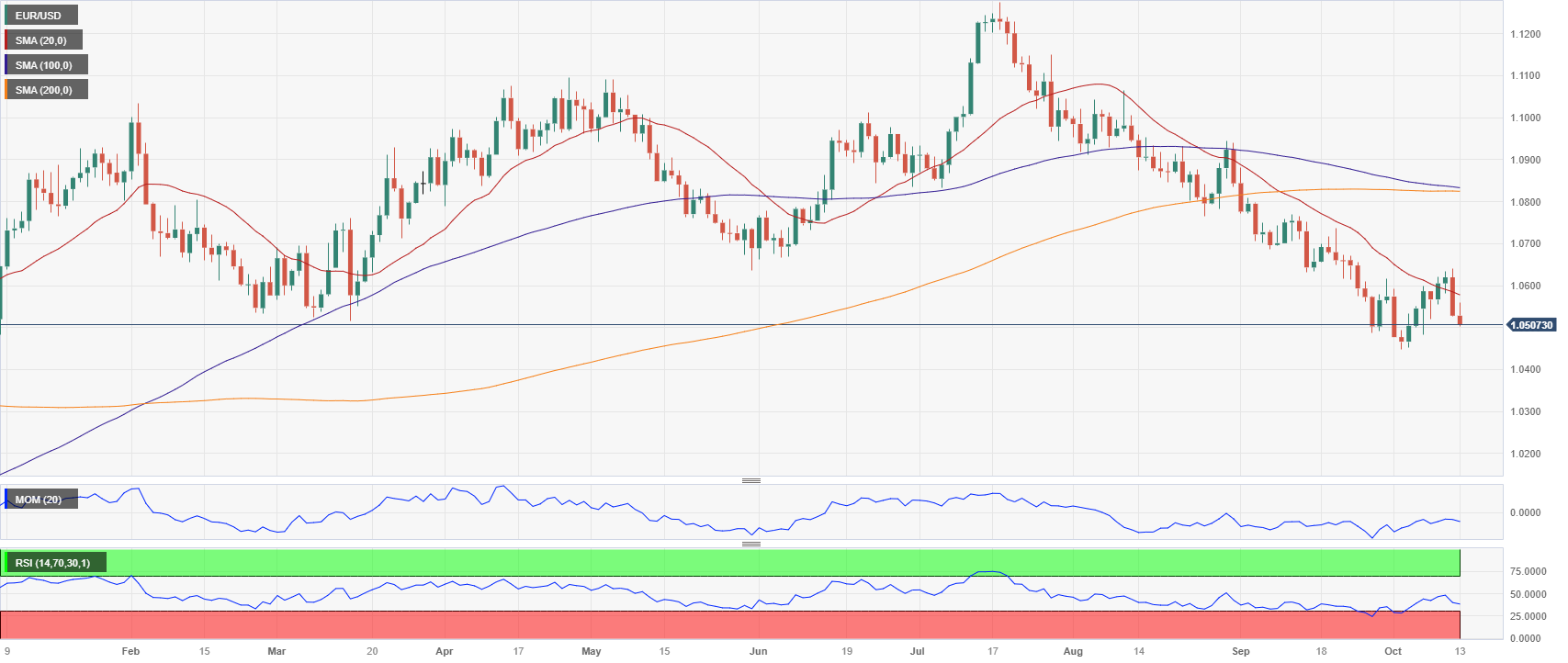
The daily chart shows EUR/USD briefly traded above a bearish 20-day SMA but plunged below the level with US data. The moving average provides dynamic resistance at around 1.0580 while extending its slide below the longer ones. Finally, technical indicators hold within negative levels, lacking clear directional strength.
Next resistance can be met at 1.0640, followed by the 1.0700 threshold. On the downside, support comes at 1.0447, followed by the 1.0320-1.0340 price zone.
EUR/USD sentiment poll
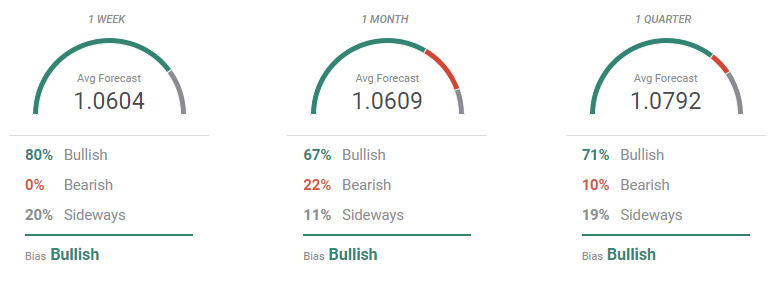
The FXStreet Forecast Poll suggests bulls will likely battle to regain control. EUR/USD buyers are a majority in all the time frame under study, while bearish interest has decreased sharply. On average, however, the pair is seen at around 1.0600 in the weekly and monthly perspectives while up to 1.0792 in the quarterly one.
Meanwhile, the Overview chart shows the near-term moving average turned north, while the longer ones have partially lost their bearish strength. In the monthly perspective, most potential targets accumulate in the 1.0400/1.0700 area, while in the wider view, the spread of potential targets widens, with most bets in the 1.0600/1.0900 range.
Author

Valeria Bednarik
FXStreet
Valeria Bednarik was born and lives in Buenos Aires, Argentina. Her passion for math and numbers pushed her into studying economics in her younger years.