EUR/USD Forecast: First down, then up? Playbook for the ECB and CPI storm
- EUR/USD has been edging lower as investors fear higher US inflation.
- The ECB is set to leave its policy unchanged and upgrade its forecasts.
- Thursday's four-hour chart is painting a mixed picture.

The big day has come – and some investors are already revealing their tensions. After several sessions of calm, the dollar has been on the rise ahead of the release of US Consumer Price Index figures for May. Has US inflation hit 5% in May? The specter of spiraling inflation has begun spooking some assets such as stocks and the dollar.
However, Treasury yields have gone the other way. Returns on 10-year bonds have dipped under 1.50%, showing markets are not fully buying the theory that price rises are coming and with it a tapering of bond-buying by the Federal Reserve. The world's most powerful central bank convenes next week and is set to remain silent until that day.
After Nonfarm Payrolls fell short of estimates, a not-so-horrible inflation figure could convince markets that the Fed is on course to sustain its $120 billion/month purchases untouched. More greenbacks mean a weaker currency.
US CPI May Preview: Inflation angst is coming
Tapering of bond buys is high on the agenda also on the other side of the pond. The European Central Bank is forecast to leave its policies unchanged on Thursday – the deposit rate at -0.50% and the total of its Pandemic Emergency Purchase Program (PEPP) at €1.85 trillion. However, there is an open question about the current pace of buying.
Back in March, the ECB announced an acceleration in purchases due to rising yields and a still-fragile economic recovery. The past three months have seen a massive vaccination campaign in the old continent and a return to normal. Is highly accommodative monetary policy still needed?
Return to a normal pace of purchases could boost the euro, but there are reasons to expect the Frankfurt-based institution to continue supporting the economy. The mix of virus variant fears and lower inflation in the eurozone – only 2% on the headline and a meager 0.9% in Core CPI – may keep ECB President Christine Lagarde and her colleagues from acting.
European Central Bank Preview: Why June's decision presents a buy the dip opportunity
Timing: The ECB announces its decision at 11:45 GMT, and if it refrains from cutting back on purchases, the euro could dip. At 12:30 GMT, the US publishes its CPI data, and Lagarde kicks off her press conference. A mix of a non-scary inflation figure and upgraded ECB growth forecasts could trigger a bounce in EUR/USD.
While these are the main events of the day and the week, it is essential to note that leaders of the G-7 convene in London and any surprising announcement from President Joe Biden and others could rock markets. However, the leaked communique suggests no market-moving declarations are on the cards.
EUR/USD Technical Analysis
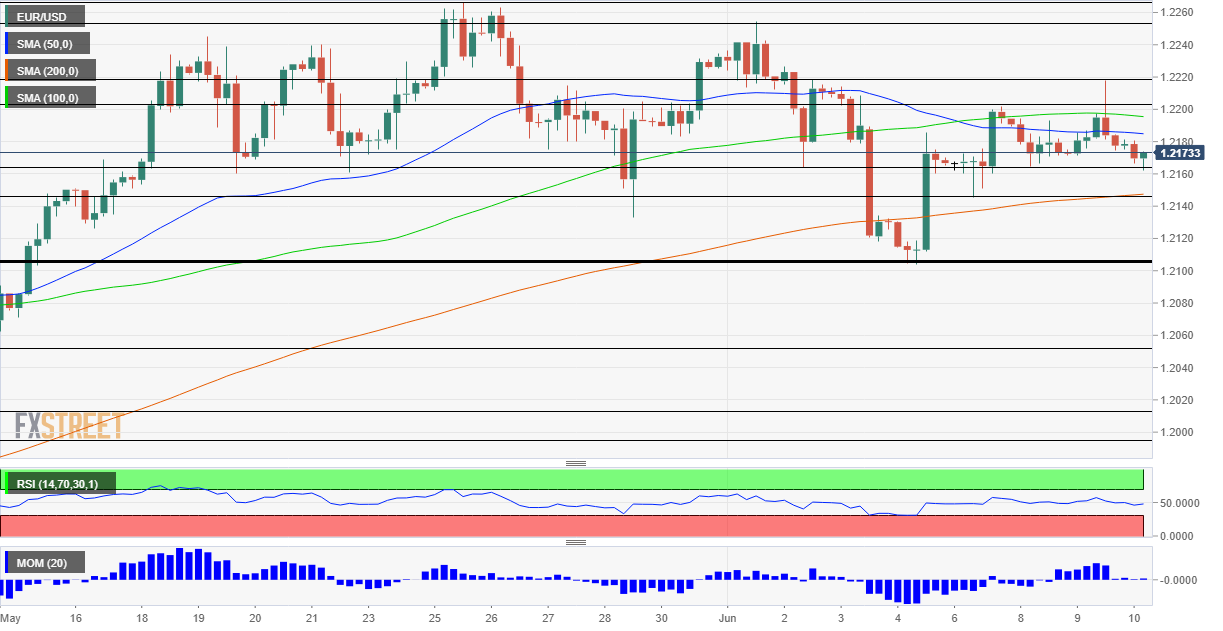
Euro/dollar has dipped back below the 50 and 100 simple moving averages on the four-hour chart and momentum has flattened out. The pair trades above the 200 SMA. All in all, bears have taken back some ground, but the pair has been flat for some time now.
Some support is at the daily low of 1.2160, followed by 1.2150 and 1.21, support lines on the way up.
Resistance is at 1.22, the round number that held it down last week, followed by 1.2220, Wednesday's peak, and then by 1.2255 and 1.2266.
Author

Yohay Elam
FXStreet
Yohay is in Forex since 2008 when he founded Forex Crunch, a blog crafted in his free time that turned into a fully-fledged currency website later sold to Finixio.