EUR/USD Forecast: EU inflation and US NFP to confirm the long-term bearish trend
- Political turmoil in the US and trade war back and forth dominated the headline.
- European data continued indicating a steepening economic slowdown.
- EUR/USD could correct higher, but it won’t be easy to recover 1.1000.

The EUR/USD pair has fallen to a fresh multi-year low of 1.0904, down for a second consecutive week and heading into the weekly close not far above this last. The shared currency started the week with a weak tone amid discouraging local data, later weighed by resurgent dollar’s demand, with a failed attempt to advance beyond the 1.1000 figure further exacerbating selling interest.
Macroeconomic data keeps playing against the EUR
Data didn’t help the EUR, as the September preliminary estimates of Markit activity indexes showed that the European economic downturn continues. The German economy contracted in the month, as the downturn in manufacturing deepened and service sector growth lost momentum. The Manufacturing PMI resulted at 41.4 while the Services PMI came in at 52.5, resulting in the Composite index falling to 49.1, its lowest since October 2012. For the whole Union, the picture was quite alike as the slowdown was also seen in France and Spain. The EU Manufacturing Index came in at 45.6, while the services one resulted at 52.0, missing the market’s expectations.
Also, EU’s Consumer Confidence in September improved to -6.5 but the Economic Sentiment Indicator for the same month decreased by more than anticipated, down to 101.7. The Bundesbank, the German central bank said, in this monthly report, that the country’s economy could once again have contracted slightly in the third quarter.
US data, on the other hand, was generally positive but failed to impress. The September estimate for the Services PMI came in below the market’s expectations at 50.9, although the Manufacturing Index improved to 51 from a previous 50.3. The composite PMI, expected at 49.6, printed 51. Q2 GDP was confirmed at 2.0%, while on Friday, the country released Durable Goods Orders, up by 0.2% in August although with the core reading missing the market’s expectations, and the Michigan Consumer Sentiment Index, upwardly revised to 93.2.
Politics get in the way
It was not just about data. Sentiment led the way throughout the week, focused on two main issues, the trade war and Trump’s possible impeachment. Late Tuesday, the US House Speaker, Nancy Pelosi, announced that the House would initiate a formal impeachment inquiry against President Trump, accused of manipulating Ukrainian authorities to investigate his rivals. The Justice Department released a document in which it concluded that Trump didn’t violate the campaign finance laws, taking off some pressure on the matter. However, political turmoil remains, and the process continues.
Meanwhile, the trade war continues, now in a good place but far from over.
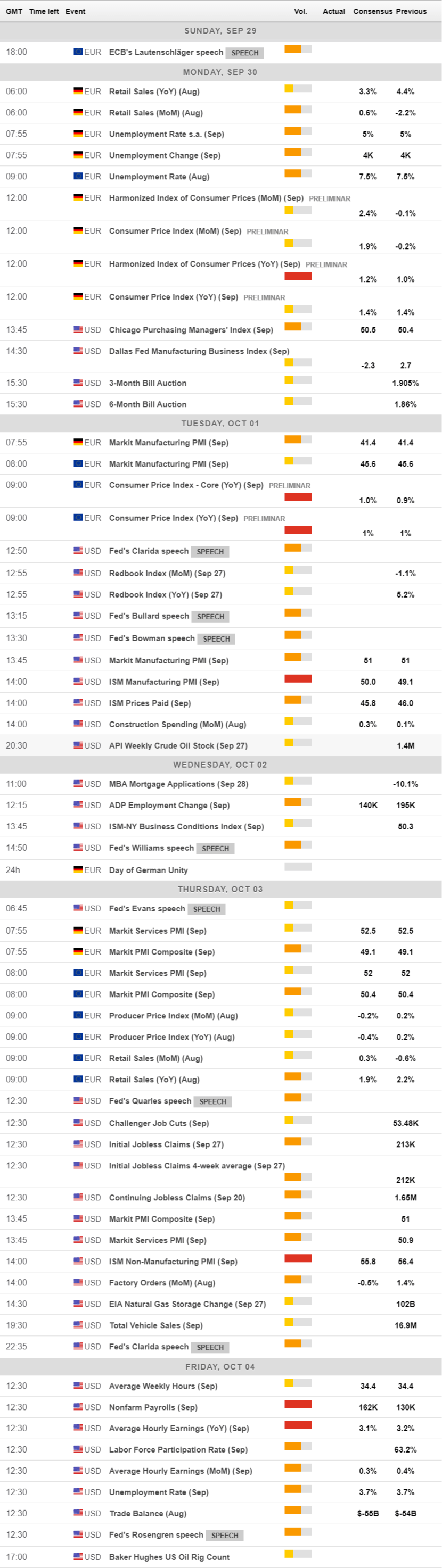
The upcoming week has plenty of data scheduled, including German and EU preliminary estimates for September inflation, seen ticking modestly higher. Markit will release the final versions of September PMI for both economies, while the US will release the official versions of the Manufacturing and Services PMI.
The US will publish on Friday the NFP report, with the economy expected to have added 162K new jobs. The unemployment rate is seen steady at 3.7% while wages’ growth is seen steady on average.
EUR/USD technical outlook
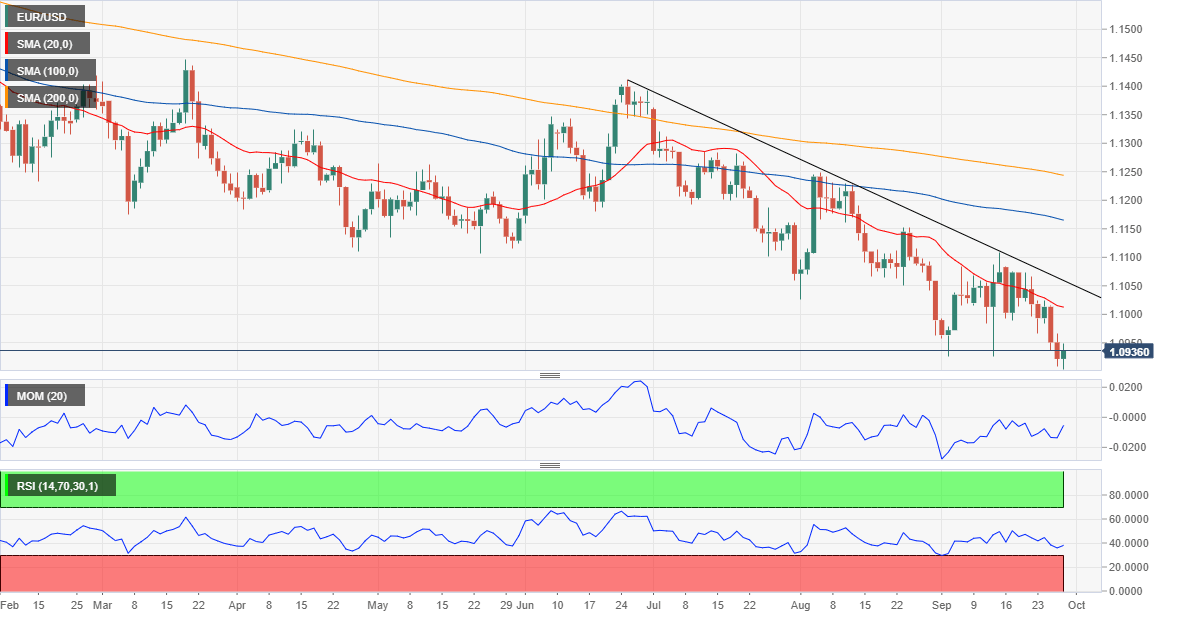
The EUR/USD pair is trading in the 1.0930 region, firmly bearish in the long-term and according to the weekly chart, as it extended its decline further below its moving averages, with the 20 SMA currently at around 1.1165. Technical indicators in the mentioned time-frame have accelerated their declines within negative levels, maintaining their strong bearish slopes.
Daily basis, the technical picture is also bearish, as the pair accelerated its slump after repeatedly failing to surpass a bearish 20 DMA, while technical indicators barely lost their bearish strength around weekly lows.
The 1.1000 level is the immediate psychological barrier, ahead of the 1.1070/80 price zone. Beyond this last, the pair can recover up to the mentioned 1.1165 level, although chances of such advance are quite limited, as selling interest will probably surge well ahead of this last.
A break below the 1.0900 figure will probably exacerbate the decline, with 1.0840 being the first bearish target. Seems unlikely the pair could extend its decline below this last without a strong catalyst, in which case, the next support comes at 1.0790.
EUR/USD sentiment poll
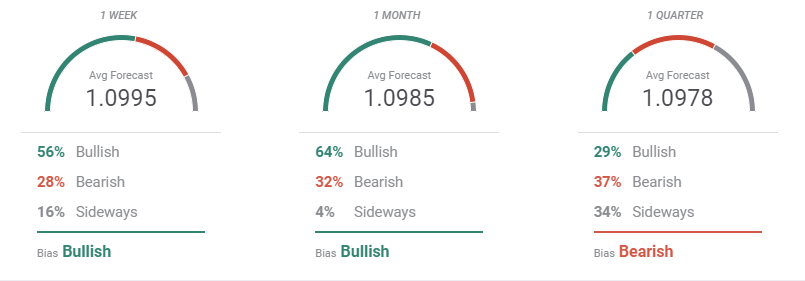
The FXStreet Forecast Poll reflects the ongoing uncertainty, as the pair is seen on average around the current levels in the three time-frame under study. In fact, those betting for a recovery are a majority in the weekly and monthly perspectives, although in any case, the pair is expected to hold on to gains beyond the 1.1000 figure. Bears are a majority in the quarterly perspective, although accounting just for the 37% polled experts, with those anticipating a sideways bias at 34%.
The Overview chart, however, paints a firmly bearish picture, with all moving averages heading south and at fresh multi-month lows.
Author

Valeria Bednarik
FXStreet
Valeria Bednarik was born and lives in Buenos Aires, Argentina. Her passion for math and numbers pushed her into studying economics in her younger years.















