EUR/USD Forecast: Bulls hold ground, gear up to challenge 1.1000

EUR/USD Current Price: 1.0917
- Eurozone S&P Global PMIs brought a positive surprise in thin market conditions.
- United States markets will be closed amid Thanksgiving holiday, work reduced hours on Friday.
- EUR/USD trades neutral, just above 1.0900 faces resistance at 1.0960.
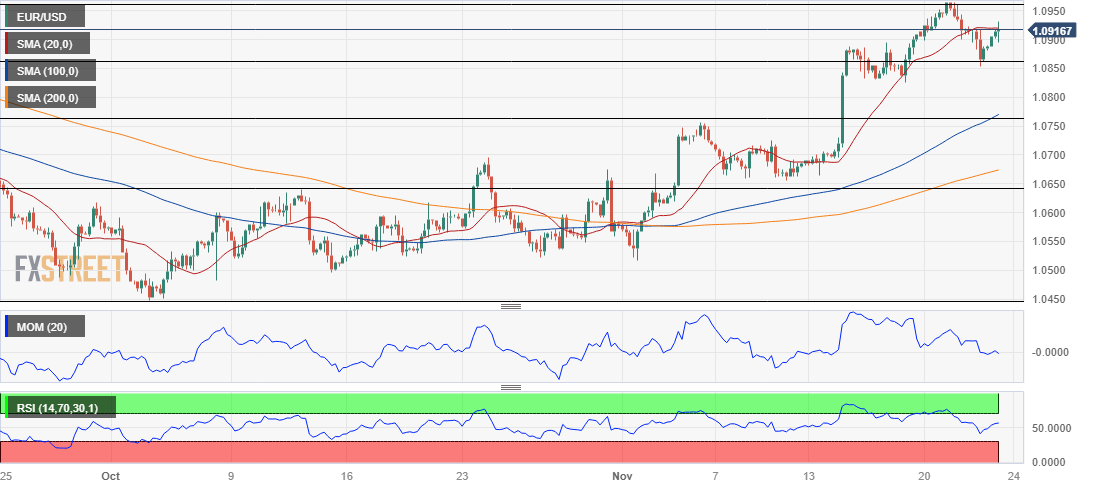
Financial markets struggle to find directional momentum as the Thanksgiving Holiday kicks in. Japanese markets remained closed on Thursday, as will the United States (US) ones, while activity will be reduced on Friday. The EUR/USD pair develops a handful of pips above the 1.0900 figure, recovering from a 1.0852 low posted on Wednesday.
Still, optimism reigns. Wall Street posted gains on Wednesday and is poised to close its best month in a year, as investors believe the tightening cycle is done and major central banks will move into a rate-cut cycle as soon as next year. Both the US Federal Reserve (Fed) and the European Central Bank (ECB) refrained from hiking interest rates for two consecutive meetings but held on to the mantra of "higher for longer." Nevertheless, speculative interest bets against policymakers' warnings, pricing in for the US a cut as soon as next May.
ECB member and Bundesbank President Joachim Nagel was on the wires early in the European session and said ECB's policy is working, but added inflation isn't yet tamed and may pick up in the upcoming months. His words did not impact EUR/USD, as investors have heard the same from different officials in the last few months.
Data-wise, S&P Global published the November Purchaser Manager Indexes (PMIs) preliminary estimates for the Eurozone. The German Manufacturing PMI improved more than anticipated to 42.3 from 40.8 in October, a 6-month high. Services output was also better than expected, hitting a 2-month high of 48.7. The official report states that the economic downturn showed signs of easing, although it also noted prices saw faster increases, with inflationary pressure remaining centred on the service sector.
Meanwhile, the EU S&P Global PMIs in the same month also beat expectations, with manufacturing output at 43.8 and the services index printing at 48.2. The contraction rate was softer than anticipated, although the official report noted business activity continued to fall amid a further solid decline in new orders. The better figures pushed EUR/USD up to 1.0930, although the absence of volumes maintained it within familiar levels ahead of London's close.
EUR/USD short-term technical outlook
The EUR/USD pair met buyers around the 50% Fibonacci retracement of the 1.1275/1.0447 slump at 1.0858, while it trades below the 61.8% retracement at 1.0960, the immediate resistance level. From a technical point of view, chances of a steeper decline seem limited. The daily chart shows that the Relative Strength Index (RSI) indicator is picking up near overbought readings, while the Momentum indicator keeps retreating, although within positive levels. Buyers remain interested, but they lack strength amid limited activity. Finally, EUR/USD continues developing above all its moving averages, with the 20 Simple Moving Average (SMA) heading firmly north at a fresh one-month high, although still below the longer ones.
In the near term, and according to the 4-hour chart, the pair is neutral. Technical indicators hover around their midlines, reflecting the absence of directional interest. At the same time, EUR/USD battles to overcome a directionless 20 SMA while the longer moving averages continue to advance far below the current level. The immediate resistance level is 1.0960, the 61.8% retracement of the aforementioned slide, with little chance of a clear breakout of the level in the upcoming sessions. Still, a break above the level should lead to a test of sellers’ willingness to defend the 1.1000 threshold.
Support levels: 1.0860 1.0825 1.0780
Resistance levels: 1.0925 1.0960 1.1005
Author

Valeria Bednarik
FXStreet
Valeria Bednarik was born and lives in Buenos Aires, Argentina. Her passion for math and numbers pushed her into studying economics in her younger years.

















