EUR/USD Forecast: Big breakout above 1.14? Three reasons why Powell may propel it higher
- EUR/USD has been advancing as the US dollar resumes its falls.
- The Federal Reserve's decision is set to rock markets.
- Wednesday's four-hour chart is showing bulls are in the lead.

The times are a-changin' – the hours before the Federal Reserve's decision used to be quiet ones, but everything is different in coronavirus times. EUR/USD has bounced off the lows and trades close to the three-month highs. Break or bounce?
The world's most powerful central bank is set to leave interest rates unchanged and after providing massive support, some suspect it may stop now. Jerome Powell, Chairman of the Federal Reserve, said the bank has "crossed red lines" and urged the government to do more.
Stocks are at elevated gains – the NASDAQ jumped some 50% from the March trough – and the recent robust jobs report may cause it to stop. However, there are three reasons why the Fed will likely continue boosting markets and weighing on the dollar.
1) Yields too strong
US ten-year Treasury bond yields have been advancing as investors rotated from bonds to equities. That means long-term borrowing costs have risen, including for homebuyers. It also raises the government's cots at a time of elevated spending.
The Fed may hint that it is returning to traditional Quantitative Easing, yield-curve control, or "Operation Twist" – buying longer-dated debt to keep yields depressed. That may weigh on the greenback.
2) Racial tensions
The Fed announces its decision after two weeks of protests against racial discrimination, following the killing of George Floyd, an unarmed black man at the hands of the police. Demonstrations have engulfed America and calls for change have dominated the news cycles.
While the Non-Farm Payrolls report showed that the unemployment rate dropped from 14.7% to 13.3%, it remains higher for blacks and Hispanics. That may prompt policymakers – including at the Fed – to favor looser monetary policy despite the overall improvement.
3) Fed does not want to ruin the rally
As mentioned earlier, Powell admitted to crossing red lines, and he may have referred to buying junk bonds, open-ended QE, and other moves. However, the bank would not like to ruin the party and turn the rally into a plunge.
The Fed will likely try to walk a fine line between supporting the economy and warning about bubble risks, but it would prefer to err on the side of too much accommodation rather than too little, at least for now.
All in all, it is hard to bet against the "Powell Put," resulting in boosting markets and weighing on the dollar.
See:
- Fed Preview: Propelling stocks with more surprises or compressing the froth? Five things to watch
- Fed Preivew: We know where we are and how we got here but where are we going?
- FOMC Preview: What else can the Fed do?
Other EUR/USD movers
Trade talks between the EU And the US are not going anywhere fast. That may weigh on the euro, as potential tariffs on European products entering America may hurt the fragile European recovery. Markets are currently shrugging off downbeat comments from Phil Hogan, the chief EU negotiator.
The European Central Bank is reportedly preparing a bad bank scheme, to counter the crisis' fallout on debt. The ECB urges governments to add further fiscal stimulus. Eurogroup head Mario Centeno announced he will step down from the job, potentially paving the way for Spain's Nadia Calviño. She will likely push countries to adopt more spending.
Coronavirus cases are falling fast in the old continent, but the picture is mixed in the US. COVID-19 hospitalizations in the US have hit a new peak, while cases are rising in California, Florida, and other states, countering the fall in the greater New York area. Another increase in coronavirus cases in the US may cause worries.
Ahead of the Fed, the US releases Consumer Price Index figures for May, which will likely inflation is stabilizing after the initial fall.
See US CPI Preivew: The pandemic inflation decline reverses
EUR/USD Technical Analysis
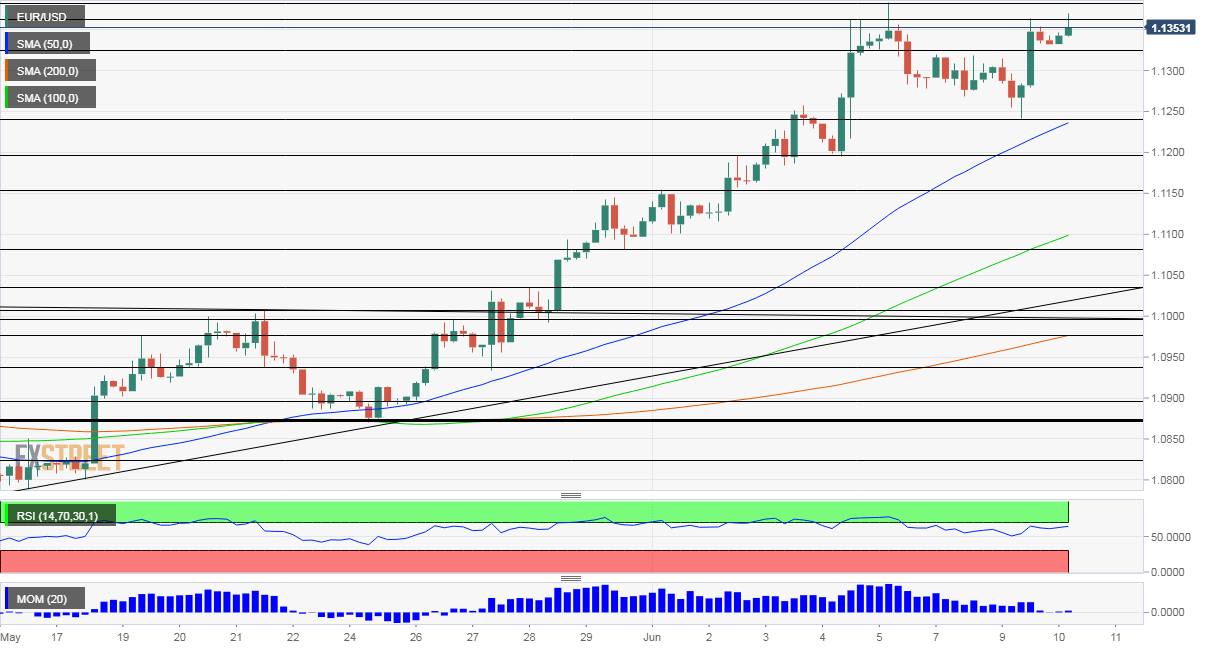
Euro/dollar is trading above the 50, 100, and 200 Simple Moving Averages on the four-hour chart, and momentum remains to the upside. The RElative Strength Index remains below 70, outside overbought conditions, despite the recent surge.
All in all, bulls are in the lead.
Resistance awaits at June's high of 1.1384, followed by levels last seen in March – 1.1410, which was a stepping stone on the way down, and 1.1495, the yearly high.
Support awaits at 1.1330, the daily low, followed by Tuesday's trough of 1.1240. The next levels to watch are 1.12 and 1.1150.
Author

Yohay Elam
FXStreet
Yohay is in Forex since 2008 when he founded Forex Crunch, a blog crafted in his free time that turned into a fully-fledged currency website later sold to Finixio.
















