AUD/USD Price Forecast: The recovery looks promising…for now
- AUD/USD extended further its breakout of the 0.6500 hurdle.
- The Aussie Dollar ignored the demand for safer assets.
- The RBA delivered a somewhat hawkish Minutes of the November event.


The US Dollar (USD) alternated gains with losses on Tuesday in an atmosphere of rising geopolitical tensions and firm demand for the safe haven space.
Despite this, the Australian Dollar (AUD) performed greatly, hitting four-day highs near 0.6530 and advancing for the third consecutive day as the hawkish tilt from the RBA Minutes appears to have underpinned further the sentiment surrounding the currency.
On the other hand, the Dollar Index (DXY) navigated an inconclusive range amidst negative US yields and always supported by the 106.00 region.
This marked rebound in the Aussie Dollar was also helped by the continuation of the march north in copper and iron ore prices, which added to the optimism seen at the beginning of the week despite investors remained somewhat sceptical of recent stimulus measures in China.
Domestically, the Reserve Bank of Australia (RBA) left its policy rate unchanged at 4.35% during its November 5 meeting, aligning with market expectations. While the central bank noted progress in taming inflation, it struck a cautious tone on growth. Governor Michele Bullock suggested that current rates are appropriate for now but reaffirmed the need for tight monetary policy until inflation shows a consistent downward trend. Market participants, however, are beginning to price in a potential rate cut by May 2025.
Australia’s inflation data offered further evidence of cooling, with the latest Consumer Price Index (CPI) dropping to 2.1% for September and the annual Q3 rate easing to 2.8%.
A potential rate cut from the Federal Reserve (Fed) could lift AUD/USD in the future, but risks persist. In particular, a potential Trump presidency and associated inflationary pressures might keep the US Dollar resilient, capping any significant upside for the Aussie.
Concerns over China’s economic performance remain a headwind for the AUD, though the labour market continues to show resilience. October’s unemployment rate held steady at 4.1%, with 15.9K jobs added, pointing to a solid domestic labor market.
Back to the domestic docket, the minutes from the RBA's November 6 policy meeting suggested that the bank is in no hurry to start cutting interest rates. Members acknowledged that a faster-than-expected drop in inflation could justify lowering the cash rate but emphasised the need to see more than one strong quarterly inflation result before feeling confident that such a trend is sustainable.
Meanwhile, market expectations continued to point to a quarter-point rate cut by the RBA by May 2025, always amid the bank’s cautious, data-dependent approach.
In market positioning, speculators have remained net buyers of AUD for seven consecutive weeks, even as open interest trends downward, signalling caution among traders.
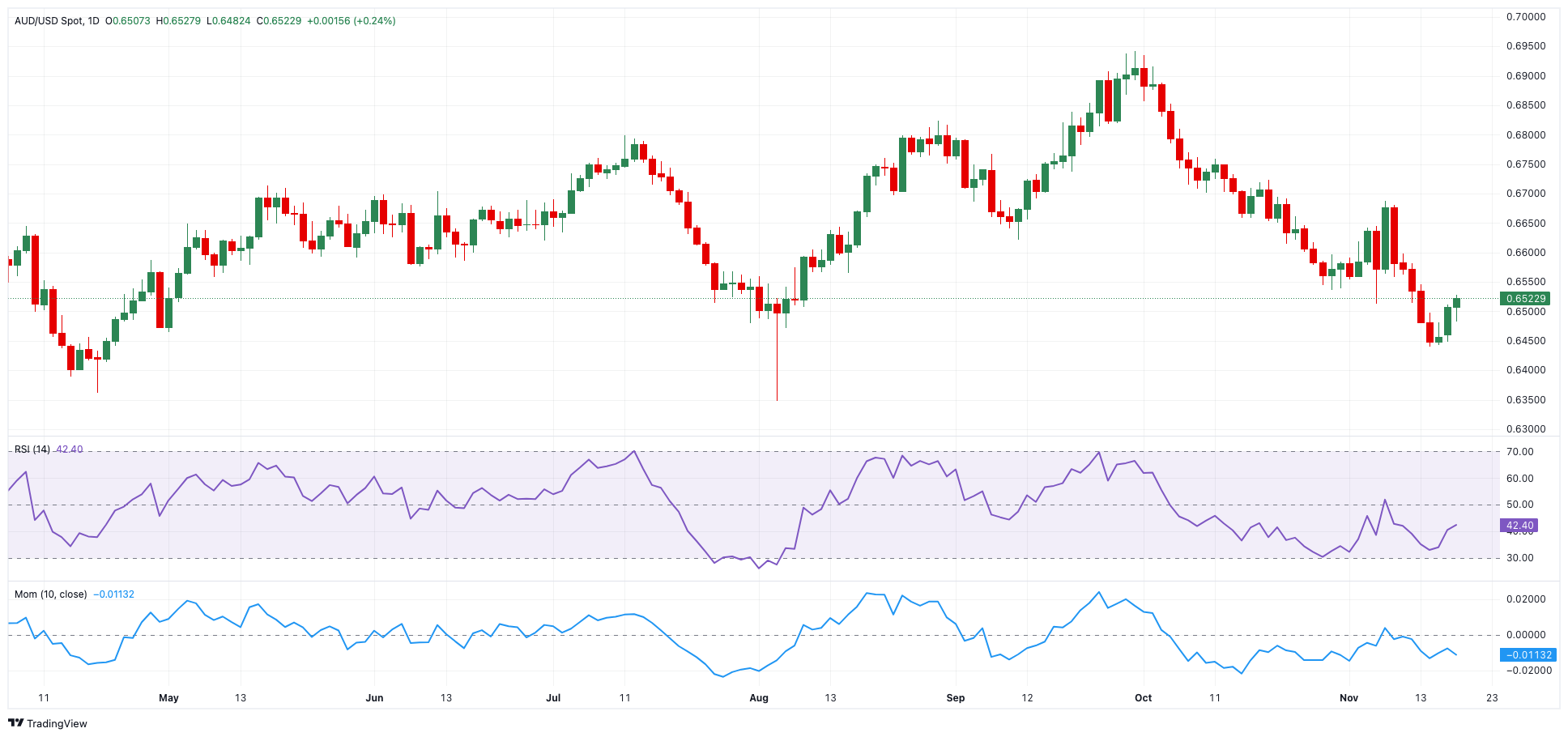
AUD/USD daily chart
Technical Outlook for AUD/USD
In the short term, if bulls maintain control, the next resistance is at the 200-day SMA of 0.6628, followed by the November high of 0.6687 (November 7), which is still supported by the 100-day SMA.
On the flip side, initial support comes at the November low of 0.6440 (November 14), prior to the 2024 bottom of 0.6347 (August 5).
The four-hour chart shows some pick up in the upside momentum. Initial support is at 0.6440, followed by 0.6347. On the other side, resistance may form at the 55-SMA (0.6536) and 100-SMA (0.6556). The RSI rose to around 59.
Premium
You have reached your limit of 3 free articles for this month.
Start your subscription and get access to all our original articles.
Author
Pablo Piovano
FXStreet
Born and bred in Argentina, Pablo has been carrying on with his passion for FX markets and trading since his first college years.