AUD/USD Price Forecast: Another test of 0.6350 should not be ruled out
- AUD/USD broke decisively below the 0.6400 support on Tuesday.
- The US Dollar remained well bid ahead of the release of US CPI.
- The RBA delivered a dovish hold at its event early on Tuesday.


The US Dollar (USD) added to Monday’s uptick and motivated the Dollar Index (DXY) to flirt with multi-day highs above 106.60 on Tuesday. Meanwhile, the Australian Dollar (AUD) lost further shine, breaching the 0.6400 contention zone with enough conviction to open the door to a probable move to the YTD lows near 0.6350 sooner rather than later.
What’s dragging the Aussie down?
The Australian Dollar’s recent struggles can be traced back to last week’s disappointing GDP data for the July–September quarter. The economy expanded by just 0.3% quarter-on-quarter and 0.8% year-on-year, falling short of expectations.
Adding to those disappointing results from key fundamentals, the RBA kept its policy rate unchanged at its meeting, although it delivered a dovish message.
In tandem with these setbacks, the Aussie derived extra weakness from falling prices for key exports like copper, which reversed recent multi-week highs. However, iron ore prices managed to advance marginally, all amid recent news about extra Chinese stimulus following disheartening inflation data for November. In addition, the consolidative range in the Chinese Yuan failed to lend some wings to the Aussie Dollar.
The RBA’s calculated approach
The Reserve Bank of Australia (RBA) kept interest rates unchanged at 4.35% during its meeting on Tuesday, as widely expected. However, the central bank hinted at a potential rate cut in February, signaling a shift in tone.
In fact, the RBA dropped its previous neutral guidance, which had stated that “the Board is not ruling anything in or out.” Instead, the bank expressed growing confidence that inflation is moving sustainably toward its target, acknowledging that "some of the upside risks to inflation appear to have eased." This marks a departure from earlier warnings about the need to stay vigilant regarding inflation risks.
At her press conference, Governor Michele Bullock remained cautious and avoided making any definitive statements about future policy. She emphasised that the Board had not explicitly discussed cutting or raising rates and refrained from outlining specific conditions for a February rate cut.
Speaking about a potential rate cut in February, bets on such a move have risen to nearly 65%, leaving the Australian currency vulnerable to further downside pressure.
AUD/USD Outlook: Challenges and opportunities
The road ahead for AUD/USD is far from smooth. On one hand, a potential shift in US Federal Reserve (Fed) policy toward rate cuts could lend support to the Aussie. On the other hand, persistent US inflation, the resilience of the USD, and China’s economic slowdown present significant obstacles.
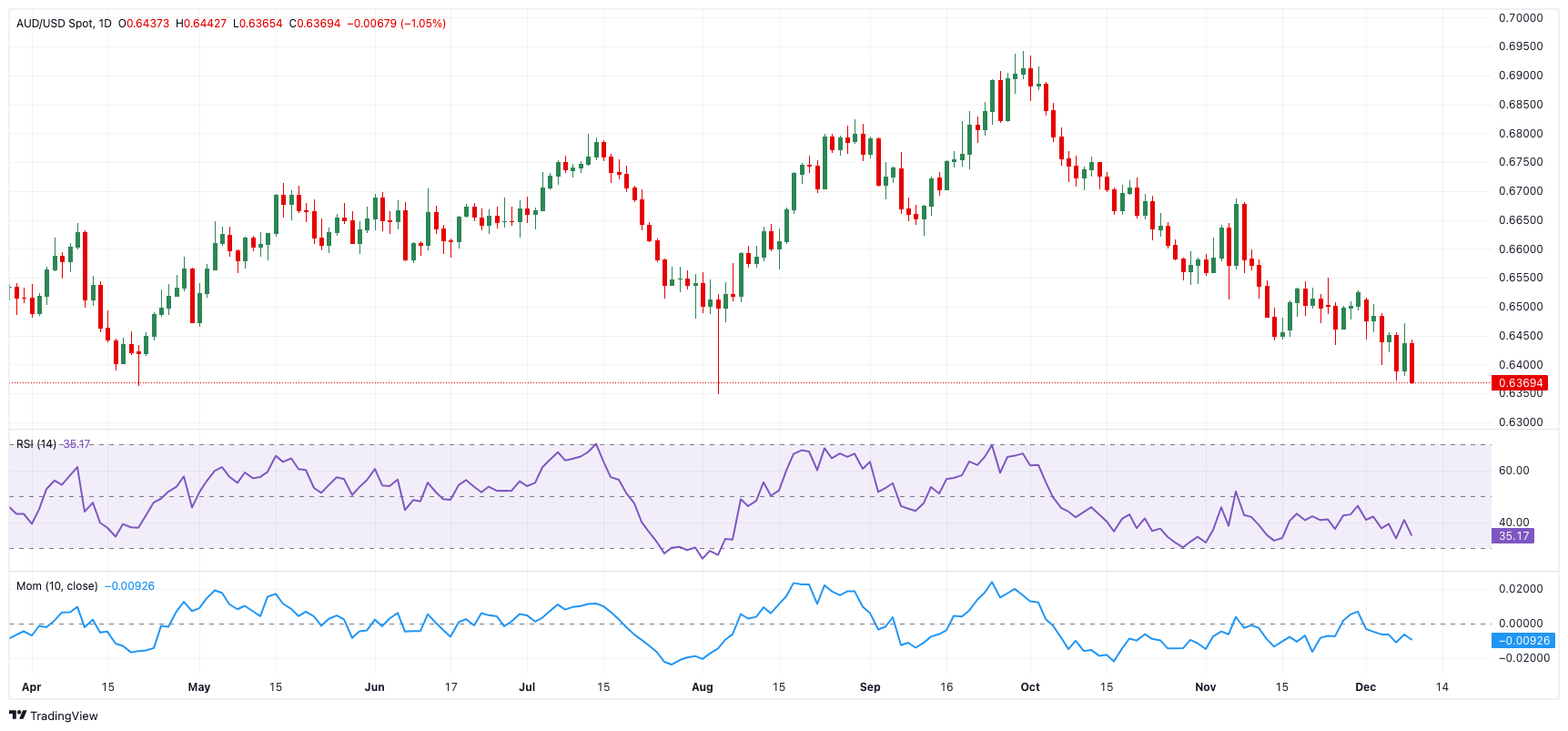
AUD/USD daily chart
Technical snapshot
The immediate up-barrier is at 0.6549, with the 200-day Simple Moving Average (SMA) at 0.6625 and the November high of 0.6687. On the downside, first support is around 0.6399 (December's low), with a deeper floor at 0.6347 (the 2024 bottom recorded in August).
Momentum indicators suggest that the Relative Strength Index (RSI) has retreated below 35, indicating increasing negative momentum, while the Average Directional Index (ADX) at above 34 indicates more strength in the trend's direction.
Key Data to Watch
The next salient event on the Australian calendar will be the release of the labour market report on December 12.
Bottom Line
The Australian Dollar remains under pressure, caught between domestic challenges and global uncertainties. While there’s room for recovery, much will depend on upcoming data from Australia, the US, and China, as well as the RBA’s timing for an interest rate cut. For now, caution seems to be the prevailing sentiment.
Premium
You have reached your limit of 3 free articles for this month.
Start your subscription and get access to all our original articles.
Author
Pablo Piovano
FXStreet
Born and bred in Argentina, Pablo has been carrying on with his passion for FX markets and trading since his first college years.