|

Nike stock spikes 5% after Vietnamese leader signals willingness to negotiate

  • Nike stock recovers after Vietnamese leader reaches out to Trump.
  • Trump says he will set a meeting with General Secretary To Lam.
  • NKE stock dropped 14.4% on Thursday in response to Trump's 46% tariff on Vietnam.
  • Dow Jones Industrial Average sheds 4.6% at the time of writing.

Nike (NKE) shares surged over 5% around lunchtime in New York on Friday after US President Donald Trump said he spoke with the leader of Vietnam. 

Vietnam is where the sport apparel and footwear maker produces the great bulk of its products. In fact, Nike-related factories employ about half a million Vietnamese.

On Wednesday, Trump announced a 46% tariff on goods imported from Vietnam, a policy that would drastically impact Nike’s operations. Nike stock slid 14.4% on Thursday in response to the tariff announcement.

"Just had a very productive call with To Lam, General Secretary of the Communist Party of Vietnam, who told me that Vietnam wants to cut their tariffs down to ZERO if they are able to make an agreement with the US,” Trump wrote. “I thanked him on behalf of our country and said I look forward to a meeting in the near future."

Post from Donald Trump on Truth Social - 4/4/2025

The news sent NKE stock from an intraday low of $52.50 to an intraday high of $58.88. Before the news, Nike shares had fallen beneath a two-year-old bottom trendline that began in September 2023. However, it quickly recovered.

Lululemon (LULU), which also produces much of its gear in Vietnam, saw its share price recover somewhat on Friday as well. These movements are in stark contrast to the overall market sentiment. The Dow Jones Industrial Average (DJIA) has lost 4.6% at the time of writing, while the S&P 500 and NASDAQ plunge over 5%.
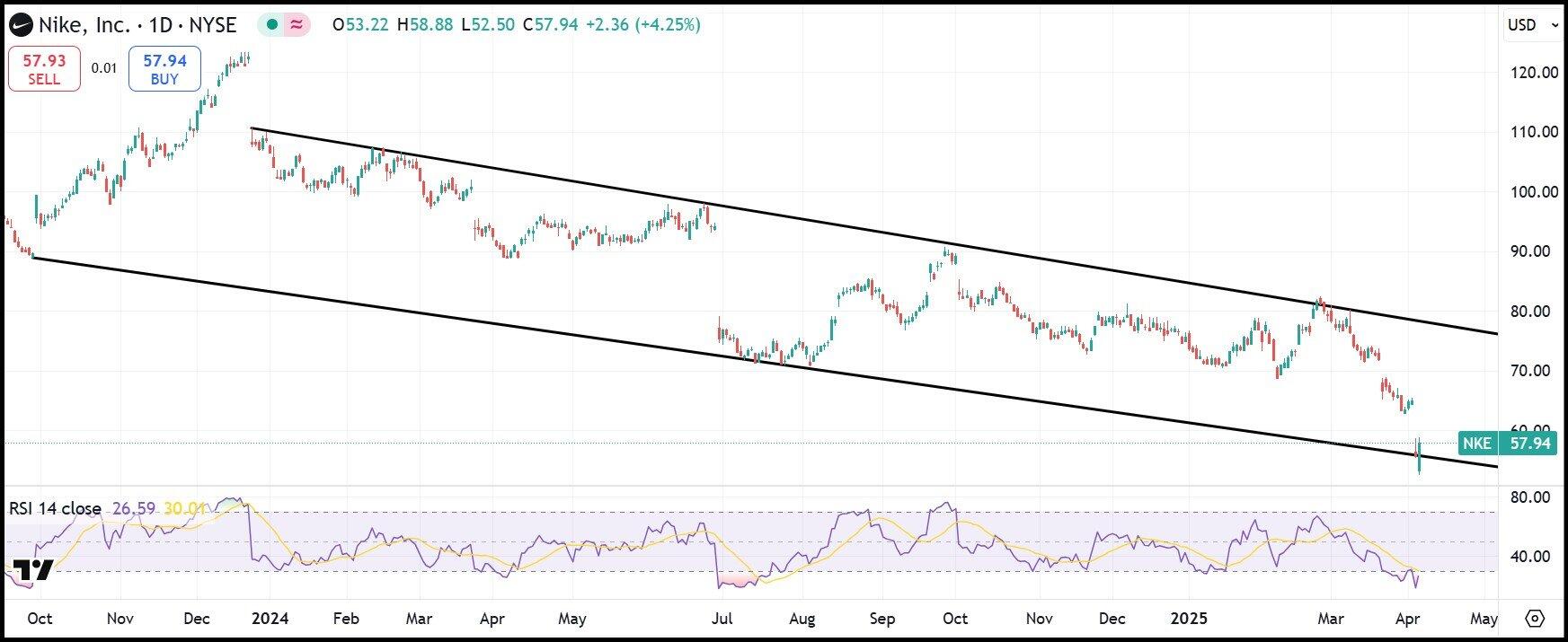
 

NKE daily stock chart


Author

Clay Webster

Clay Webster

FXStreet

Clay Webster grew up in the US outside Buffalo, New York and Lancaster, Pennsylvania. He began investing after college following the 2008 financial crisis.


More from Clay Webster
Share:

Editor's Picks

AUD/USD bounces back toward 0.6950 on fresh USD supply

AUD/USD bounces back toward 0.6950 in the Asian session on Friday. The US Dollar retreats from 17-month highs as traders take profits off the table ahead of the all-important US Nonfarm Payrolls report. Meanwhile, the Australian Dollar draws support from reviving expectations of a November interest rate hike amid elevated global yields and inflation risks.


USD/JPY struggles near 158.00 as USD retreats ahead of NFP

USD/JPY is struggling for fresh impetus near 158.00, moving away from the top end of its weekly range in the Asian session on Friday, after hotter-than-expected Tokyo CPI and amid a broad US Dollar retreat. Traders reposition themselves ahead of US Nonfarm Payrolls.

Gold fades the earlier optimism; back below $4,200

Gold could not sustain the post-NFP bull run past the $4,200 mark per troy ounce, receding toward the $4,180 region at the end of the week. The precious metal’s inconclusive price action comes amid fresh selling pressure hurting the US Dollar as investors assess the latest NFP data.

Crypto Today: Bitcoin, Ethereum and XRP gains reinforce bullish outlook

Cryptocurrency prices are broadly recovering on Friday, led by Bitcoin moving above $86,000. Ethereum has reaffirmed its bullish outlook, rising above $2,700 while the immediate area at $2,800 caps upside. Meanwhile, Ripple hovers near $1.54.

Week ahead – Fed minutes in the spotlight amid bond market rout

Energy crisis and soaring bond yields to stay in driver’s seat in quiet week. Fed minutes eyed after drop in October rate hike bets. ISM services PMI and Treasury auctions to be watched too. Canadian employment, Japanese wages and ECB minutes also on tap.

The Euro is near a one-year low: Inflation could trigger its rebound, not its fall

EUR/USD has fallen to its lowest level since May 2025. The pair hit 1.1312 on Wednesday and trades well below the January peak of 1.2082. The decline reflects a powerful combination of US Dollar strength, geopolitical uncertainty and renewed concerns about Europe's exposure to higher energy prices.















