AUD/USD Forecast: Ready to go down under? Global gloom likely to overcome Australia's achievements
- AUD/USD has been torn between the ever-changing market mood and mixed Australian data.
- The Fed decision, US GDP, Australian inflation figures, Chinese PMIs, and coronavirus figures stand out.
- Mid-April's daily chart is painting an improving picture for the currency pair.
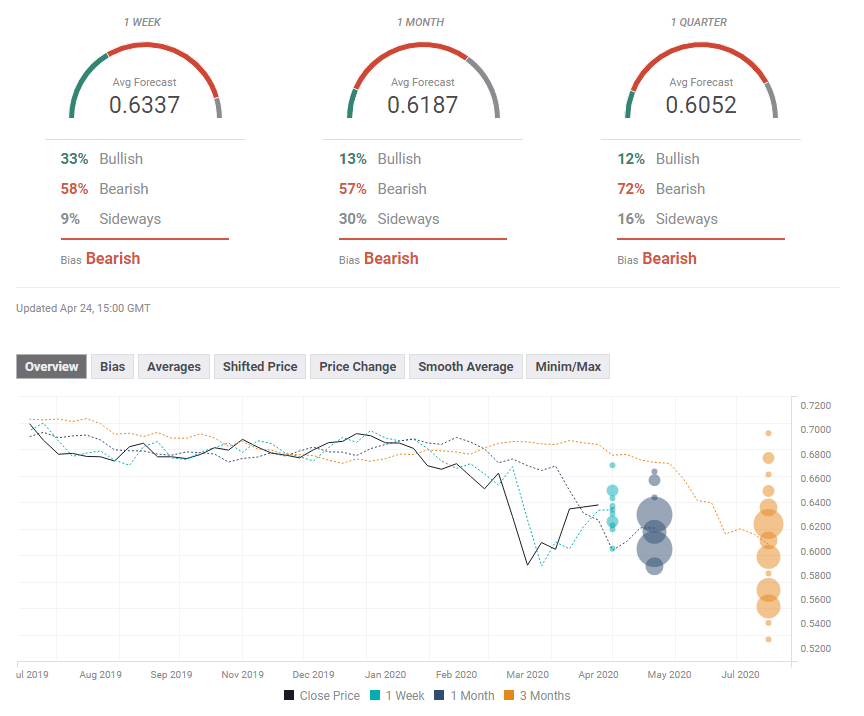
- The FX Poll is pointing to the downside on all timeframes.

The Aussie, a "risk" currency, traded between optimism and pessimism, driven by volatile oil prices. The commodity-exporting nation also received a mixed dose of data, and now it faces quarterly inflation figures. Top-tier US events and Chinese statistics are also in the mix as April draws to a close.
This week in AUD/USD: Mixed signals
Oil prices collapsed early in the week as a result of technical quirks but also collapsing demand due to coronavirus lockdowns. While Australia's principal exports are metals, its currency suffered amid the worsening mood. The crash in petrol represents coronavirus' collateral damage to the global economy, and the ensuing recovery in oil prices helped the Aussie move back up.
The A$ received some support from the Reserve Bank of Australia's meeting minutes, which showed reluctance to stimulate the economy further. The RBA's interest rate is at 0.25% and is unlikely to also fall. Economic indicators from the land down under were mixed, with the Commonwealth Bank Manufacturing Purchasing Managers' Index tumbling to 45.6 in April, while exports leaped by 29% in March.
COVID-19 cases in Australia are well below 10,000, and the death toll is in double-digits. The government announced the easing of restrictions, including opening the Sydney's iconic Bondi beach. Despite its success in dealing with the disease, Marise Payne, Australia's foreign minister, criticized China for its handling of the outbreak. Tensions with the world's second-largest economy and Australia's No. 1 trade partner have somewhat weighed on the Aussie.
Contrary to Australia, the US death toll is reaching 50,000, and cases have surpassed 800,000 at the time of writing. President Donald Trump has been moving from calling for a prudent approach to demanding the reopening of the economy, encouraging protests. The curve has flattened in New York, the epicenter of the disease, but coronavirus is still spreading a stubbornly rapid clip in general.
US economic figures have been horrible, with over four million initial jobless claims reported for the week ending April 17 – the week when the Non-Farm Payrolls survey is taken. The US may report 20 million job losses in April. The safe-haven US dollar gained ground in response to depressing news, including the report that Remdesivir, a potential COVID-19 cure, has probably been inefficient in helping patients. Additional studies of Gilead's drug and other treatments are necessary, yet there is no light at the end of the tunnel at this point.
Overall, relatively upbeat news from Australia was not enough to counter the mostly dark picture from the rest of the world.
Australian and Chinese events: Forward and backward-looking data
The gradual reopening of the Australian economy will likely be followed closely. Investors will want to see that coronavirus statistics remain low in the land down under. The Aussie's role as a commodity currency means that prices of metals will also be of interest.
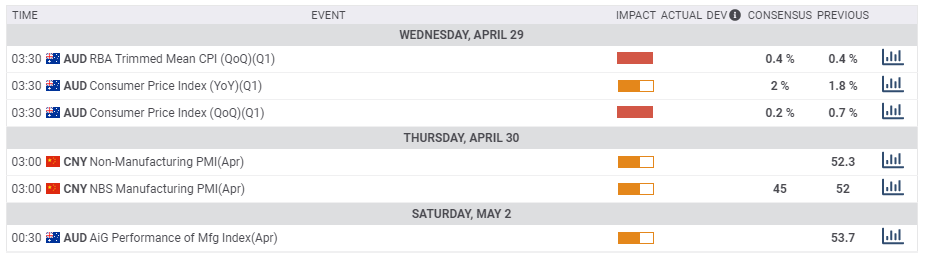
The economic calendar features the backward-looking Australian Consumer Price Index release for the first quarter. Economists foresee a pickup in inflation, yet the RBA is unlikely to raise rates anytime soon.
The second significant release of the week is China's official PMIs for April. These forward-looking surveys have been surprisingly resilient in March, topping the 50 thresholds. The Manufacturing PMI has likely dropped below that level, shifting from expansion to contraction.
Here the most prominent Australian and Chinese releases on the economic calendar:
US events: Opening the tap and top-tier events
April is drawing to an end, and President Trump touted May as a potential opportunity for returning to normal. It is already clear that any removal of restrictions will be gradual and at different speeds in America's 50 states. Governors' decisions depend on COVID-19 statistics, testing capacity, and also on politics. Figures from New York are in the spotlight, but other states may grab attention.
While lawmakers have passed several massive stimulus bills, they may begin working on new ones, perhaps helping cities and states. Tensions between the White House and governors are also eyed.
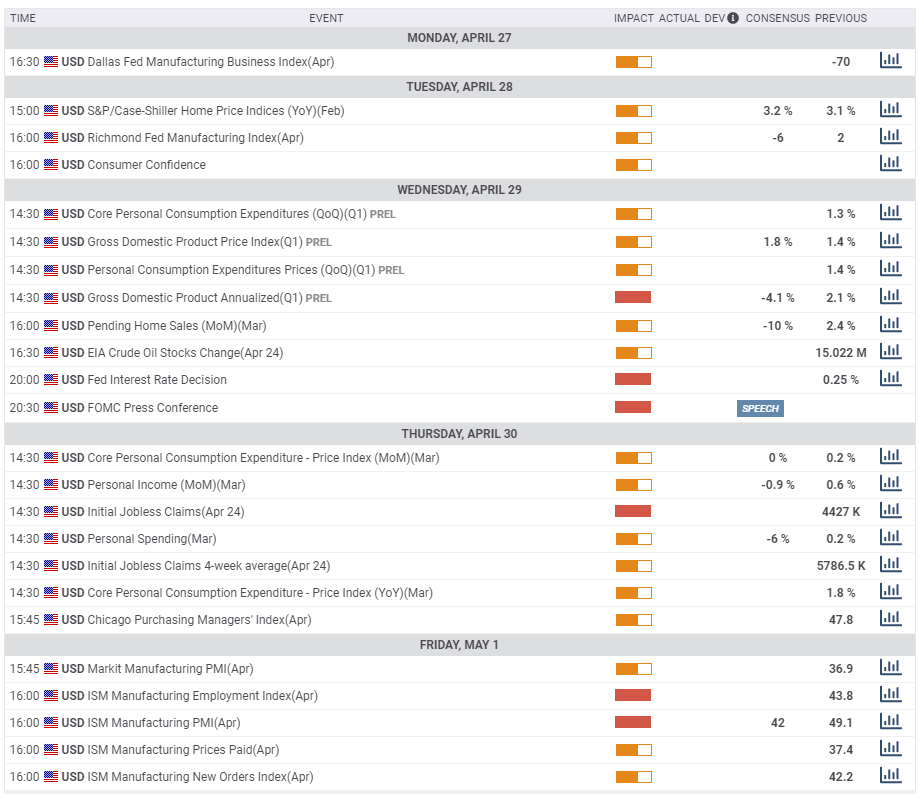
The economic calendar consists of top-tier events. The Conference Board's Consumer Confidence report for April is of interest on Tuesday and serves as a warmup for Wednesday's highly-anticipated releases. The first estimate for Gross Domestic Product for the first quarter is set to show an annualized contraction of 4.1%, which may be only the beginning of a downfall
The Federal Reserve announces its first scheduled decisions since January and after non-stop announcements during March and early April. The Fed will likely leave its interest rate at 0% and continues its massive Quantitative Easing schemes and other measures. Jerome Powell, Chairman of the Federal Reserve, will likely present new economic forecasts which may move markets. The dollar has room to rise in response to inaction or gloomy forecasts.
For more, see the full Fed Preview: Taking a break after two months of madness? Addicted markets may fall, dollar rise
The action continues with weekly unemployment claims, and continuing claims may be of interest as they refer to the week ending April 17, the Non-Farm Payrolls survey period. Both figures are set to remain in the millions.
The last word of the week belongs to the ISM Manufacturing PMI for April, which also provides a hint toward the NFP. After holding in March, it will likely fall in the upcoming report. The employment component is of interest.
Here are the top US events as they appear on the forex calendar:
AUD/USD Technical Analysis
The Aussie/USD daily chart is somewhat mixed. While momentum remains positive, it is waning. The currency pair surpassed the 50-day SMA but remained well below the 100 and 200 SMAs. All in all, the picture is mixed.
Support awaits at 0.6260, which provided support in late April. It is closely followed by 0.6215, which capped AUD/USD in late March. Next, 0.61 was a stepping stone on the way up and is supported by 0.5980, which was a low point in early April.
Resistance is at 0.64, a round mark, and also a stubborn cap in late April. The monthly high of 0.6450 is critical resistance. The next noteworthy level is 0.6550, which separated ranges in February and March, followed by 0.6590, where the 100-day SMA hits the price.
-637233200410758405.png)
AUD/USD Sentiment Poll
While coronavirus may have peaked in many Western countries, the economic damage is becoming more and more evident. Without massive new stimulus or medical breakthroughs, the gloomy mood may send markets and the Aussie lower.
The FXStreet Forecast Poll is showing that experts are bearish, seeing gradual falls as time passes by. The average target for the short term is little-changed, but the medium and long-term targets have been downgraded.
Related Forecasts:
- Reopening: Timing is tough, and two assets have more room to rise regardless
- Coronavirus: Lack of leadership may lead to an L-shaped economy, markets may suffer badly
- GBP/USD Forecast: How long can it hold on? UK lockdowns and gloomy US data may bring it down
- Gold Price Forecast: More easing in the docket to keep boosting the metal
Author

Yohay Elam
FXStreet
Yohay is in Forex since 2008 when he founded Forex Crunch, a blog crafted in his free time that turned into a fully-fledged currency website later sold to Finixio.

















