USD/JPY surrenders majority of intraday gains as US Dollar retreats
- USD/JPY surrenders a majority of its intraday gains after a sharp rally in the opening session.
- The pair gives up gains as US Dollar falls back amid uncertainty ahead of US data.
- The scenario of a coalition government in Japan has diminished BoJ rate hike prospects.
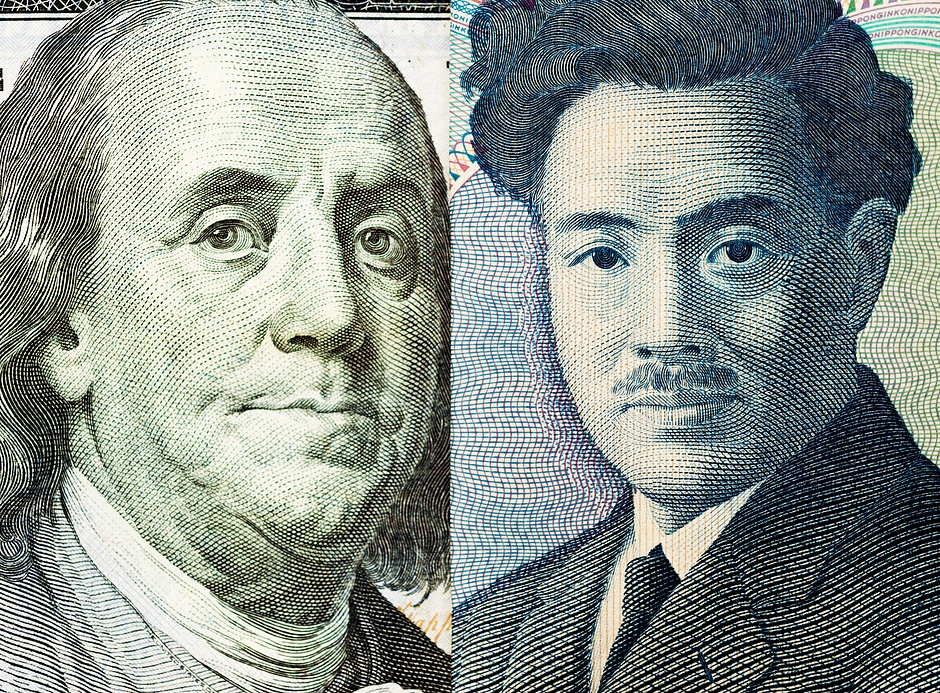

The USD/JPY pair gives up the majority of its intraday gains after facing significant bids near 154.00 in Monday’s North American session. The asset showed a strong upside move in the opening session due to a sharp weakness in the Japanese Yen (JPY) but faced pressure at elevated levels as the US Dollar (USD) retreated after failing to extend rally.
The US Dollar Index (DXY), which tracks the Greenback’s value against six major currencies, falls back after revisiting an almost three-month high of 104.60. The Greenback’s rally appears to have stalled as investors turn cautious ahead of a string of United States (US) economic data such as: JOLTS Job Openings and Personal Consumption Expenditure Price Index (PCE) for September, Q3 Gross Domestic Product (GDP), and the ISM Manufacturing PMI and the Nonfarm Payrolls (NFP) data for October, to be published this week.
The economic data will significantly influence market expectations for the Federal Reserve’s (Fed) likely interest rate action for the remaining two meetings this year. According to the CME FedWatch tool, traders have priced in a usual size rate cut of 25 basis points (bps) in November and are confident that a similar move will be performed in the December meeting.
Market participants are likely to focus more on the economic growth and labor market-related data as Fed officials are confident the inflation remains sustainably on track towards bank’s target of 2%.
Meanwhile, the outlook of the Yen has weakened as the Japanese economy is poised to run by a coalition government after the ruling Liberal Democratic Party (LDP) failed to get majority seats in the snap election. The scenario bodes poorly for forward growth as Shigeru Ishiba won’t be the only caretaker of the economy. This has also weakened hopes of more interest rate hikes from the Bank of Japan (BoJ) for this year.
Japanese Yen FAQs
The Japanese Yen (JPY) is one of the world’s most traded currencies. Its value is broadly determined by the performance of the Japanese economy, but more specifically by the Bank of Japan’s policy, the differential between Japanese and US bond yields, or risk sentiment among traders, among other factors.
One of the Bank of Japan’s mandates is currency control, so its moves are key for the Yen. The BoJ has directly intervened in currency markets sometimes, generally to lower the value of the Yen, although it refrains from doing it often due to political concerns of its main trading partners. The BoJ ultra-loose monetary policy between 2013 and 2024 caused the Yen to depreciate against its main currency peers due to an increasing policy divergence between the Bank of Japan and other main central banks. More recently, the gradually unwinding of this ultra-loose policy has given some support to the Yen.
Over the last decade, the BoJ’s stance of sticking to ultra-loose monetary policy has led to a widening policy divergence with other central banks, particularly with the US Federal Reserve. This supported a widening of the differential between the 10-year US and Japanese bonds, which favored the US Dollar against the Japanese Yen. The BoJ decision in 2024 to gradually abandon the ultra-loose policy, coupled with interest-rate cuts in other major central banks, is narrowing this differential.
The Japanese Yen is often seen as a safe-haven investment. This means that in times of market stress, investors are more likely to put their money in the Japanese currency due to its supposed reliability and stability. Turbulent times are likely to strengthen the Yen’s value against other currencies seen as more risky to invest in.
Author
Sagar Dua
FXStreet
Sagar Dua is associated with the financial markets from his college days. Along with pursuing post-graduation in Commerce in 2014, he started his markets training with chart analysis.