|

USD/JPY Price Prediction: Potential for more downside

  • USD/JPY has pulled back after touching down on support at the 100-day SMA. 
  • The pair is in a downtrend and has broken out of a bearish pattern, raising the risk of further declines. 

USD/JPY has found support just above the 100-day Simple Moving Average (SMA) at 148.96 and bounced. 

On Monday, the pair formed an Inverted Hammer candlestick pattern and if Tuesday ends as a green up day it will gain confirmation as a near-term reversal signal. This could indicate a recovery and correction higher.

USD/JPY Daily Chart 
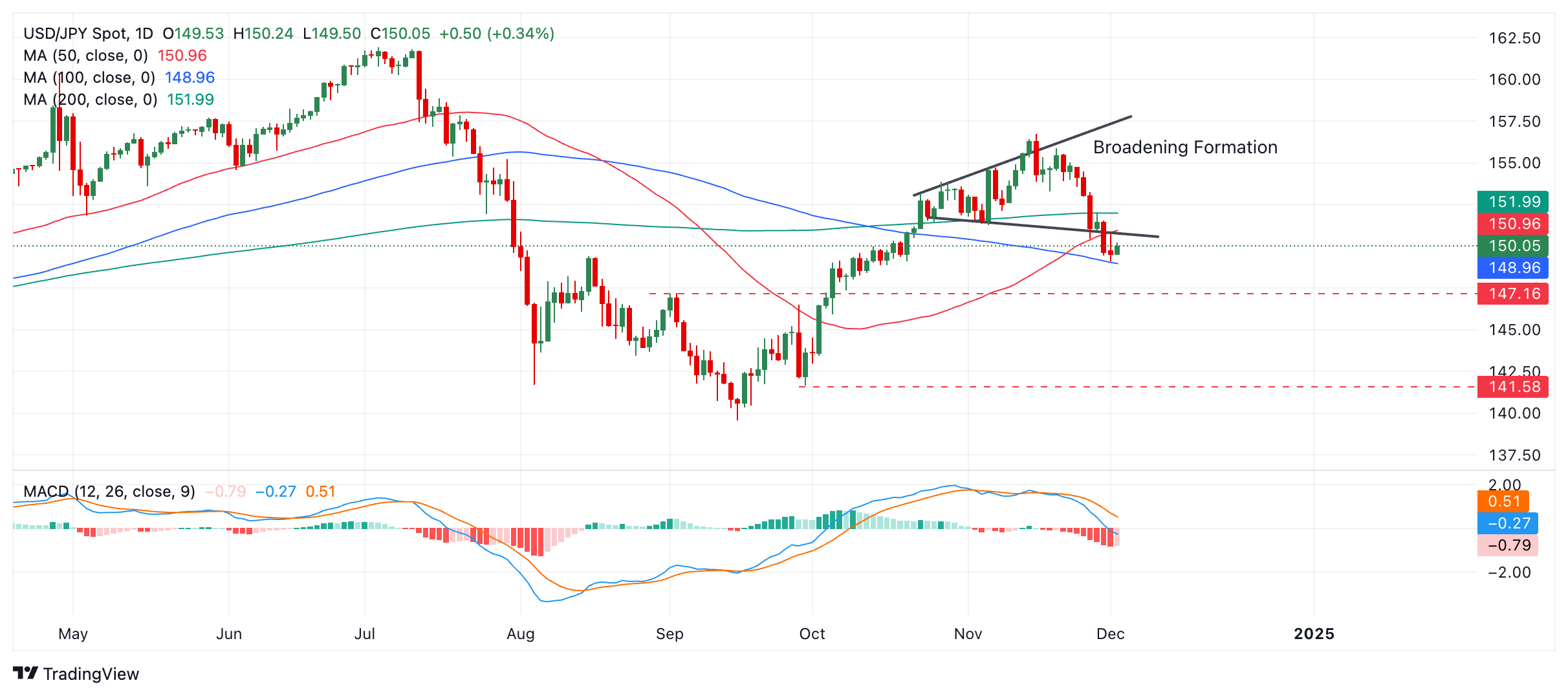
Despite the risk of a correction higher, USD/JPY remains in a downtrend on a short and medium-term basis and because of the technical analysis principle that trends tend to extend, the odds favor more downside evolving eventually.

A break below the December 2 lows at 149.08 would confirm an extension of the downtrend to the first target at around 147.92 (revised down due to pattern widening), the 61.8% Fibonacci extrapolation of the height of the bearish Broadening Formation pattern extrapolated lower. 

Further bearishness could carry USD/JPY to the next target at 147.18, the September 2, key swing high.

The (blue) Moving Average Convergence Divergence (MACD) momentum indicator is diverging away from its red signal line which is bearish and has fallen below the zero line on an intraday basis. If it closes below zero then it will increase the bearishness of the indicator reading.   

Author

Joaquin Monfort

Joaquin Monfort is a financial writer and analyst with over 10 years experience writing about financial markets and alt data. He holds a degree in Anthropology from London University and a Diploma in Technical analysis.


More from Joaquin Monfort
Share:

Markets move fast. We move first.

Orange Juice Newsletter brings you expert driven insights - not headlines. Every day on your inbox.

By subscribing you agree to our Terms and conditions.

Editor's Picks

EUR/USD could test 1.1750 amid strengthening bullish bias

EUR/USD remains flat after two days of small losses, trading around 1.1740 during the Asian hours on Thursday. On the daily chart, technical analysis indicates a strengthening of a bullish bias, as the pair continues to trade within an ascending channel pattern.

GBP/USD consolidates above mid-1.3300s as traders await BoE and US CPI report

The GBP/USD pair struggles to capitalize on the overnight bounce from the 1.3310 area, or a one-week low, and oscillates in a narrow band during the Asian session on Thursday. Spot prices currently trade around the 1.3370 region, down less than 0.10% for the day, as traders opt to wait on the sidelines ahead of the key central bank event risk and US consumer inflation data.

Gold awaits weekly trading range breakout ahead of US CPI report

Gold struggles to capitalize on the previous day's move higher back closer to the $4,350 level and trades with a mild negative bias during the Asian session on Thursday. The downtick could be attributed to some profit-taking amid a US Dollar uptick, though it is likely to remain cushioned on the back of a supportive fundamental backdrop. 

Dogecoin breaks key support amid declining investor confidence

Dogecoin trades in the red on Thursday, following a 4% decline on the previous day. The DOGE supply in profit declines as large wallet investors trim their portfolios. Derivatives data shows a surge in bearish positions amid declining retail interest.

Monetary policy: Three central banks, three decisions, the same caution

While the Fed eased its monetary policy on 10 December for the third consecutive FOMC meeting, without making any guarantees about future action, the BoE, the ECB and the BoJ are holding their respective meetings this week. 

Dogecoin Price Forecast: DOGE breaks key support amid declining investor confidence

Dogecoin (DOGE) trades in the red on Thursday, following a 4% decline on the previous day. The DOGE supply in profit declines as large wallet investors trim their portfolios. Derivatives data shows a surge in bearish positions amid declining retail interest.