USD/INR drifts higher as investors await US PMI data
- The Indian Rupee loses ground in Thursday’s early European session.
- Indian HSBC Manufacturing PMI came in weaker than expected, declining to 58.1 in July vs. 58.3 prior.
- India’s outflows, renewed USD demand and higher crude oil prices might undermine the INR, while Fed’s dovish could limit losses.
- Market players await the US Manufacturing PMI and weekly Initial Jobless Claims on Thursday for fresh impetus.

The Indian Rupee (INR) edges lower despite the decline of the US Dollar (USD) on Thursday. The latest data showed that India's manufacturing sector growth eased slightly in July due to softer increases in new orders and output, while cost pressures and demand strength contributed to the steepest increase in selling prices since October 2013. The INR struggles to gain ground despite continuous growth in the manufacturing sector.
Additionally, significant outflows from Indian equities, persistent USD demand from importers, and fluctuations in the Chinese Yuan might cap the INR’s upside in the near term. A rise in crude oil prices amid the Middle East geopolitical tensions is likely to weigh on the local currency as India is the third largest consumer of oil behind the US and China.
The US Federal Reserve (Fed) decided to keep its interest rates unchanged in the range of 5.25%-5.50% for the eighth time in a row at its July meeting on Wednesday. The dovish stance of Fed Chair Jerome Powell after the policy meeting could undermined the Greenback broadly.
Looking ahead, traders will keep an eye on the US ISM Manufacturing PMI, weekly Initial Jobless Claims, and the final S&P Global Manufacturing PMI, which are due later on Thursday. The outcome of these reports might offer more hints about the interest rate path in September.
Daily Digest Market Movers: Indian Rupee remains weak amid global challenges
- India’s HSBC Manufacturing Purchasing Managers Index (PMI) eased to 58.1 in July from 58.3 in the previous reading. This figure was below the market consensus of 59.0.
- "India's headline manufacturing PMI showed a marginal slowdown in the pace of expansion in July, but with most components remaining at robust levels, the small drop is no cause for concern," said Pranjul Bhandari, Chief India Economist at HSBC.
- India's Ratings and Research (Ind-Ra) raised its economic growth projection for the current fiscal year to 7.5%, up from its earlier estimate of 7.1%.
- Ind-Ra's revised growth projection is higher than most other estimates, including those from the Reserve Bank of India (7.2%), the Economic Survey (6.5 to 7%), and the International Monetary Fund (7%).
- The final reading of HSBC Manufacturing PMI is estimated to improve to 58.5 in July from the previous reading of 58.3.
- During the press conference, Fed Chair Jerome Powell said that the first interest rate cut could come "as soon as" the Fed's next rate meeting in September if the data "continue to point to kind of the direction we would want to see.”
- Powell further stated that the US central bank will closely monitor the labor market and stay vigilant for signs of a potentially sharp downturn.
- Futures traders are now pricing in a 100% possibility that the central bank will cut interest rates by 25 basis points (bps) in its September meeting, according to CME FedWatch Tool.
Technical analysis: USD/INR keeps the bullish vibe in the longer term
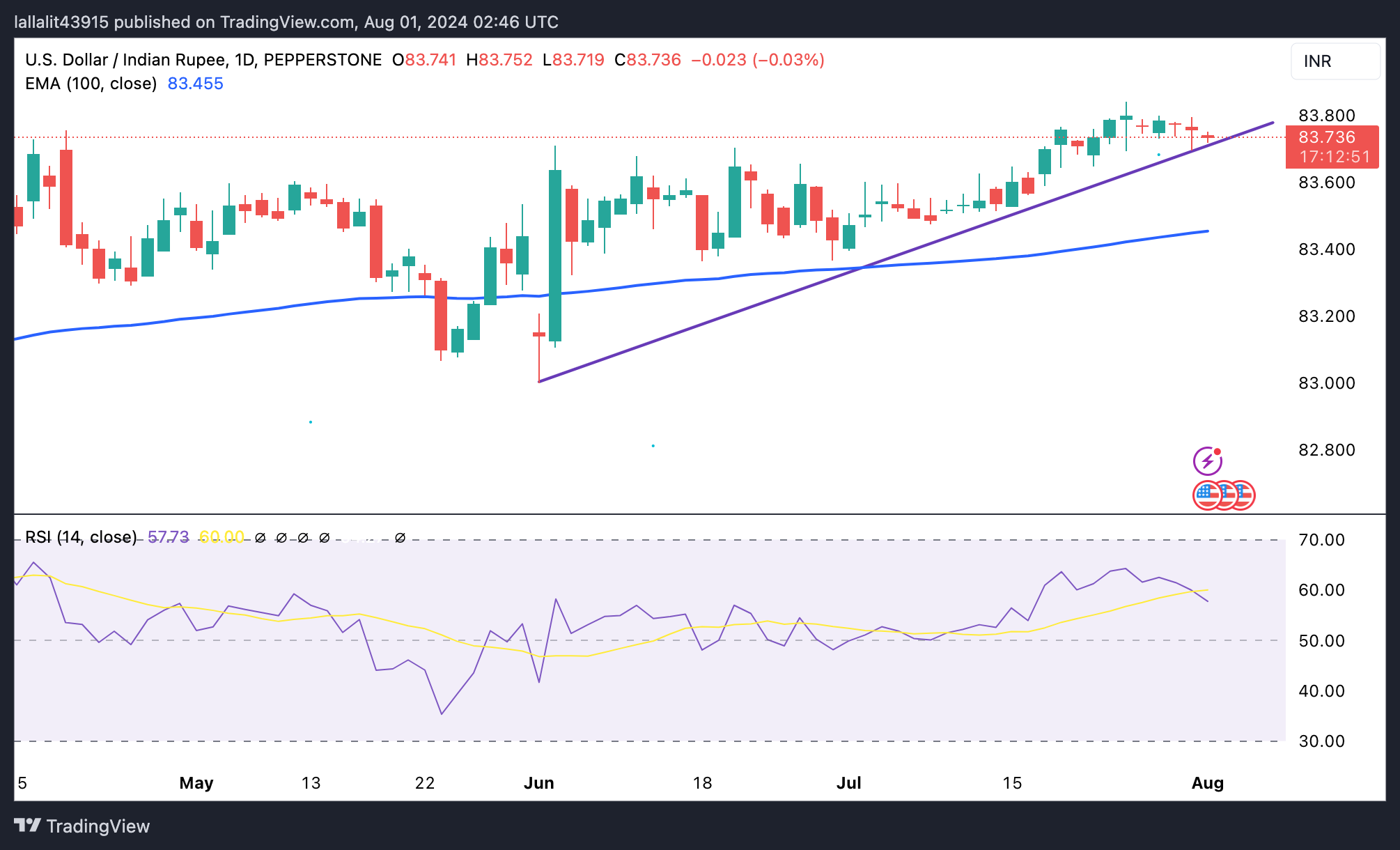
Indian Rupee trades softer on the day. The longer-term trend of the USD/INR pair remains bullish, with the price holding around the key 100-day Exponential Moving Average (EMA) and being underpinned by the uptrend line since June 3 on the daily chart. The 14-day Relative Strength Index (RSI) stands above the midline near 58.40, suggesting a potential upside for the time being.
The immediate resistance level is located at the all-time high of 83.85. If the price manages to break above this level, it will spur further upside to the 84.00 psychological level.
On the other hand, the initial support level is seen at the uptrend line around 83.70. If the price breaks below this level, it would signal further selling pressure towards 83.51, a low of July 12. Extended losses will pave the way to 83.45, the 100-day EMA.
US Dollar price this week
The table below shows the percentage change of US Dollar (USD) against listed major currencies this week. US Dollar was the strongest against the Australian Dollar.
| USD | EUR | GBP | CAD | AUD | JPY | NZD | CHF | |
| USD | 0.24% | 0.12% | -0.18% | 0.35% | -2.96% | -1.12% | -0.84% | |
| EUR | -0.24% | -0.12% | -0.42% | 0.13% | -3.19% | -1.36% | -1.10% | |
| GBP | -0.13% | 0.12% | -0.30% | 0.24% | -3.07% | -1.24% | -0.97% | |
| CAD | 0.18% | 0.42% | 0.30% | 0.54% | -2.78% | -0.94% | -0.67% | |
| AUD | -0.38% | -0.11% | -0.23% | -0.53% | -3.34% | -1.49% | -1.21% | |
| JPY | 2.87% | 3.11% | 2.99% | 2.69% | 3.22% | 1.79% | 2.05% | |
| NZD | 1.12% | 1.34% | 1.22% | 0.91% | 1.46% | -1.82% | 0.27% | |
| CHF | 0.84% | 1.08% | 0.96% | 0.67% | 1.20% | -2.10% | -0.27% |
The heat map shows percentage changes of major currencies against each other. The base currency is picked from the left column, while the quote currency is picked from the top row. For example, if you pick the Euro from the left column and move along the horizontal line to the Japanese Yen, the percentage change displayed in the box will represent EUR (base)/JPY (quote).
Interest rates FAQs
Interest rates are charged by financial institutions on loans to borrowers and are paid as interest to savers and depositors. They are influenced by base lending rates, which are set by central banks in response to changes in the economy. Central banks normally have a mandate to ensure price stability, which in most cases means targeting a core inflation rate of around 2%. If inflation falls below target the central bank may cut base lending rates, with a view to stimulating lending and boosting the economy. If inflation rises substantially above 2% it normally results in the central bank raising base lending rates in an attempt to lower inflation.
Higher interest rates generally help strengthen a country’s currency as they make it a more attractive place for global investors to park their money.
Higher interest rates overall weigh on the price of Gold because they increase the opportunity cost of holding Gold instead of investing in an interest-bearing asset or placing cash in the bank. If interest rates are high that usually pushes up the price of the US Dollar (USD), and since Gold is priced in Dollars, this has the effect of lowering the price of Gold.
The Fed funds rate is the overnight rate at which US banks lend to each other. It is the oft-quoted headline rate set by the Federal Reserve at its FOMC meetings. It is set as a range, for example 4.75%-5.00%, though the upper limit (in that case 5.00%) is the quoted figure. Market expectations for future Fed funds rate are tracked by the CME FedWatch tool, which shapes how many financial markets behave in anticipation of future Federal Reserve monetary policy decisions.
Author

Lallalit Srijandorn
FXStreet
Lallalit Srijandorn is a Parisian at heart. She has lived in France since 2019 and now becomes a digital entrepreneur based in Paris and Bangkok.