USD/CAD Price Forecast: Trades cautiously ahead of US PCE inflation, Canadian GDP
- USD/CAD exhibits caution below 1.3500 ahead of US and Canada data.
- Economists estimate the Canadian economy to have grown by 0.1% in July.
- The US PCE inflation will influence market expectation for Fed’s interest rate outlook.

The USD/CAD pair trades with caution below the psychological resistance of 1.3500 in Friday’s European session. The Loonie asset is marginally higher despite a slight decline in the US Dollar (USD), suggesting a weakness in the Canadian Dollar (CAD) ahead of the monthly Gross Domestic Product (GDP) data for July, which will be published at 12:30 GMT.
The Canadian economy is estimated to have barely grown after remaining flat in June. The Bank of Canada (BoC) is already expected to extend its policy-easing cycle due to decelerating inflation trend and weakening labor market conditions.
At the same time, the major release will be the United States (US) Personal Consumption Expenditures price index (PCE) data for August. The core PCE inflation, the Federal Reserve’s (Fed) preferred inflation gauge, is estimated to have grown by 2.7% year-on-year, faster than 2.6% in July.
The underlying inflation data will significantly influence the Fed’s interest rate outlook for the last quarter of the year. Financial market participants expect the Fed to reduce interest rates further by 75 bps, collectively in the remaining two policy meetings.
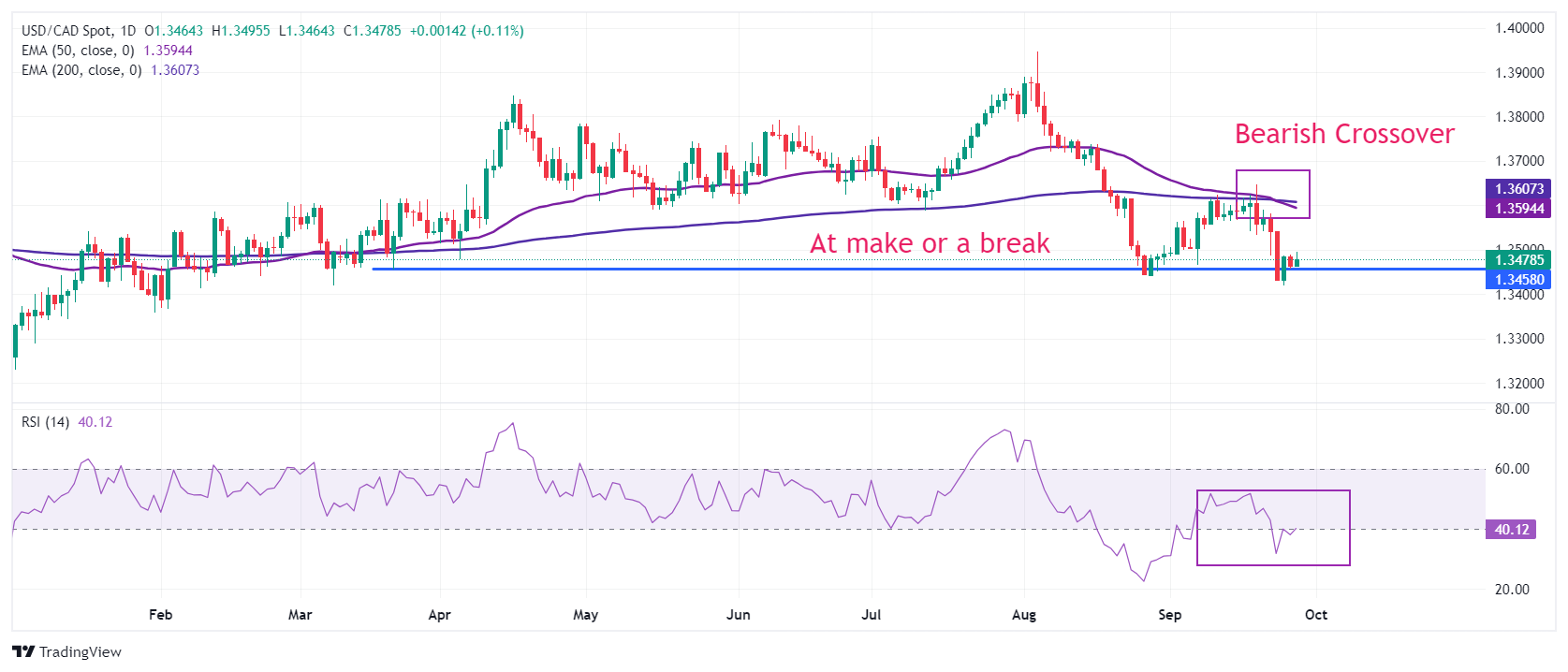
USD/CAD trades at a make or a break above the immediate support of 1.3400. The major formed a fresh swing low near 1.3400 on a daily timeframe, suggesting a bearish trend. A bear cross, represented by the 20 and 50-day Exponential Moving Averages (EMAs) near 1.3600, indicates more downside ahead.
The 14-day Relative Strength Index delivers a range shift move into the 20.00-60.00 territory from 40.00-80.00, which suggests that pullbacks would be considered as selling opportunities by investors.
Going forward, a further correction by the major below the immediate support of 1.3400 would expose it to the January 31 low of 1.3360 and a June 9 low of 1.3340.
In an alternate scenario, a recovery move above the psychological support of 1.3500 would drive the asset towards the April 5 low of 1.3540, followed by the September 20 high of 1.3590.
USD/CAD daily chart
Canadian Dollar FAQs
The key factors driving the Canadian Dollar (CAD) are the level of interest rates set by the Bank of Canada (BoC), the price of Oil, Canada’s largest export, the health of its economy, inflation and the Trade Balance, which is the difference between the value of Canada’s exports versus its imports. Other factors include market sentiment – whether investors are taking on more risky assets (risk-on) or seeking safe-havens (risk-off) – with risk-on being CAD-positive. As its largest trading partner, the health of the US economy is also a key factor influencing the Canadian Dollar.
The Bank of Canada (BoC) has a significant influence on the Canadian Dollar by setting the level of interest rates that banks can lend to one another. This influences the level of interest rates for everyone. The main goal of the BoC is to maintain inflation at 1-3% by adjusting interest rates up or down. Relatively higher interest rates tend to be positive for the CAD. The Bank of Canada can also use quantitative easing and tightening to influence credit conditions, with the former CAD-negative and the latter CAD-positive.
The price of Oil is a key factor impacting the value of the Canadian Dollar. Petroleum is Canada’s biggest export, so Oil price tends to have an immediate impact on the CAD value. Generally, if Oil price rises CAD also goes up, as aggregate demand for the currency increases. The opposite is the case if the price of Oil falls. Higher Oil prices also tend to result in a greater likelihood of a positive Trade Balance, which is also supportive of the CAD.
While inflation had always traditionally been thought of as a negative factor for a currency since it lowers the value of money, the opposite has actually been the case in modern times with the relaxation of cross-border capital controls. Higher inflation tends to lead central banks to put up interest rates which attracts more capital inflows from global investors seeking a lucrative place to keep their money. This increases demand for the local currency, which in Canada’s case is the Canadian Dollar.
Macroeconomic data releases gauge the health of the economy and can have an impact on the Canadian Dollar. Indicators such as GDP, Manufacturing and Services PMIs, employment, and consumer sentiment surveys can all influence the direction of the CAD. A strong economy is good for the Canadian Dollar. Not only does it attract more foreign investment but it may encourage the Bank of Canada to put up interest rates, leading to a stronger currency. If economic data is weak, however, the CAD is likely to fall.
Author

Sagar Dua
FXStreet
Sagar Dua is associated with the financial markets from his college days. Along with pursuing post-graduation in Commerce in 2014, he started his markets training with chart analysis.