USD/CAD Price Forecast: Hesitates to break above 1.3900
- USD/CAD strives to climb above 1.3900 as the US Dollar clings to gains.
- Investors await a slew of US macroeconomic data for fresh interest rate guidance.
- The Canadian Dollar has been battered by weak Oil prices.

The USD/CAD pair struggles to extend its rally above the round-level resistance of 1.3900 in Tuesday’s European session. The rally in the Loonie pair appears to have paused for a while, with investors focusing on a string of the United States (US) economic data to be released this week. The US Dollar Index (DXY), which tracks the Greenback’s value against six major currencies, edges lower in European trading hours but is close to a fresh almost three-month high near 104.60.
This week, investors will pay close attention to the US labor market-related indicators such as JOLTS Job Openings, ADP Employment and the Nonfarm Payrolls, Personal Consumption Expenditure Price Index (PCE), and the flash Q3 Gross Domestic Product (GDP) to get insights about the Federal Reserve’s (Fed) likely interest rate action in both policy meetings in November and December.
Meanwhile, the overall market mood appears to be very quiet, with investors remaining cautious about US presidential elections on November 5. Latest election polls have shown that the competition between Vice President Kamala Harris and former US President Donald Trump will be a tough call.
In the Canadian region, plunging Oil prices have dampened the Canadian Dollar’s (CAD) appeal. It is worth noting that Canada is the leading exporter of Oil to the US and lower fund flows into the oil-exporting region weakens its domestic currency.
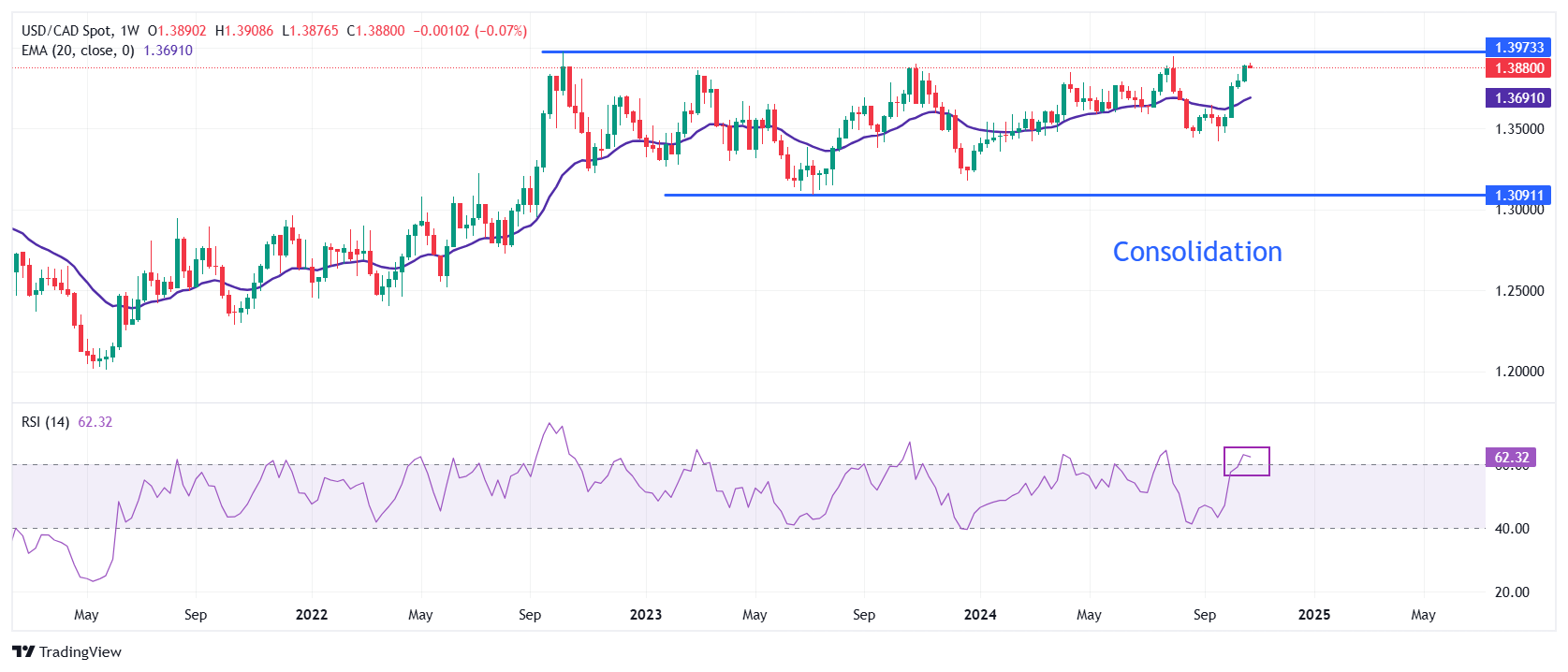
USD/CAD is swiftly approaching the upper end of a year-long consolidation range near 1.3980. The outlook of the Loonie pair remains firm as it trades above the 20-week Exponential Moving Average (EMA), which trades around 1.3690.
The 14-day Relative Strength Index (RSI) climbs above 60.00, pointing to an activation in bullish momentum.
The Loonie asset could extend its upside towards the October 2022 high of nearly 1.3977 after breaking above Monday’s high of 1.3910. The asset will enter unchartered territory if it breaks above the annual high.
On the flip side, a downside move could appear if the asset breaks below the October 22 low of 1.3810. This would expose the asset to the 20-day EMA near 1.3770 and the October 16 low of 1.3750.
USD/CAD daily chart
Canadian Dollar FAQs
The key factors driving the Canadian Dollar (CAD) are the level of interest rates set by the Bank of Canada (BoC), the price of Oil, Canada’s largest export, the health of its economy, inflation and the Trade Balance, which is the difference between the value of Canada’s exports versus its imports. Other factors include market sentiment – whether investors are taking on more risky assets (risk-on) or seeking safe-havens (risk-off) – with risk-on being CAD-positive. As its largest trading partner, the health of the US economy is also a key factor influencing the Canadian Dollar.
The Bank of Canada (BoC) has a significant influence on the Canadian Dollar by setting the level of interest rates that banks can lend to one another. This influences the level of interest rates for everyone. The main goal of the BoC is to maintain inflation at 1-3% by adjusting interest rates up or down. Relatively higher interest rates tend to be positive for the CAD. The Bank of Canada can also use quantitative easing and tightening to influence credit conditions, with the former CAD-negative and the latter CAD-positive.
The price of Oil is a key factor impacting the value of the Canadian Dollar. Petroleum is Canada’s biggest export, so Oil price tends to have an immediate impact on the CAD value. Generally, if Oil price rises CAD also goes up, as aggregate demand for the currency increases. The opposite is the case if the price of Oil falls. Higher Oil prices also tend to result in a greater likelihood of a positive Trade Balance, which is also supportive of the CAD.
While inflation had always traditionally been thought of as a negative factor for a currency since it lowers the value of money, the opposite has actually been the case in modern times with the relaxation of cross-border capital controls. Higher inflation tends to lead central banks to put up interest rates which attracts more capital inflows from global investors seeking a lucrative place to keep their money. This increases demand for the local currency, which in Canada’s case is the Canadian Dollar.
Macroeconomic data releases gauge the health of the economy and can have an impact on the Canadian Dollar. Indicators such as GDP, Manufacturing and Services PMIs, employment, and consumer sentiment surveys can all influence the direction of the CAD. A strong economy is good for the Canadian Dollar. Not only does it attract more foreign investment but it may encourage the Bank of Canada to put up interest rates, leading to a stronger currency. If economic data is weak, however, the CAD is likely to fall.
Author

Sagar Dua
FXStreet
Sagar Dua is associated with the financial markets from his college days. Along with pursuing post-graduation in Commerce in 2014, he started his markets training with chart analysis.

















