USD/CAD bulls stepping in during accumilation phase
- USD/CAD is currently consolidating around the lowest levels since 2017.
- Bulls are looking for an upside correction on a monthly basis as accumulation kicks in.

Funds travelled between a high of 1.2078 and 1.2029 on the day with some upside pressure, rising 0.12% at the time of writing.
The loonie edged lower against its broadly weaker greenback on Tuesday.
The US dollar has edged lower on Tuesday to print 89.5350 for a fresh 4-1/2 month lows against a basket of peers in the DXY.
Officials from the US Federal Reserve reiterated that policy would stay pat and this has calmed fears about inflation forcing rates higher.
Earlier this week, we heard from both Fed Board Governor Lael Brainard and James Bullard, president of the St. Louis Federal Reserve.
Brainard assuaged inflation concerns, saying she expects that price spikes associated with supply bottlenecks and the reopening of the economy to "subside over time."
Bullard said that while still in the pandemic, it was not the time to talk more about changing the parameters of monetary policy.
The tones were backed by today's comments from Fed's Richard Clarida who said the threats to financial stability are manageable and that data continue to support inflation forecasts that are well anchored.
Meanwhile, however, the Canadian dollar was pressured by domestic data that has otherwise enjoyed consistent better than expected data of late.
On Tuesday, the numbers showed a likely drop for manufacturing sales in April.
Canadian factory sales likely fell 1.1% in April from March, giving back some of the previous month's increase, a flash estimate from Statistics Canada showed.
The decrease was mostly attributed to lower sales in the transportation equipment industry.
Canadian government bond yields were lower across a flatter curve as well.
The 10-year marked its lowest since May 10 at 1.505% before edging up to 1.508%, down 3.5 basis points on the day.
Taking a deeper look at the outlook
Winding the charts back, the loonie has climbed 5.7% since the start of the year, the biggest gain among G10 currencies.
The currency has been bolstered by higher commodity prices and a hawkish shift last month from the Bank of Canada.
The monthly and weekly charts are compelling and are due for a correction, (more on this below).
Fundamentally, however, strategists at Scotiabank, including Shaun Osborne, said "there appears to be little concern at the central bank about the CAD and the message is clear that the central bank will keep policy settings aligned with the economy as it works towards its goals."
"We continue to target a deeper push below 1.20 in the coming months," the strategists said.
Moreover, speculators have raised their bullish bets on the Canadian dollar to the highest since November 2019, data from the US Commodity Futures Trading Commission (CFTC) showed on Friday as the market prices in a reasonably hawkish road map for the BoC.
All eyes on the oil price
This week will be very quiet otherwise on the data front and there are no BoC speakers scheduled which leaves the loonie more vulnerable to potential unwelcome swings in commodity prices.
While there is the case for a technical upside correction, the linchpin for the loonie could be in the price of oil in particular.
The price of oil, one of Canada's major exports, has been supported by tempered expectations of an early return of oil exporter Iran to international crude markets as well as prospects of unprecedented demand from the global economic recovery during these forthcoming summer vacation and travelling months.
Concerns that Iran was soon going to start selling oil if an agreement resulted in the lifting of UN and other sanctions on crude exports had pulled down prices earlier but talks have not been conclusive.
Indirect negotiations between the United States and Iran are due to resume in Vienna this week. Talks were given another life after Tehran and the UN nuclear agency extended a monitoring agreement on the Middle Eastern country's atomic programme.
However, the apparent differences suggest an end to sanctions is still some way off,'' analysts at ANZ Bank said.
''With economic growth continuing to recover, and the market approaching the seasonal peak in demand, it will be in a much stronger position to handle any additional oil.''
USD/CAD technical analysis
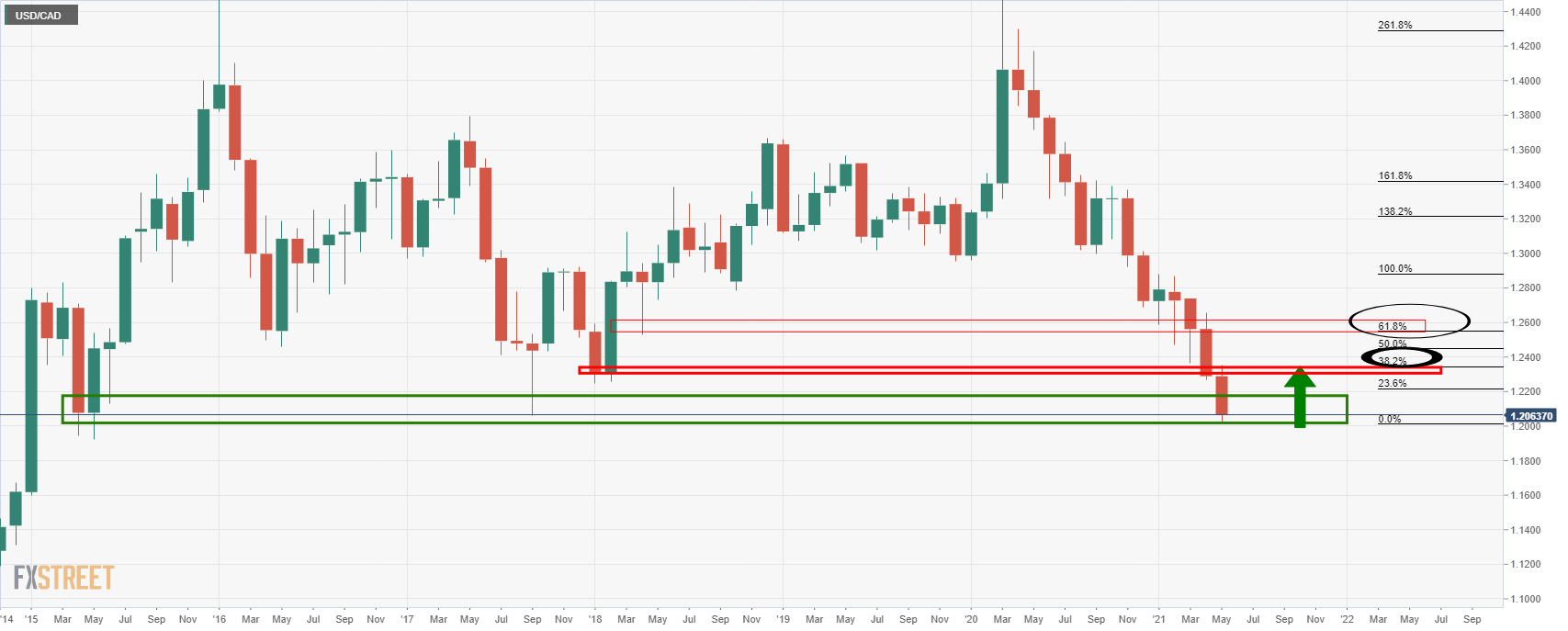
The price would be expected to correct following such a fast move to the downside within three months of consecutive lower lows.
Accumilation is kicking in.
A 38.2% Fibonacci retracement aligns perfectly with the prior lows of 2018 as a meanwhile upside target.
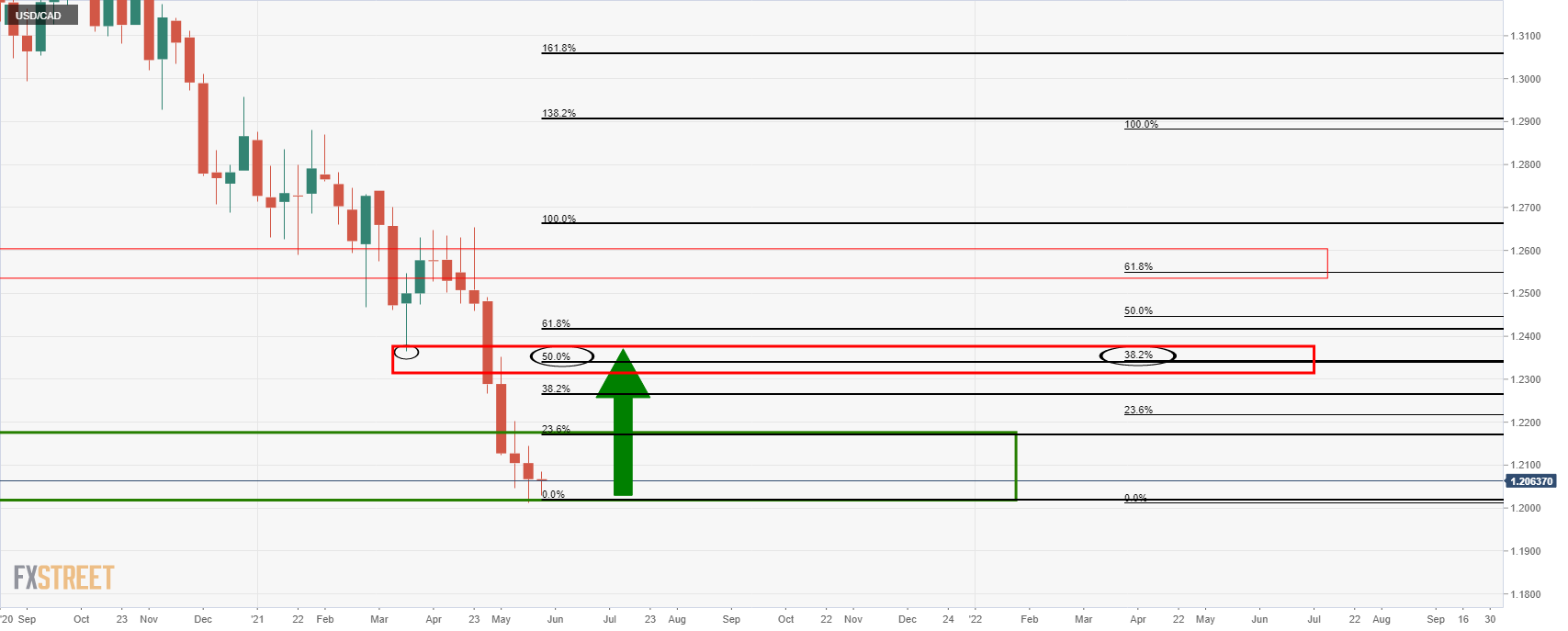
From a weekly impulse perspective, there is a confluence of the 50% mean reversion and 38.2% Fibonacci on the monthly impulse reinforcing the monthly resistance target:
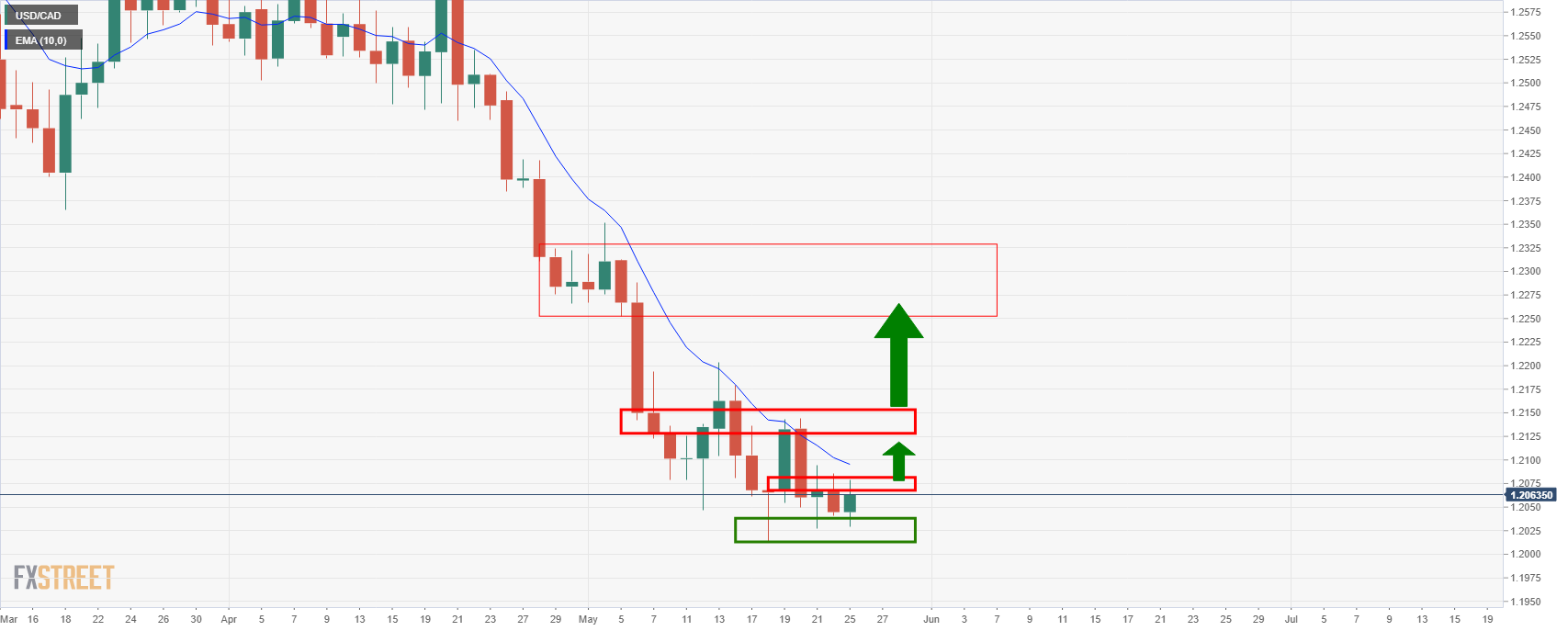
From a daily perspective, bulls will want to see the near term resistances broken for a high probability run between there and the monthly/weekly resistance target area:
Author
Ross J Burland
FXStreet
Ross J Burland, born in England, UK, is a sportsman at heart. He played Rugby and Judo for his county, Kent and the South East of England Rugby team.