US Dollar roars after December Jobs Report smashes it out of the park
- The US Dollar rallies and sees Euro (EUR) print fresh 13-month low against the Greenback at 1.0215.
- Inflation concerns are emerging again after the strong Employment Report and push back Fed's rate cut planning.
- The US Dollar Index (DXY) nearly reaches 110.00 in the US Jobs Report aftermath.

The US Dollar Index (DXY), which tracks the Greenback’s value against six major currencies, is peaking again this Friday. Catalyst was the very positive US employment report where the Nonfarm Payrolls print came in at 256,000 people. Although that was not a beat of the highest estimate, the number was perceived as very good and further fueld the US Dollar.
The upbeat report kicks possible rate cut projections further down the line. At one point even October was penciled in as the first moment for a rate cut in 2025 from the Federal Reserve. It makes sense that with such a strong US employment report, that the Fed will want to keep rates elevated in order to keep inflation under controle and not let the economy overheat.
Daily digest market movers: Best outcome possible
- The US employment report for December was a very good one:
- Nonfarm Payrolls headline data came in at 256,000 new workers against the 227,000 in November.
- The Unemployment Rate fell to 4.1%, coming from 4.2%.
- The monthly Average Hourly Earnings eased a touch to 0.3% in December from the previous 0.4%, as expected.
- At 15:00 GMT, the University of Michigan releases its January preliminary reading:
- The Consumer Sentiment Index is expected to remain elevated at 73.8, just a bit lower from the previous 74.0.
- The 5-year Consumer Inflation Expectation print has no forecast and was at 3% in the final December reading.
- Equities are not happy with the upbeat jobs report, with both European and US equities dipping lower on the back of it.
- The CME FedWatch Tool is projecting a 93.1% chance that interest rates will be kept unchanged at current levels in the January meeting. Expectations are for the Federal Reserve (Fed) to remain data-dependent with uncertainties that could influence the inflation path once President-elect Donald Trump takes office on January 20.
- US yields are soaring again with the 10-year benchmark at 4.786%, again a fresh nine -month high, beating the 4.728% seen on Wednesday.
US Dollar Index Technical Analysis: On its way to parity
The US Dollar Index (DXY) is entering its last ten days of trading under President Joe Biden before President-elect Donald Trump’s inauguration on January 20. The question will be how much downside there is, given the general consensus that Trump’s policies will be inflationary and drive the US Dollar higher. Expect buyers to come in and quickly push the DXY back up, even with a weaker Nonfarm Payrolls release.
On the upside, it is key that the green ascending trend line can hold as support, although that is often not the scenario going forward. If the DXY can head and break above the 110.00 psychological barrier, 110.79 becomes the next big level. Once beyond there, it is quite a stretch to 113.91, the double top from November 2023.
On the contrary, the first downside barrier is 107.35, which has now turned into support. The next level that might halt any selling pressure is 106.52, with the 55-day Simple Moving Average (SMA) at 106.72 reinforcing this region of support.
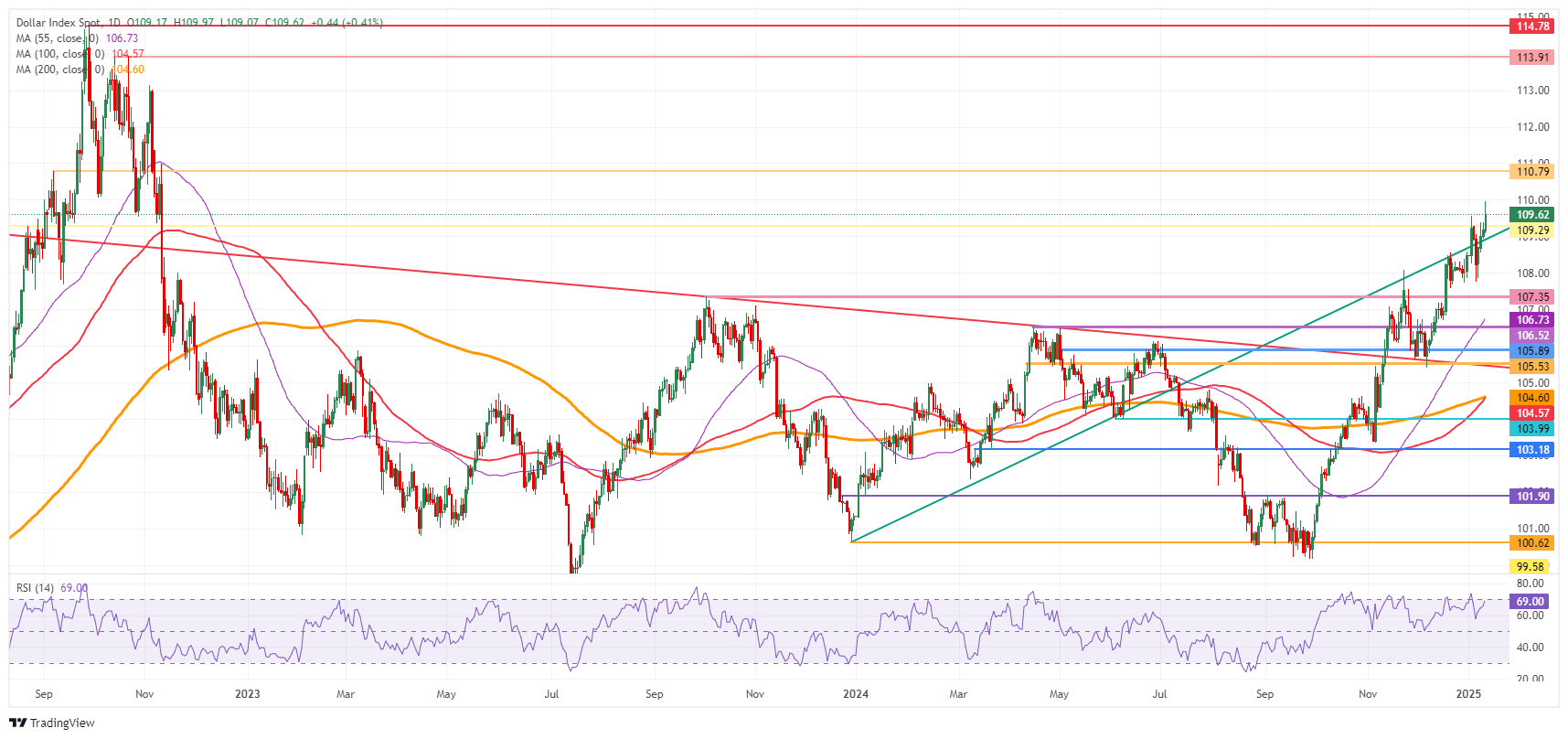
US Dollar Index: Daily Chart
Inflation FAQs
Inflation measures the rise in the price of a representative basket of goods and services. Headline inflation is usually expressed as a percentage change on a month-on-month (MoM) and year-on-year (YoY) basis. Core inflation excludes more volatile elements such as food and fuel which can fluctuate because of geopolitical and seasonal factors. Core inflation is the figure economists focus on and is the level targeted by central banks, which are mandated to keep inflation at a manageable level, usually around 2%.
The Consumer Price Index (CPI) measures the change in prices of a basket of goods and services over a period of time. It is usually expressed as a percentage change on a month-on-month (MoM) and year-on-year (YoY) basis. Core CPI is the figure targeted by central banks as it excludes volatile food and fuel inputs. When Core CPI rises above 2% it usually results in higher interest rates and vice versa when it falls below 2%. Since higher interest rates are positive for a currency, higher inflation usually results in a stronger currency. The opposite is true when inflation falls.
Although it may seem counter-intuitive, high inflation in a country pushes up the value of its currency and vice versa for lower inflation. This is because the central bank will normally raise interest rates to combat the higher inflation, which attract more global capital inflows from investors looking for a lucrative place to park their money.
Formerly, Gold was the asset investors turned to in times of high inflation because it preserved its value, and whilst investors will often still buy Gold for its safe-haven properties in times of extreme market turmoil, this is not the case most of the time. This is because when inflation is high, central banks will put up interest rates to combat it. Higher interest rates are negative for Gold because they increase the opportunity-cost of holding Gold vis-a-vis an interest-bearing asset or placing the money in a cash deposit account. On the flipside, lower inflation tends to be positive for Gold as it brings interest rates down, making the bright metal a more viable investment alternative.
Author

Filip Lagaart
FXStreet
Filip Lagaart is a former sales/trader with over 15 years of financial markets expertise under its belt.

















