Bitcoin could be the winner in the ongoing trade war after showing signs of decoupling from stocks
- President Donald Trump called out Fed Chair Jerome Powell to cut interest rates and "stop playing politics."
- Powell stated that the Fed will maintain a "wait and see" approach as it's too soon to determine policy changes.
- Bitcoin's price held steady on Friday despite the stock market erasing $1.5 trillion, signaling a slight decline in the correlation between crypto and stocks.
- Bitcoin could be the winner in the ongoing global trade war if its "safe haven" narrative picks up pace.

Bitcoin (BTC) traded above $84,000 on Friday, showing strength despite the stock market experiencing significant declines. The market reaction stems from United States (US) President Donald Trump's clash with the Federal Reserve (Fed) Chairman Jerome Powell over interest rate decisions.
Bitcoin shows resilience amid debate on interest rate cuts
In the wake of imposing reciprocal tariffs on international trading patterns, President Trump called out Jerome Powell on his social media platform Truth Social, stating that this is a perfect time for the Fed to cut interest rates. He also claimed that Powell is "always late" and could seize this opportunity to "change his image." Trump further stated that Powell needs to "stop playing politics" concerning the lowering of interest rates.
President Trump's social media post came a few minutes before Powell's speech at the Society for Advancing Business Editing and Writing Annual Conference in Virginia.
Powell shared that the Fed will continue to monitor economic data and weigh potential risks before making any policy changes. He noted that the central bank is in a strong position to hold off on adjustments until there is greater clarity on the economic outlook.
The Fed's decision to maintain a "wait and see" approach to rate cuts sparked further declines across the financial markets. US stocks saw accelerated losses, with the S&P 500 and Nasdaq 100 falling 5.9% and 6%, respectively.
Precious metals also reacted negatively, with Gold down 2.6% and Silver declining over 8% on the day.
However, Bitcoin and crypto prices held steady despite the broader market turmoil. Bitcoin briefly reclaimed the $84,000 mark, while XRP and Solana are up 3% and 5%, respectively.
Bitcoin safe haven narrative picks up pace after decoupling from stocks
The crypto market's firm stance despite a crash in stocks could mean that the correlation between crypto and stocks is weakening. It also indicates a preference for crypto assets as the effect of Trump's tariffs may spark an extended global trade war.
The crypto market's reaction aligns with Bitcoin's safe-haven narrative during periods of extreme market uncertainty, which could appeal to investors if stocks and Gold continue declining.
A similar pattern occurred with Bitcoin during the 2020 COVID-19 pandemic. Bitcoin began 2020 trading at approximately $7,161. The pandemic sparked an initial crash across cryptocurrencies and stocks, with Bitcoin dropping to a bottom of $4,900 in March.
However, the top crypto decoupled from its correlation with stocks, quickly rising in the next couple of months while stocks remained pressured by the pandemic.
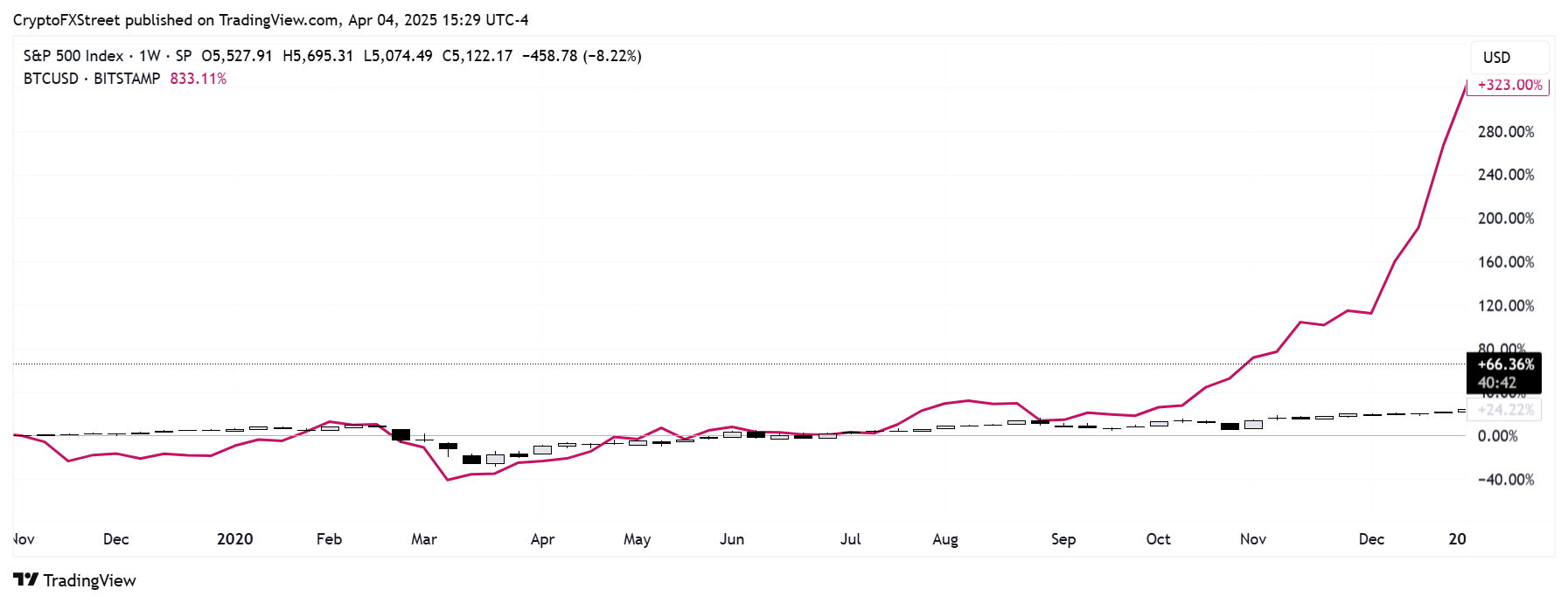
SPX vs BTC 2020 weekly chart
The market could pull off a similar move, considering Bitcoin declined alongside stocks over the past two months — as it did in the 2020 pandemic — when Trump began hinting at tariffs in February. The top crypto is now beginning to show strength, gaining over 2% despite the S&P 500 erasing over $1.5 trillion on Friday. This highlights a slight decoupling from equities, like in mid-March 2020.
If Bitcoin continues to hold its ground in the coming weeks, its safe-haven narrative could pick up pace, potentially boosting its appeal as Trump's tariff war takes its toll on financial markets.
However, a decline below the $80,000 support will invalidate the thesis and potentially trigger massive sell-offs for the top crypto.
Cryptocurrency metrics FAQs
The developer or creator of each cryptocurrency decides on the total number of tokens that can be minted or issued. Only a certain number of these assets can be minted by mining, staking or other mechanisms. This is defined by the algorithm of the underlying blockchain technology. On the other hand, circulating supply can also be decreased via actions such as burning tokens, or mistakenly sending assets to addresses of other incompatible blockchains.
Market capitalization is the result of multiplying the circulating supply of a certain asset by the asset’s current market value.
Trading volume refers to the total number of tokens for a specific asset that has been transacted or exchanged between buyers and sellers within set trading hours, for example, 24 hours. It is used to gauge market sentiment, this metric combines all volumes on centralized exchanges and decentralized exchanges. Increasing trading volume often denotes the demand for a certain asset as more people are buying and selling the cryptocurrency.
Funding rates are a concept designed to encourage traders to take positions and ensure perpetual contract prices match spot markets. It defines a mechanism by exchanges to ensure that future prices and index prices periodic payments regularly converge. When the funding rate is positive, the price of the perpetual contract is higher than the mark price. This means traders who are bullish and have opened long positions pay traders who are in short positions. On the other hand, a negative funding rate means perpetual prices are below the mark price, and hence traders with short positions pay traders who have opened long positions.
Author

Michael Ebiekutan
FXStreet
With a deep passion for web3 technology, he's collaborated with industry-leading brands like Mara, ITAK, and FXStreet in delivering groundbreaking reports on web3's transformative potential across diverse sectors. In addition to