US Dollar unable to make a fist against the softer US data
- The US Dollar retreats further after softer US data.
- Markets see Wednesday's data confirm Fed's Goolsbee suggestion to cut rates.
- The US Dollar index falls below 105.50 after US data triggers another leg lower.

The US Dollar (USD) is continuing its easing for this Wednesday after both ADP and Initial Jobless Claims numbers confirmed and backed earlier comments from US Federal Reserve Bank of Chicago President Austan Goolsbee in Sintra during the European Central Bank symposium. Goolsbee said that keeping rates steady while inflation is coming down should also be considered as tightening and is no longer needed, suggesting interest rate cuts on the table. Ahead of the Fed’s Federal Open Market Committee (FOMC) Minutes, a bold statement to make.
On the US economic front, the calendar is very crowded on Wednesday, with many data points being moved from Thursday due to the US public holiday. The main key element, the ADP Employment Change number for June ahead of the US Nonfarm Payrolls print on Friday, came in softer than expected. Additionally, the FOMC Minutes for the June meeting will be released at the end of the day, and some volatility looks to be guaranteed.
Daily digest market movers: Minutes to signal pivot?
- At 11:30 GMT, the Challenger Job Cuts for June saw a decline in job cuts from 63,816 to 48,786.
- The June ADP Employment Change data missed estimates on all fronts. An increase of 160,000 was expected after the 152,000 seen in Maym though the actual number came in at 150,000.
- Weekly Jobless Claims were exceptionally on Wednesday:
- Initial Jobless Claims for the week ending June 28 are expected to rise to 235,000 from 233,000 a week before. Though the uptick was bigger, to 238,000.
- Continuing Jobless Claims were at 1.839 million, and came in at 1.858 million for the week ending June 21.
- At 14:00 GMT, the Institute for Supply Management will release June’s Purchasing Managers Index (PMI) reading for the Services sector:
- The Employment Index was at 47.1 in May, with no forecast available for June.
- The New Orders Index was at 54.1 in May, with no forecast available for June.
- The ISM Services PMI is expected to ease to 52.5 in June from 53.8.
- The Prices Paid Index was at 58.1 in May, with no forecast available for June.
- On the Federal Reserve front, some communication on the docket:
- At 10:30 GMT, comments from the Federal Reserve Bank of New York President John Williams, who participates in a panel about drivers of equilibrium interest rates at the ECB Forum on central banking in Sintra, Portugal.
- At 18:00 GMT, the FOMC Minutes for the Federal Reserve’s June meeting will be released.
- European equities are flirting with a 1% increase on the day. US Futures are still looking for direction though are starting dig out more losses.
- The CME Fedwatch Tool is broadly backing a rate cut in September despite recent comments from Fed officials. The odds now stand at 59.9% for a 25-basis-point cut. A rate pause stands at a 34.7% chance, while a 50-basis-point rate cut has a slim 5.4% possibility.
- The US 10-year benchmark rate trades near 4.40%, and falls to the lower end for this week.
US Dollar Index Technical Analysis: Time to say goodbey again
The US Dollar Index (DXY) is easing a touch after Fed member Goolsbee dissented from his fellow members by saying that keeping rates steady for longer is not helping anymore. His call for rate cuts is a welcomed change after hearing each and every FOMC member saying that rates will remain steady for longer. Rate cuts should see some weakening of the Greenback, and could mean that the DXY will not be making any new highs anytime soon.
On the upside, the pivotal level of 105.89 is a must-have for additional gains. Once a daily close has taken place above that level, marching above the red descending trend line in the chart below at 106.26 and the peak of April at 106.52 are the two main resistances ahead of a fresh nine-month high. That would be reached once 107.35 is broken to the upside.
On the downside, 105.53 is the first support ahead of a trifecta of Simple Moving Averages (SMA). Next down is the 55-day SMA at 105.24, safeguarding the 105.00 round figure. A touch lower, near 104.75 and 104.45, both the 100-day and the 200-day SMA form a double layer of protection to support any declines together with the green ascending trendline from last December.
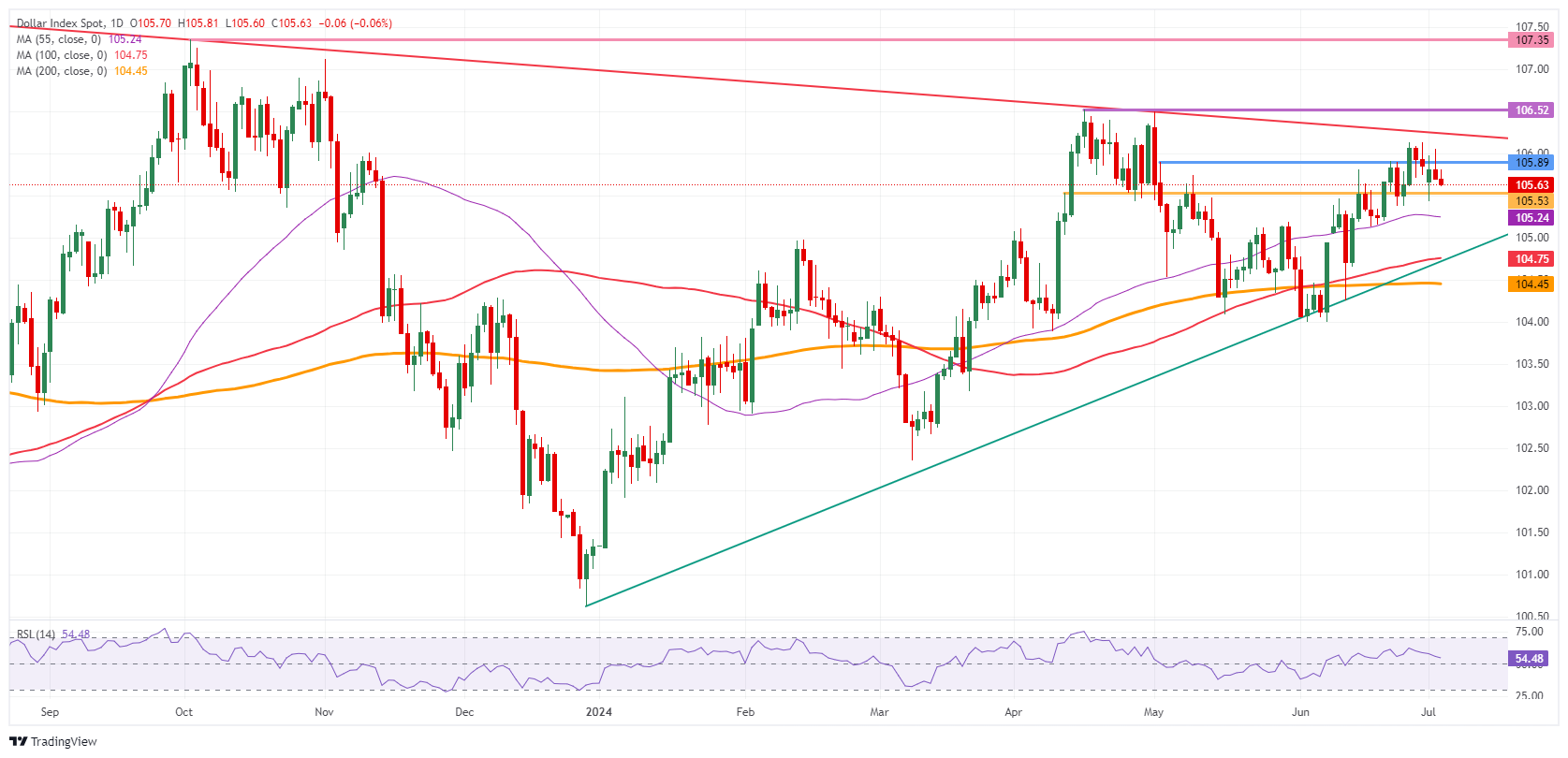
US Dollar Index: Daily Chart
Central banks FAQs
Central Banks have a key mandate which is making sure that there is price stability in a country or region. Economies are constantly facing inflation or deflation when prices for certain goods and services are fluctuating. Constant rising prices for the same goods means inflation, constant lowered prices for the same goods means deflation. It is the task of the central bank to keep the demand in line by tweaking its policy rate. For the biggest central banks like the US Federal Reserve (Fed), the European Central Bank (ECB) or the Bank of England (BoE), the mandate is to keep inflation close to 2%.
A central bank has one important tool at its disposal to get inflation higher or lower, and that is by tweaking its benchmark policy rate, commonly known as interest rate. On pre-communicated moments, the central bank will issue a statement with its policy rate and provide additional reasoning on why it is either remaining or changing (cutting or hiking) it. Local banks will adjust their savings and lending rates accordingly, which in turn will make it either harder or easier for people to earn on their savings or for companies to take out loans and make investments in their businesses. When the central bank hikes interest rates substantially, this is called monetary tightening. When it is cutting its benchmark rate, it is called monetary easing.
A central bank is often politically independent. Members of the central bank policy board are passing through a series of panels and hearings before being appointed to a policy board seat. Each member in that board often has a certain conviction on how the central bank should control inflation and the subsequent monetary policy. Members that want a very loose monetary policy, with low rates and cheap lending, to boost the economy substantially while being content to see inflation slightly above 2%, are called ‘doves’. Members that rather want to see higher rates to reward savings and want to keep a lit on inflation at all time are called ‘hawks’ and will not rest until inflation is at or just below 2%.
Normally, there is a chairman or president who leads each meeting, needs to create a consensus between the hawks or doves and has his or her final say when it would come down to a vote split to avoid a 50-50 tie on whether the current policy should be adjusted. The chairman will deliver speeches which often can be followed live, where the current monetary stance and outlook is being communicated. A central bank will try to push forward its monetary policy without triggering violent swings in rates, equities, or its currency. All members of the central bank will channel their stance toward the markets in advance of a policy meeting event. A few days before a policy meeting takes place until the new policy has been communicated, members are forbidden to talk publicly. This is called the blackout period.
Author

Filip Lagaart
FXStreet
Filip Lagaart is a former sales/trader with over 15 years of financial markets expertise under its belt.