US Dollar supported while equity markets dive lower
- The US Dollar tightens range after a grind higher to a fresh 11-week high.
- US equities retrace further from all-time highs as the Fed might not cut that much as first anticipated.
- The US Dollar index trades in a tight range on Tuesday after failing to break above 104.00.

The US Dollar (USD) slightly retraces on Tuesday following a small sprint higher on Monday that drove the US Dollar Index (DXY), which gauges Greenback’s value against six major currencies, to a fresh 11-week high after US equities retreated from their all-time highs. The US Treasury bonds are starting to sell off as well as it appears that markets are starting to reprice their interest rate cut expectations, with rising probabilities that the Federal Reserve (Fed) only set to cut once more this year before going into a wait-and-see mode.
On the US economic front, a very light calendar is ahead for markets to digest on Tuesday. One takeaway, though, comes from the Fed speakers as there is a clear dispersion in opinions within the Federal Open Market Committee (FOMC), as Atlanta Fed President Raphael Bostic pleaded for no rate cuts anymore this year while San Francisco Fed President Mary Daly commented on Monday that the Fed needs to go ahead with its rate cutting cycle and ease further. Market participants are intrigued to see what Philadelphia Fed President Patrick Harker thinks about the matter this Tuesday around 14:00 GMT.
Daily digest market movers: Risk Off
- At 14:00 GMT, Federal Reserve Bank of Philadelphia President Patrick Harker delivers opening remarks at the Eight Annual Fintech Conference Hosted by the Federal Reserve Bank of Philadelphia.
- While Harker will deliver his speech, the Richmond Fed Manufacturing Index for October will be released at 14:00 GMT. Analysts expect the number to remain in contraction at -18, a touch better than the -21 in September.
- Asian equities are sluggish again, with Japan’s main indices having closed over -1% lower. European equities are flat to marginally higher, while US equity futures are diving deeper in the red.
- The CME Fedwatch Tool is still backing a small 25 basis point (bps) rate cut with an 87.0% probability against a 13.0% chance of no rate cut for the upcoming Fed meeting on November 7.
- The US 10-year benchmark rate trades at 4.17% and rallied substantially on Monday while bonds were selling off. Note that when bond prices fall, the inverted yield increases.
US Dollar Index Technical Analysis: Risk Off inflow
The US Dollar Index (DXY) trades between two firm levels on Tuesday after breaking through a bearish fortress, which came in the form of the 200-day Simple Moving Average (SMA) at 103.80 on Monday. Unfortunately, the 103.99/104.00 level was too heavy to break through at the first attempt. Should markets price in lesser interest rate cuts from the Fed, expect to see a 105.00 appear rather quickly in the US Dollar Index.
Ver closeby on the upside, the 103.99/104.00 level triggered a rejection on Monday and continues as resistance on Tuesday. Once that level breaks, look for the 105.00 round level and even 105.53 (the April 11 high) in a quick sprint higher. More upside would see some resistances near 105.89 (the May 2 high and descending trendline) before considering 106.00.
On the downside, the 200-day SMA is very strong support due to a test at 103.80. Look out for false breaks, and consider waiting for a daily close below that level when reassessing if there will be more downside for the DXY. The next big support is a double one, with the 100-day SMA at 103.19 together with the pivotal 103.18 level (the March 12 high). If that level breaks, a big gap lower would occur to the 101.90 support zone, with the 55-day SMA at 101.89.
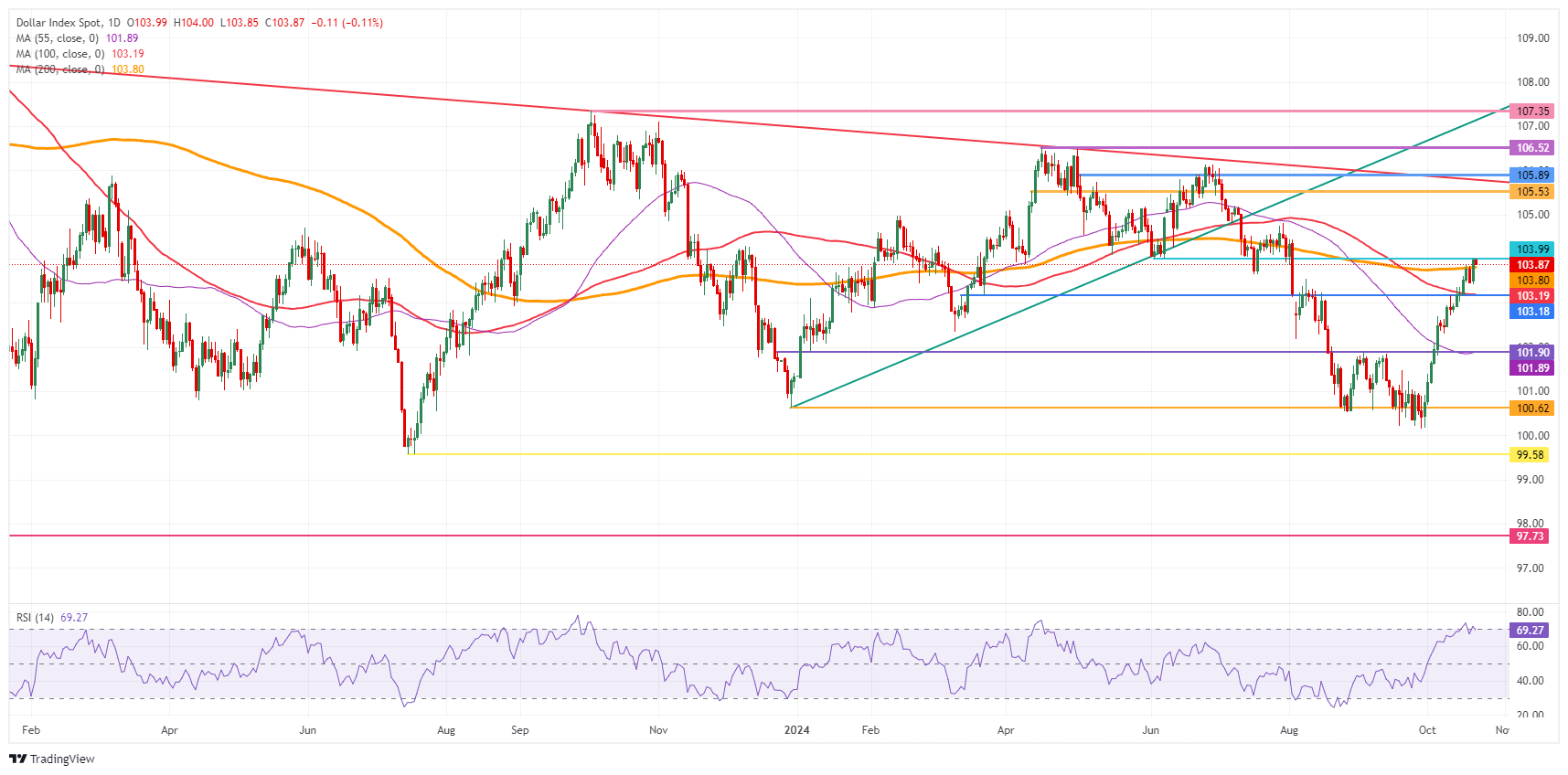
US Dollar Index: Daily Chart
Fed FAQs
Monetary policy in the US is shaped by the Federal Reserve (Fed). The Fed has two mandates: to achieve price stability and foster full employment. Its primary tool to achieve these goals is by adjusting interest rates. When prices are rising too quickly and inflation is above the Fed’s 2% target, it raises interest rates, increasing borrowing costs throughout the economy. This results in a stronger US Dollar (USD) as it makes the US a more attractive place for international investors to park their money. When inflation falls below 2% or the Unemployment Rate is too high, the Fed may lower interest rates to encourage borrowing, which weighs on the Greenback.
The Federal Reserve (Fed) holds eight policy meetings a year, where the Federal Open Market Committee (FOMC) assesses economic conditions and makes monetary policy decisions. The FOMC is attended by twelve Fed officials – the seven members of the Board of Governors, the president of the Federal Reserve Bank of New York, and four of the remaining eleven regional Reserve Bank presidents, who serve one-year terms on a rotating basis.
In extreme situations, the Federal Reserve may resort to a policy named Quantitative Easing (QE). QE is the process by which the Fed substantially increases the flow of credit in a stuck financial system. It is a non-standard policy measure used during crises or when inflation is extremely low. It was the Fed’s weapon of choice during the Great Financial Crisis in 2008. It involves the Fed printing more Dollars and using them to buy high grade bonds from financial institutions. QE usually weakens the US Dollar.
Quantitative tightening (QT) is the reverse process of QE, whereby the Federal Reserve stops buying bonds from financial institutions and does not reinvest the principal from the bonds it holds maturing, to purchase new bonds. It is usually positive for the value of the US Dollar.
Author

Filip Lagaart
FXStreet
Filip Lagaart is a former sales/trader with over 15 years of financial markets expertise under its belt.
















