US Dollar pulls back as Trump remains silent over the upcoming tariff approach
- The US Dollar is on the backfoot after the December Producer Price Index got released.
- Traders are easing their US Dollar position heading into Wednesday's CPI release.
- The US Dollar Index (DXY) dips below 110.00 and looks for support to bounce back.

The US Dollar Index (DXY), which tracks the Greenback’s value against six major currencies, is fading further after the December Producer Price Index report came in softer than expected. The main driver this Tuesday remains comments from team memberes from the upcoming President-elect Donald Trump administration, who disclosed that they are considering a very slow month-to-month implementation of tariffs to avoid an inflationary shock, Bloomberg reported. Meanwhile markets are on edge over any comments from President-elect Donald Trump himself on the matter.
The US economic calendar picks up in importance on Tuesday, with the Producer Price Index (PPI) release as an appetizer for the more important Consumer Price Index (CPI) on Wednesday. Every number in the report, both Headline and Core gauge for the monthly and yearly time frame came in substantially softer than expected. This should ease expectations a touch for the upcoming CPI release on Wednesday.
Daily digest market movers: Easing into CPI
- The Producer Price Index (PPI) for December came in softer than expected:
- The monthly core PPI gauge increased by 0.0%, below the 0.3% expected and compared to 0.2% in November.
- The monthly headline PPI went to 0.2%, softer than the 0.3% survey and lower than the 0.4% in the previous month.
- The yearly headline PPI increased by 3.3%, below the expected 3.4%, and up from 3.0% in November, while the annual core PPI jumped to 3.5%, below the 3.8% survey expectation and up from 3.4% in the previous month.
- At 15:00 GMT, Federal Reserve Bank of Kansas City President Jeff Schmid delivers a speech about the US economic and monetary policy outlook at an event organized by The Central Exchange.
- At 20:05 GMT, Federal Reserve Bank of New York President John Williams delivers open remarks at the "An Economy That Works for All: Housing Affordability" event organized by the New York Fed in New York.
- European equities and US futures are welcoming the softer than expected PPI reading, with all major indices in the green on the day.
- The CME FedWatch Tool projects a 97.3% chance that interest rates will be kept unchanged at current levels in the January meeting. Expectations are for the Federal Reserve (Fed) to remain data-dependent with uncertainties that could influence the inflation path once President-elect Donald Trump takes office on January 20.
- US yields are softening substantially. The 10-year benchmark trades around 4.794% at the time of writing on Tuesday, fading from its fresh 14-month high of 4.802% seen on Monday.
US Dollar Index Technical Analysis: Softening stance
The US Dollar Index (DXY) is set to see volatility pick up. The constant deliverance of statements from President-elect Donald Trump, followed by comments from sources inside his team, will deliver several knee-jerk moments and reactions. This means that sense of direction could get distorted and misty from now on.
On the upside, the 110.00 psychological level remains the key resistance to beat. Further up, the next big upside level to hit before advancing any further remains at 110.79. Once beyond there, it is quite a stretch to 113.91, the double top from October 2022.
Looking down, the DXY will look for a bounce off the green ascending trend line from December 2023, which currently comes in around 109.00 as nearby support. In case of more downside, the next support is 107.35. The next level that might halt any selling pressure is 106.52, with the 55-day Simple Moving Average (SMA) at 106.92 reinforcing ahead of this region of support.
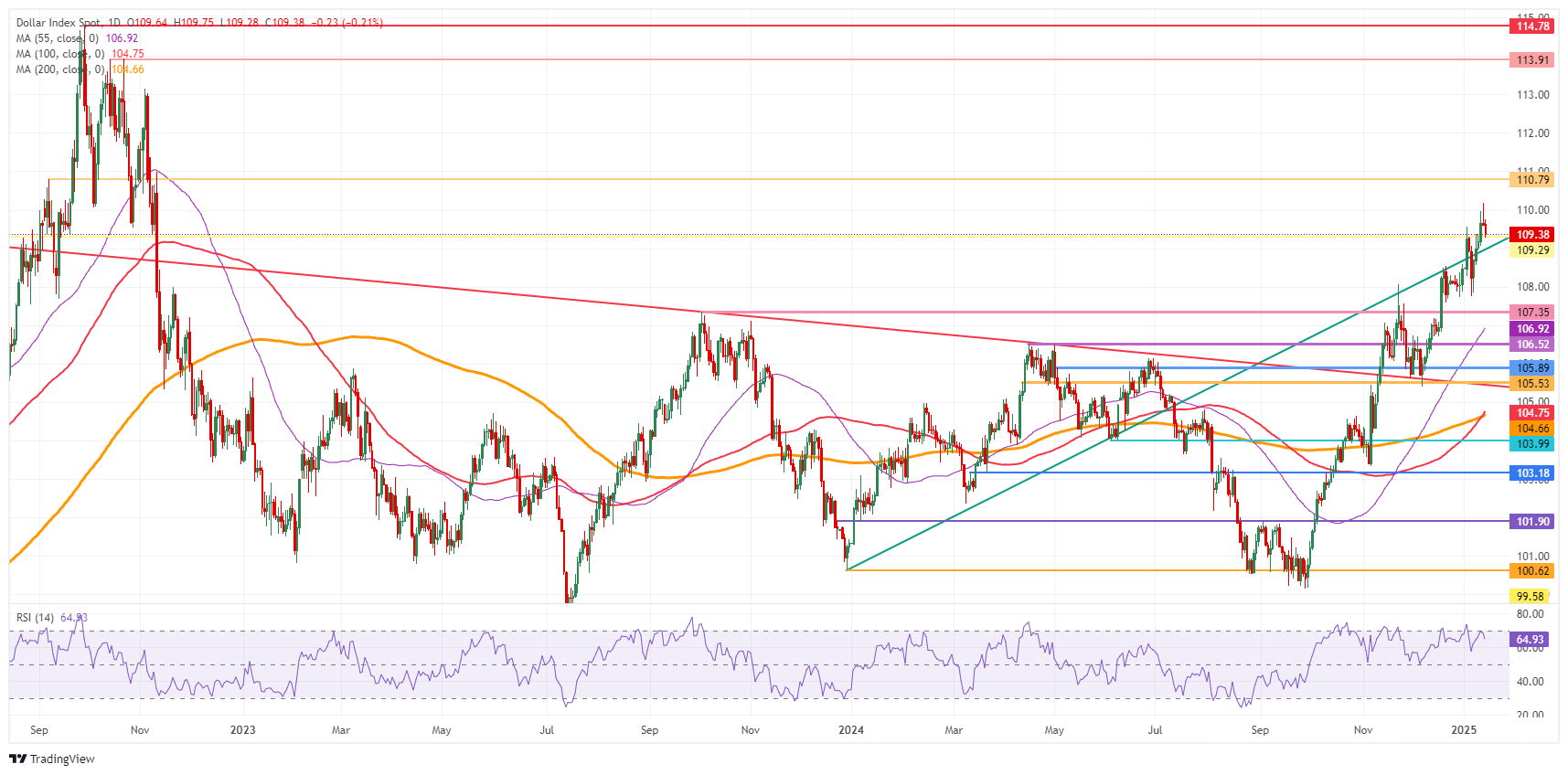
US Dollar Index: Daily Chart
Inflation FAQs
Inflation measures the rise in the price of a representative basket of goods and services. Headline inflation is usually expressed as a percentage change on a month-on-month (MoM) and year-on-year (YoY) basis. Core inflation excludes more volatile elements such as food and fuel which can fluctuate because of geopolitical and seasonal factors. Core inflation is the figure economists focus on and is the level targeted by central banks, which are mandated to keep inflation at a manageable level, usually around 2%.
The Consumer Price Index (CPI) measures the change in prices of a basket of goods and services over a period of time. It is usually expressed as a percentage change on a month-on-month (MoM) and year-on-year (YoY) basis. Core CPI is the figure targeted by central banks as it excludes volatile food and fuel inputs. When Core CPI rises above 2% it usually results in higher interest rates and vice versa when it falls below 2%. Since higher interest rates are positive for a currency, higher inflation usually results in a stronger currency. The opposite is true when inflation falls.
Although it may seem counter-intuitive, high inflation in a country pushes up the value of its currency and vice versa for lower inflation. This is because the central bank will normally raise interest rates to combat the higher inflation, which attract more global capital inflows from investors looking for a lucrative place to park their money.
Formerly, Gold was the asset investors turned to in times of high inflation because it preserved its value, and whilst investors will often still buy Gold for its safe-haven properties in times of extreme market turmoil, this is not the case most of the time. This is because when inflation is high, central banks will put up interest rates to combat it. Higher interest rates are negative for Gold because they increase the opportunity-cost of holding Gold vis-a-vis an interest-bearing asset or placing the money in a cash deposit account. On the flipside, lower inflation tends to be positive for Gold as it brings interest rates down, making the bright metal a more viable investment alternative.
Author

Filip Lagaart
FXStreet
Filip Lagaart is a former sales/trader with over 15 years of financial markets expertise under its belt.