US Dollar sees Nonfarm Payrolls revision come in down at 818,000
- The US Dollar sees back in the green and snapping this week's losing streak.
- The Nonfarm Payrolls revision comes in at -818,000, less than the projected -1,000,000 number.
- The US Dollar index trades near 101.50, with a long road to recovery ahead.

The US Dollar (USD) is back to flat, residing near the opening level of 2024 and could still see this year's performance turn negative. A very specific element that draws attention, is that again spot on at 12:30 GMT, the US Dollar selling frenzy takes place. This could point to US hedge funds that are being very active for a third day in a row, seeing the recent moves in speculative futures positionings from hedge funds on Japanese Yen, US Dollar and Euro.
On the economic data front, the Federal Open Market Committee (FOMC) Meeting Minutes for July will be published, although these are not expected to move the needle ahead of Jackson Hole on Friday. Besides the FOMC Minutes, the Nonfarm Payrolls Benchmark revision has come in with a downside revision by 818,000, softer than the feared nearly 1,000,000,000 number that was spreaded across banks. Markets already got rattled by the latest US Nonfarm Payrolls number on the first Friday of August, a data point that triggered the unwinding of the carry trade which had spillover effects in equities and caused recession concerns for the US economy. Although the revisions are not going to cover August, the revision helps the Greenback gain at least a little bit of momentum for a recovery.
Daily digest market movers: Nonfarm revisions slightly softer
- Earlier this Wednesday, Mortgage Applications fell by 10.1% against the number last week.
- At 14:00 GMT, the Nonfarm Payrolls Benchmark revision is due to come out. The revisions covered 12 months up to March of this year and came in at a softer downside revision by 818,000 against near 1 million that was forecasted by most banks.
- The US Treasury is set to allocate a 20-year Bond at 17:00 GMT.
- At 18:00 GMT, the Fed will release its Minutes from July’s meeting.
- Asian equity markets are facing a bit of pressure and are in the red, which helps the US Dollar strengthen a touch. European and US equities are on the rise.
- The CME Fedwatch Tool shows a 69.5% chance of a 25 basis points (bps) interest rate cut by the Fed in September against a 30.5% chance for a 50 bps cut. Another 25 bps cut (if September is a 25 bps cut) is expected in November by 50.9%, while there is a 40.9% chance that rates will be 75 bps below the current levels and an 8.2% probability of rates being 100 basis points lower.
- The US 10-year benchmark rate trades at 3.81%, printing a fresh low for the week.
US Dollar Index Technical Analysis: Small support coming in
The US Dollar Index (DXY) is trying to snap the losing streak with some conviction. The bounce comes after the DXY hit the low seen on January 2, which is the low of this year as well. The question is if this has room to go higher considering there are no real significant data elements or market movers ahead of Jackson Hole on Friday.
Defining pivotal levels becomes very important in order to avoid any dead-cat bounces, in which traders pile in too quickly in a trade and get caught on the wrong side of the fence once the course reverses. First up is 103.18, a level that traders were unable to hold last week. Next up, a heavy resistance level is at 103.99-104.00, and inches above there is the 200-day Simple Moving Average (SMA) at 104.07.
On the downside, 101.30 (low from January 2) is trying to hold for now and has triggered a bounce thus far. Should it break, the low of December 28 at 100.62 will be the ultimate level to look out for.
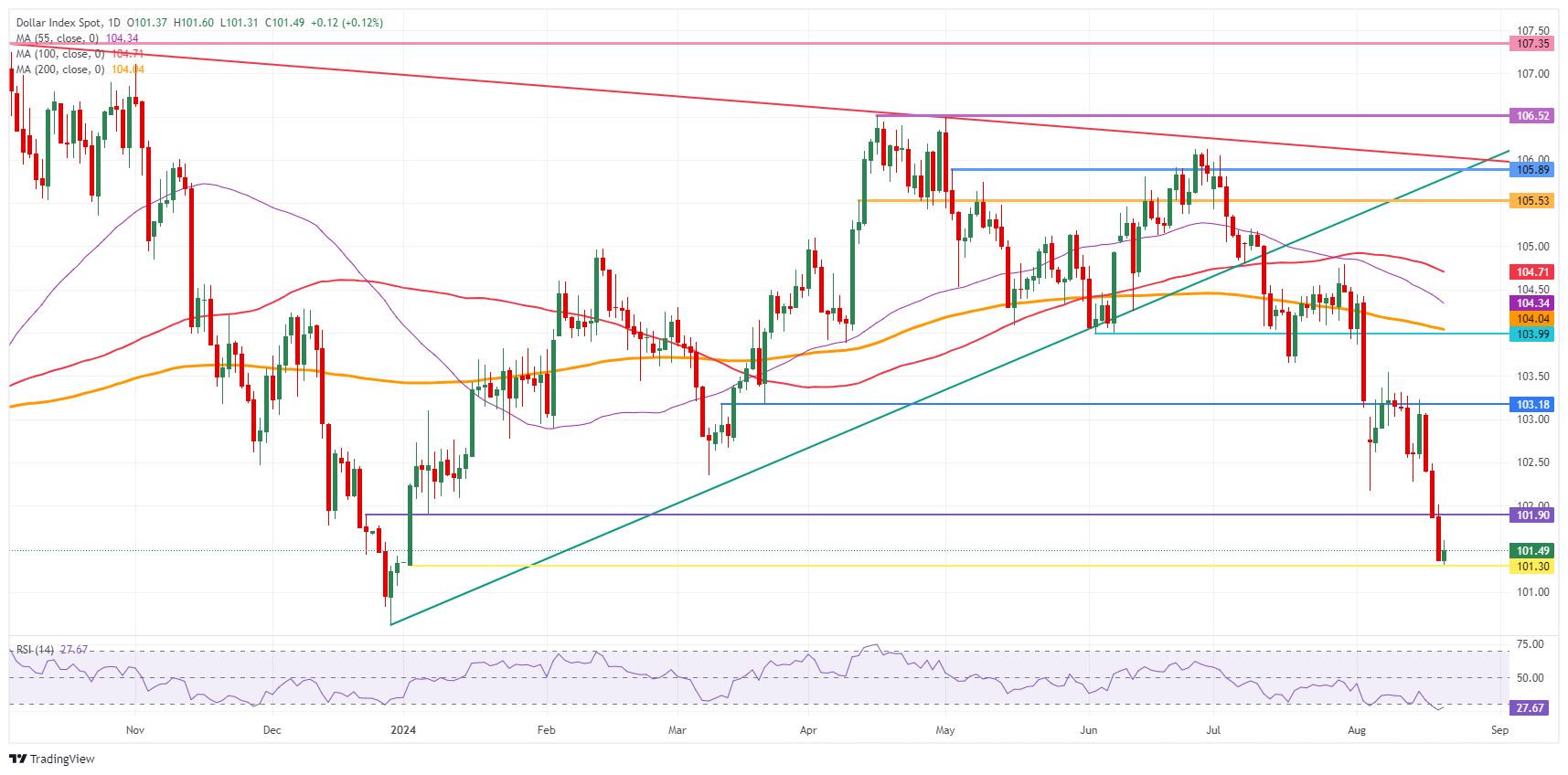
US Dollar Index: Daily Chart
Central banks FAQs
Central Banks have a key mandate which is making sure that there is price stability in a country or region. Economies are constantly facing inflation or deflation when prices for certain goods and services are fluctuating. Constant rising prices for the same goods means inflation, constant lowered prices for the same goods means deflation. It is the task of the central bank to keep the demand in line by tweaking its policy rate. For the biggest central banks like the US Federal Reserve (Fed), the European Central Bank (ECB) or the Bank of England (BoE), the mandate is to keep inflation close to 2%.
A central bank has one important tool at its disposal to get inflation higher or lower, and that is by tweaking its benchmark policy rate, commonly known as interest rate. On pre-communicated moments, the central bank will issue a statement with its policy rate and provide additional reasoning on why it is either remaining or changing (cutting or hiking) it. Local banks will adjust their savings and lending rates accordingly, which in turn will make it either harder or easier for people to earn on their savings or for companies to take out loans and make investments in their businesses. When the central bank hikes interest rates substantially, this is called monetary tightening. When it is cutting its benchmark rate, it is called monetary easing.
A central bank is often politically independent. Members of the central bank policy board are passing through a series of panels and hearings before being appointed to a policy board seat. Each member in that board often has a certain conviction on how the central bank should control inflation and the subsequent monetary policy. Members that want a very loose monetary policy, with low rates and cheap lending, to boost the economy substantially while being content to see inflation slightly above 2%, are called ‘doves’. Members that rather want to see higher rates to reward savings and want to keep a lit on inflation at all time are called ‘hawks’ and will not rest until inflation is at or just below 2%.
Normally, there is a chairman or president who leads each meeting, needs to create a consensus between the hawks or doves and has his or her final say when it would come down to a vote split to avoid a 50-50 tie on whether the current policy should be adjusted. The chairman will deliver speeches which often can be followed live, where the current monetary stance and outlook is being communicated. A central bank will try to push forward its monetary policy without triggering violent swings in rates, equities, or its currency. All members of the central bank will channel their stance toward the markets in advance of a policy meeting event. A few days before a policy meeting takes place until the new policy has been communicated, members are forbidden to talk publicly. This is called the blackout period.
Author

Filip Lagaart
FXStreet
Filip Lagaart is a former sales/trader with over 15 years of financial markets expertise under its belt.