US Dollar whipsaws in volatile session near 14-month low
- The US Dollar bounces off this year's low for now.
- Recession fears could pick up Thursday when US GDP would ease further.
- The US Dollar Index still flirts with a fresh 14-month low.

The US Dollar (USD) is bouncing after earlier seeing the Euro (EUR) first hit a 14-month high at 1.1214 against the US Dollar (USD). The reshuffle comes after investors relocate their investments from the US to Chinese equities. The move is triggered by a massive stimulus plan from the Chinese government that was implemented on Tuesday.
On the economic data front, there is a very light calendar ahead, with no real market-moving data on Wednesday. One element that might draw some attention is comments from Federal Reserve (Fed) Governor Adriana Kugler, who delivers a speech about the US economic outlook at the Harvard Kennedy School in Cambridge, Massachusetts. From there, markets will be on edge over the US Q2 Gross Domestic Product (GDP) release, and Fed Chairman Jerome Powell set to speak on Thursday.
Daily digest market movers: All eyes on Thursday
- “Sentiment is firing up in Asian markets after China announced a raft of policy stimulus measures,” damping demand for the Dollar, said Wei Liang Chang, a foreign exchange and credit strategist at DBS Bank in Singapore, Bloomberg reports.
- At 11:00 GMT, the Mortgage Bankers Association (MBA) released its weekly mortgage applications index. There was a surge of 11.0% in applications against 14.2% last week.
- Related to mortgages, New Home Sales are due at 14:00 GMT. Expectations are for a touch softer number at 0.700 million units in August against 0.739 million previously.
- The US Treasury will allocate a 5-year Note around 17:00 GMT.
- At 20:00 GMT, Federal Reserve Governor Adriana Kugler delivers a speech about the US economic outlook at the Harvard Kennedy School in Cambridge, Massachusetts.
- US equities try to head higher, and are posting small gains for this Wednesday.
- The CME Fedwatch Tool shows a 41.6% chance of a 25-basis-point rate cut at the next Fed meeting on November 7, while 58.4% is pricing in another 50-basis-point rate cut.
- The US 10-year benchmark rate trades at 3.77%, retreating from its attempt earlier to print a fresh monthly high.
US Dollar Index Technical Analysis: Holding strong for now
The US Dollar Index (DXY) is flirting with a fresh 15-month low after Tuesday’s data and China stimulus triggered some further devaluation for the Greenback. Going forward, rather the main data on Thursday and Friday will act as catalysts that might move the DXY. Watch out for the US Q2 Gross Domestic Product (GDP), that could trigger recession fears in case it drops.
The upper level of the September range remains at 101.90. Further up, the index could go to 103.18, with the 55-day Simple Moving Average (SMA) at 102.42 along the way. The next tranche up is very misty, with the 100-day SMA at 103.61 and the 200-day SMA at 103.76, just ahead of the big 104.00 round level.
On the downside, 100.22 (the September 18 low) is the first support, and a break could point to more weakness ahead. Should that take place, the low from July 14, 2023, at 99.58, will be the next level to look out for. If that level gives way, early levels from 2023 are coming in near 97.73.
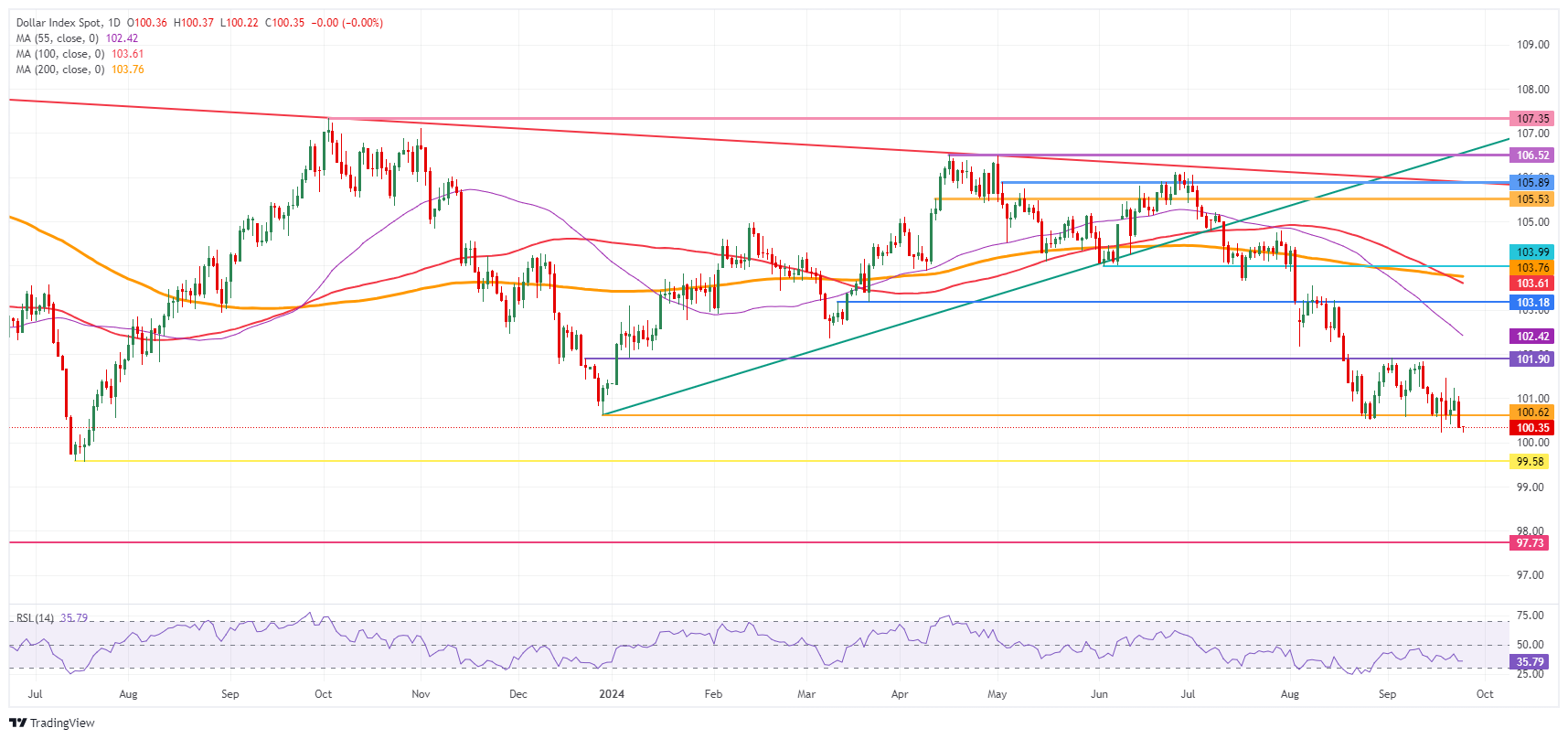
US Dollar Index: Daily Chart
Fed FAQs
Monetary policy in the US is shaped by the Federal Reserve (Fed). The Fed has two mandates: to achieve price stability and foster full employment. Its primary tool to achieve these goals is by adjusting interest rates. When prices are rising too quickly and inflation is above the Fed’s 2% target, it raises interest rates, increasing borrowing costs throughout the economy. This results in a stronger US Dollar (USD) as it makes the US a more attractive place for international investors to park their money. When inflation falls below 2% or the Unemployment Rate is too high, the Fed may lower interest rates to encourage borrowing, which weighs on the Greenback.
The Federal Reserve (Fed) holds eight policy meetings a year, where the Federal Open Market Committee (FOMC) assesses economic conditions and makes monetary policy decisions. The FOMC is attended by twelve Fed officials – the seven members of the Board of Governors, the president of the Federal Reserve Bank of New York, and four of the remaining eleven regional Reserve Bank presidents, who serve one-year terms on a rotating basis.
In extreme situations, the Federal Reserve may resort to a policy named Quantitative Easing (QE). QE is the process by which the Fed substantially increases the flow of credit in a stuck financial system. It is a non-standard policy measure used during crises or when inflation is extremely low. It was the Fed’s weapon of choice during the Great Financial Crisis in 2008. It involves the Fed printing more Dollars and using them to buy high grade bonds from financial institutions. QE usually weakens the US Dollar.
Quantitative tightening (QT) is the reverse process of QE, whereby the Federal Reserve stops buying bonds from financial institutions and does not reinvest the principal from the bonds it holds maturing, to purchase new bonds. It is usually positive for the value of the US Dollar.
Author

Filip Lagaart
FXStreet
Filip Lagaart is a former sales/trader with over 15 years of financial markets expertise under its belt.