US Dollar at fresh nine-day low after Pennsylvania odds go in favor of Harris
- The US Dollar in red figures on Monday after Ipsos polls project Vice President Kamala Harris taking the lead in the US presidential elections.
- Traders set for a very volatile week, with the Fed meeting amidst US presidential election uncertainty.
- The US Dollar index slides below 104.00 and is looking for support.

The US Dollar (USD) sees Friday's gains being erased and dips lower on all fronts on Monday, after a final poll publication from ABC News and Ipsos showed Vice President Kamala Harris leading by 49% against 46% for former President Donald Trump. Another element for more US Dollar weakness comes from The New York Times, which released data pointing that Harris is ahead in five of the seven swing states that will determine the outcome of the US presidential election.
The US economic calendar, meanwhile, needs to be considered as well with a very interesting element ahead this Monday: the Senior Loan Officer Opinion Survey (SLOOS) for the third quarter. The report will tell more on the conditions, supply and demand of loans extended to customers in the US. Loan distribution is a very good leading indicator to sketch how the economy will evolve in the coming weeks and months.
Daily digest market movers: Be on the lookout for headlines as of now
- Several analysts and strategist from several big banks are releasing their outlook and reports on the US presidential election outcome this week. Main theme several are reporting on, is that it might take days, even weeks until the actual 60th US President will be known with former US President Donald Trump having filed several court cases in key swing states on election fraude, Reuters reports.
- On Sunday night, the final poll from ABC News and Ipsos showed Vice President Kamala Harris leading by a 49%-46% edge nationally. The New York Times/Siena survey showed Harris being ahead in five of the seven swing states.
- Factory Orders for September came out roughly in line of expectations, with a contraction by 0.5%, against the -0.4% against the previous decline of 0.2%.
- The Senior Loan Officer Opinion Survey (SLOOS) for the third quarter will be published at 19:00 GMT.
- Chinese equities are very happy with the positive Harris polls and have closed in the green on Monday. European equities and US equity futures are still looking for direction.
- The CME FedWatch Tool is backing a 25 basis point (bps) interest-rate cut on Thursday’s meeting with a 99.7% probability against a marginal 0.3% chance of rates remaining stable.
- The US 10-year benchmark rate trades at 4.29%, lower than the 4.38% where it closed on Friday.
US Dollar Index Technical Analysis: Aligned
The US Dollar Index (DXY) is set to enter a rough patch of volatility this week, so precautionary measures are needed when trading the US Dollar. Expect to see massive swings, mostly headline driven with even possibly unclear direction and rapid moves days after the election. Bigger levels – such as 102.11 on the downside and 105.53 on the upside – need to be considered as possible outcomes.
The DXY has given up two key levels on Monday and needs to regain control of those two levels first, before considering recovering toward 105.00 and higher. First up is the 200-day Simple Moving Average (SMA) at 103.84 together with the 104.00 big figure. The second element is the high of last week at 104.63.
On the downside, the 100-day SMA at 103.12, together with the pivotal level at 103.18 (high from March 12) are the first line of defence. In case of rapid and volatile moves this week, rather look for 101.90 together with the 55-day SMA at 102.11 to consider as a substantial support level. In case that level snaps, an excursion below 101.00 could be possible.
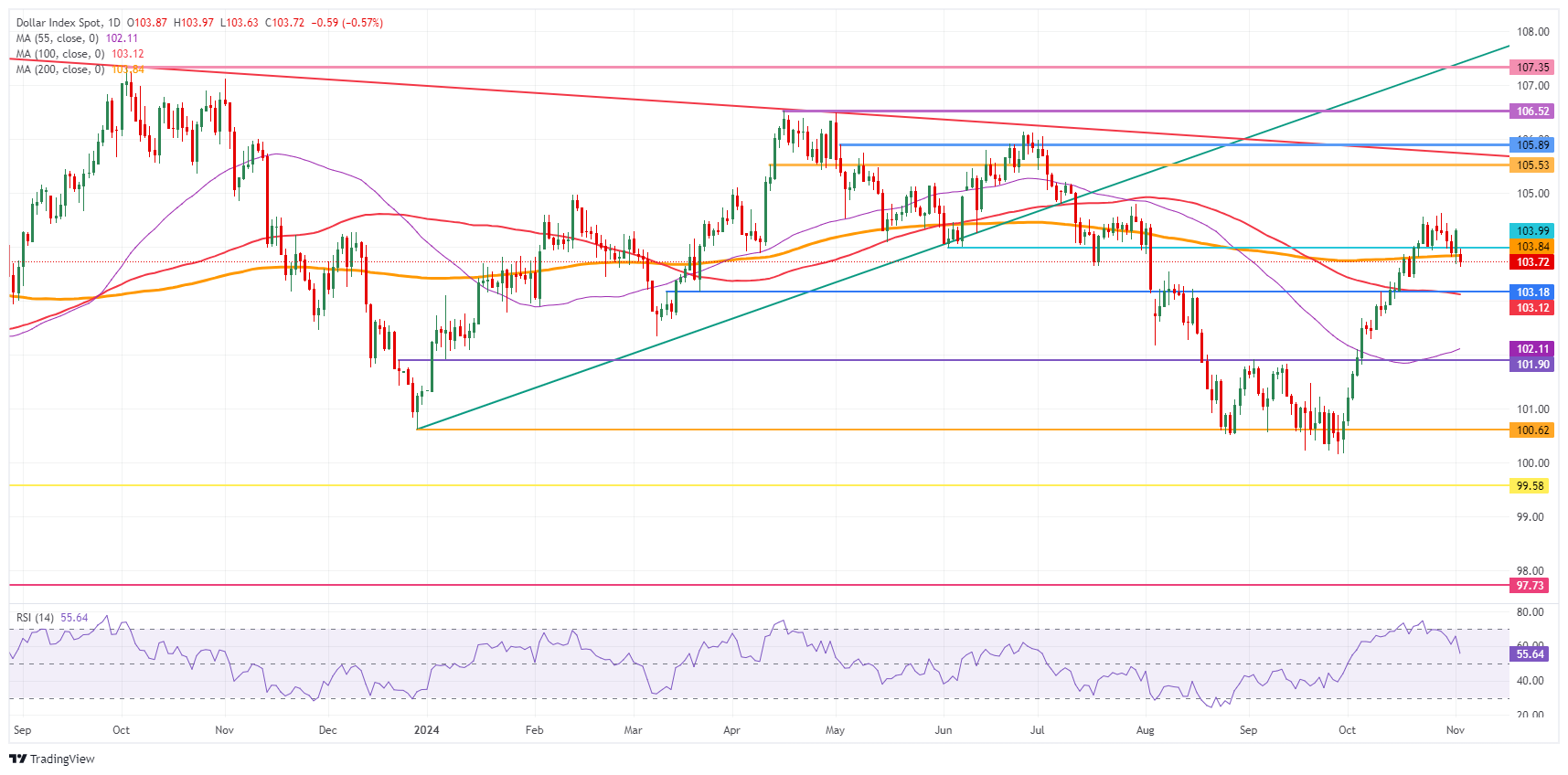
US Dollar Index: Daily Chart
Employment FAQs
Labor market conditions are a key element to assess the health of an economy and thus a key driver for currency valuation. High employment, or low unemployment, has positive implications for consumer spending and thus economic growth, boosting the value of the local currency. Moreover, a very tight labor market – a situation in which there is a shortage of workers to fill open positions – can also have implications on inflation levels and thus monetary policy as low labor supply and high demand leads to higher wages.
The pace at which salaries are growing in an economy is key for policymakers. High wage growth means that households have more money to spend, usually leading to price increases in consumer goods. In contrast to more volatile sources of inflation such as energy prices, wage growth is seen as a key component of underlying and persisting inflation as salary increases are unlikely to be undone. Central banks around the world pay close attention to wage growth data when deciding on monetary policy.
The weight that each central bank assigns to labor market conditions depends on its objectives. Some central banks explicitly have mandates related to the labor market beyond controlling inflation levels. The US Federal Reserve (Fed), for example, has the dual mandate of promoting maximum employment and stable prices. Meanwhile, the European Central Bank’s (ECB) sole mandate is to keep inflation under control. Still, and despite whatever mandates they have, labor market conditions are an important factor for policymakers given its significance as a gauge of the health of the economy and their direct relationship to inflation.
Author

Filip Lagaart
FXStreet
Filip Lagaart is a former sales/trader with over 15 years of financial markets expertise under its belt.

















