|

Silver rallies to a new high for 2024

  • Silver breaks to a new high for the year and a 12-year high for the precious metal overall. 
  • The news of another stimulus package from the Chinese government helped push up the commodity. 
  • The escalating conflict in the Middle East and expectations of aggressive Fed easing further propel Silver.

Silver (XAG/USD) breaks to a new high for 2024 and a 12-year high overall on Thursday, after the Chinese authorities announced another 1 trillion CNY of extra stimulus on top of the package of measures already proposed by the People’s Bank of China (PBoC). China is the largest consumer of Silver in the world so the stimulus is expected to increase demand for the commodity. 

Silver also saw gains from the escalation of the conflict in the Middle East between Israel and Hezbollah, and continued bets the Federal Reserve (Fed) will cut its key fed funds rate by another half a percent at its November meeting. Lower interest rates are positive for Silver because they increase the attractiveness of the non-interest bearing asset. 

Technical Analysis: Silver breaks above key trendline and rallies 

Silver has broken decisively above a key trendline and escaped from the range it was trapped in since May 2024. 

It is now in an established short and medium-term uptrend and given “the trend is your friend” according to technical analysis theory, the odds favor an extension higher. 

Silver Daily Chart
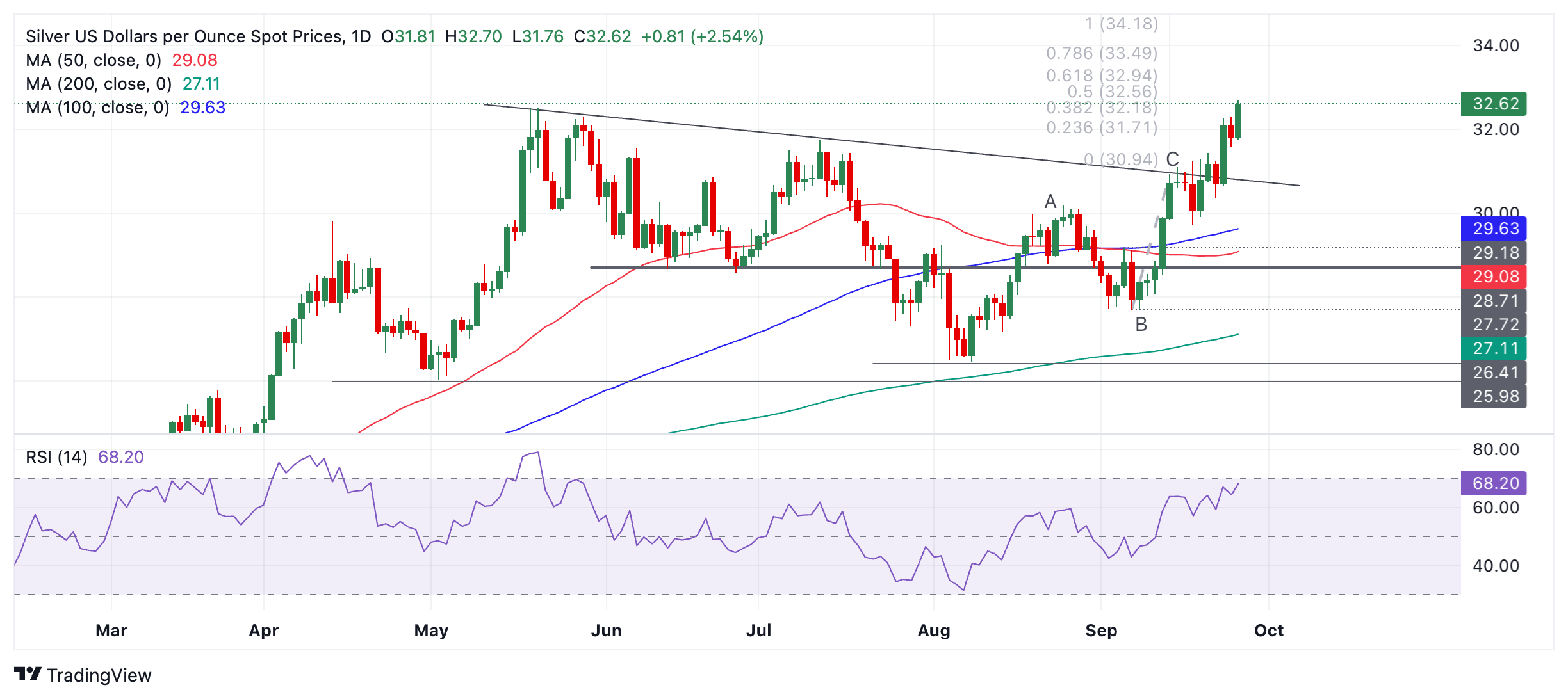


The next target on the radar is $32.94, the 0.618 Fibonacci ratio extrapolation of the C wave of the Measured Move pattern outlined prior to the breakout above the trendline. A really bullish move could eventually reach $34.18, the 100% extrapolation of wave C. 

The Relative Strength Index (RSI) momentum gauge is not yet overbought, indicating there is probably more upside left in the market.

Author

Joaquin Monfort

Joaquin Monfort is a financial writer and analyst with over 10 years experience writing about financial markets and alt data. He holds a degree in Anthropology from London University and a Diploma in Technical analysis.


More from Joaquin Monfort
Share:

Editor's Picks

GBP/USD defends 1.3300 after strong UK PMI data

Following Thursday's sharp decline, GBP/USD clings to small gains above 1.3300 in the American session on Friday, supported by the upbeat UK Retail Sales and July PMI data. Nevertheless, the pair's upside remains capped as investors cling to a cautious stance amid a further escalation of tensions in the Middle East. The US July PMI data failed to trigger relevant price action.

EUR/USD remains below 1.1400 after mixed US PMIs

EUR/USD pressures daily lows below the 1.1400 mark in the American session on Friday. Mixed S&P Global PMIs, as manufacturing output contracted while services activity expanded in July, triggered no relevant market reaction. The focus remains in Middle East developments and inflation-related concerns.

Gold holds above $4,050 but momentum still missing

Gold builds on its modest intraday bounce and climbs above the $4,050 level on Friday, hitting a fresh daily high amid a modest US Dollar pullback. The fundamental backdrop, however, warrants some caution before confirming that the pullback from an over two-week high, touched on Wednesday, has run its course and positioning for any meaningful upside.

Ethereum: Derivatives interest in ETH improves, but signs of caution remain

Ethereum is hovering slightly below the $1,900 level, down 3% on Thursday following a slight expansion in derivatives interest. The top altcoin's open interest has increased to 14.60 million ETH, marking a 600K ETH increase over the past two days and its highest level since June 7.

XRP retreats as ETF interest cools
Ripple (XRP) slides toward the short-term $1.10 support on Friday, as broader crypto market sentiment weighs on crypto assets. The sell-off mainly stems from fears of inflation in the United States (US) amid the ongoing war in the Middle East and rising Oil prices.
US Dollar mid-year outlook: Exceptional currency, exceptional risks?
The US Dollar enters the second half of 2026 in a markedly different position from a year ago. The King currency has recovered, reflecting persistent US inflation, changing expectations for Fed policy, geopolitical tensions and renewed demand for defensive assets.