Pound Sterling looks fragile near 1.2660 ahead of UK inflation and BoE outcome
- The Pound Sterling remains vulnerable around 1.2670 as investors turn cautious ahead of the UK inflation for May and the BoE’s policy outcome.
- UK’s headline inflation is expected to come lower at the central bank’s target of 2%.
- Fed’s Kashkari sees only one rate-cut move this year despite progress in disinflation has resumed.

The Pound Sterling (GBP) continues its losing streak for the third trading day against the US Dollar (USD) on Monday. The GBP/USD pair hovers near a monthly low at around 1.2670 as the Federal Reserve’s (Fed) hawkish outlook on interest rates keeps the US Dollar’s appeal firm.
This weekend, Minneapolis Fed Bank President Neel Kashkari said in an interview with CBS that it's a "reasonable prediction" that the United States (US) central bank will cut interest rates once this year, waiting until December to do it.
Contrary to the Fed’s support for reducing interest rates only once this year, financial markets speculate that the Fed will deliver two rate cuts and start unwinding its restrictive policy framework from the September meeting, with subsequent rate cuts in the November or December meeting. The soft US Consumer Price Index (CPI) and Producer Price Index (PPI) reports for May have prompted higher expectations for early rate cuts.
On Friday, Chicago Fed Bank President Austan Goolsbee acknowledged that cooler consumer and producer inflation reports for May had relieved him. However, he wants to see similar data for months before lowering interest rates. Goolsbee advocated for reducing interest rates only once this year.
Daily digest market movers: Pound Sterling weakens against US Dollar
- The Pound Sterling exhibits a poor performance against all major currencies amid uncertainty ahead of the United Kingdom (UK) Consumer Price Index (CPI) data for May and the Bank of England’s (BoE) interest rate policy, which are scheduled for Wednesday and Thursday, respectively.
- Economists expect the UK Office for National Statistics (ONS) to report a sharp decline in the core CPI, which strips off the more volatile items, to 3.5% from 3.9% in April. The headline inflation is expected to return to the central bank’s target of 2.0% from the prior reading of 2.3%. Investors will keenly focus on service inflation, which has been a major barrier to the BoE’s move towards policy normalization.
- The expected decline in UK inflation will increase investors’ confidence that price pressures will stabilize near the desired rate. This will boost expectations of early rate cuts by the Bank of England (BoE). For June’s policy meeting, the BoE is expected to leave interest rates unchanged at 5.25%. Investors will pay close attention to the vote split and fresh cues on the interest rate outlook.
- In the last policy meeting, BoE Deputy Governor Dave Ramsden joined policymaker Swati Dhingra and voted for lowering interest rates by 25 basis points (bps) to 5.0%. Currently, investors see a 57% chance of another BoE rate hold in August, Reuters reported.
Pound Sterling Price Today:
British Pound PRICE Today
The table below shows the percentage change of British Pound (GBP) against listed major currencies today. British Pound was the strongest against the Japanese Yen.
| GBP | EUR | USD | JPY | CAD | AUD | NZD | CHF | |
|---|---|---|---|---|---|---|---|---|
| GBP | -0.21% | -0.13% | 0.30% | -0.09% | 0.07% | 0.22% | 0.08% | |
| EUR | 0.21% | 0.09% | 0.46% | 0.13% | 0.31% | 0.48% | 0.28% | |
| USD | 0.13% | -0.09% | 0.33% | 0.04% | 0.32% | 0.35% | 0.18% | |
| JPY | -0.30% | -0.46% | -0.33% | -0.20% | -0.02% | 0.15% | -0.10% | |
| CAD | 0.09% | -0.13% | -0.04% | 0.20% | 0.22% | 0.32% | 0.17% | |
| AUD | -0.07% | -0.31% | -0.32% | 0.02% | -0.22% | 0.23% | 0.00% | |
| NZD | -0.22% | -0.48% | -0.35% | -0.15% | -0.32% | -0.23% | -0.15% | |
| CHF | -0.08% | -0.28% | -0.18% | 0.10% | -0.17% | -0.01% | 0.15% |
The heat map shows percentage changes of major currencies against each other. The base currency is picked from the left column, while the quote currency is picked from the top row. For example, if you pick the British Pound from the left column and move along the horizontal line to the US Dollar, the percentage change displayed in the box will represent GBP (base)/USD (quote).
Technical Analysis: Pound Sterling hovers around 50-day EMA
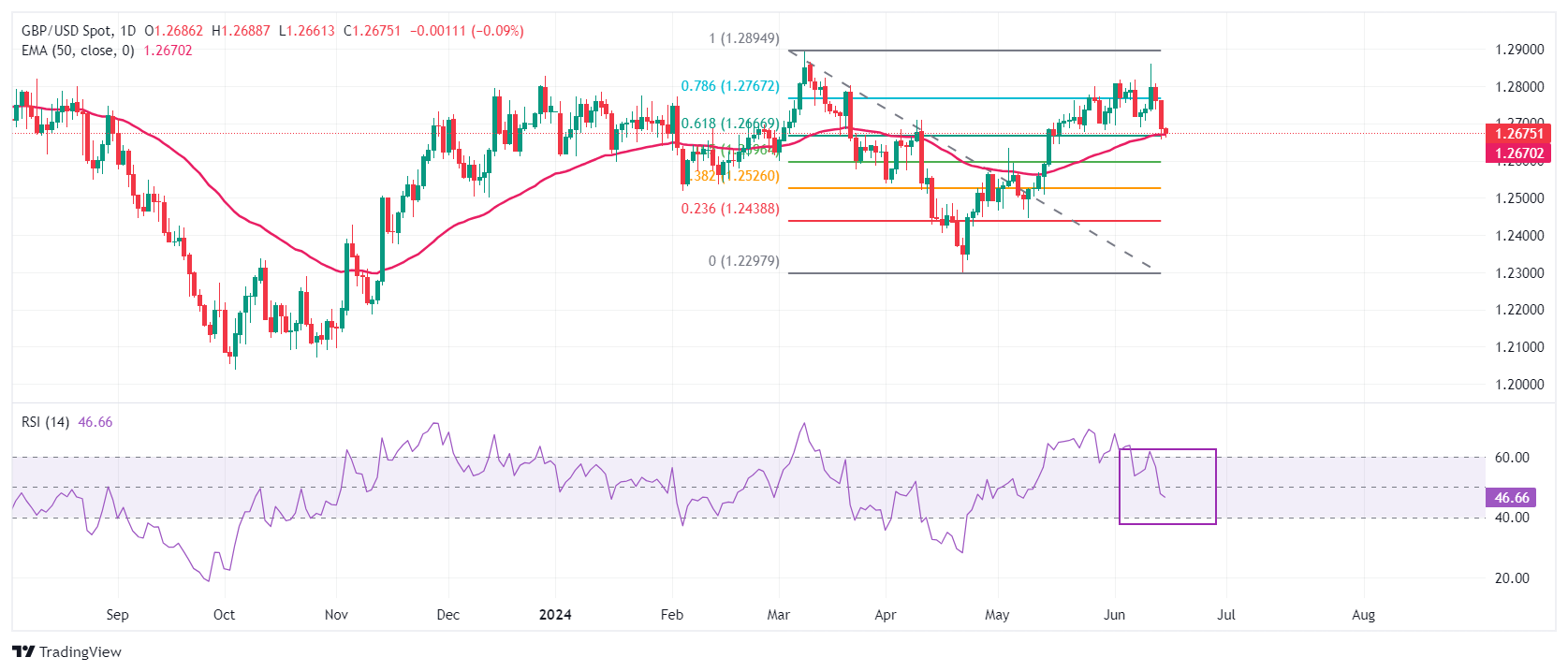
The Pound Sterling trades close to Friday’s low around 1.2660 amid caution ahead of UK inflation data and the BoE monetary policy meeting. The GBP/USD pair struggles to sustain above the 61.8% Fibonacci retracement support (plotted from the March 8 high of 1.2900 to the April 22 low at 1.2300) at 1.2667.
The Cable has declined to near the 50-day Exponential Moving Average (EMA), which trades around 1.2670, suggesting that the near-term outlook is uncertain.
The 14-period Relative Strength Index (RSI) falls back into the 40.00-60.00 range, indicating that the upside momentum has faded.
BoE FAQs
The Bank of England (BoE) decides monetary policy for the United Kingdom. Its primary goal is to achieve ‘price stability’, or a steady inflation rate of 2%. Its tool for achieving this is via the adjustment of base lending rates. The BoE sets the rate at which it lends to commercial banks and banks lend to each other, determining the level of interest rates in the economy overall. This also impacts the value of the Pound Sterling (GBP).
When inflation is above the Bank of England’s target it responds by raising interest rates, making it more expensive for people and businesses to access credit. This is positive for the Pound Sterling because higher interest rates make the UK a more attractive place for global investors to park their money. When inflation falls below target, it is a sign economic growth is slowing, and the BoE will consider lowering interest rates to cheapen credit in the hope businesses will borrow to invest in growth-generating projects – a negative for the Pound Sterling.
In extreme situations, the Bank of England can enact a policy called Quantitative Easing (QE). QE is the process by which the BoE substantially increases the flow of credit in a stuck financial system. QE is a last resort policy when lowering interest rates will not achieve the necessary result. The process of QE involves the BoE printing money to buy assets – usually government or AAA-rated corporate bonds – from banks and other financial institutions. QE usually results in a weaker Pound Sterling.
Quantitative tightening (QT) is the reverse of QE, enacted when the economy is strengthening and inflation starts rising. Whilst in QE the Bank of England (BoE) purchases government and corporate bonds from financial institutions to encourage them to lend; in QT, the BoE stops buying more bonds, and stops reinvesting the principal maturing on the bonds it already holds. It is usually positive for the Pound Sterling.
Author

Sagar Dua
FXStreet
Sagar Dua is associated with the financial markets from his college days. Along with pursuing post-graduation in Commerce in 2014, he started his markets training with chart analysis.

















